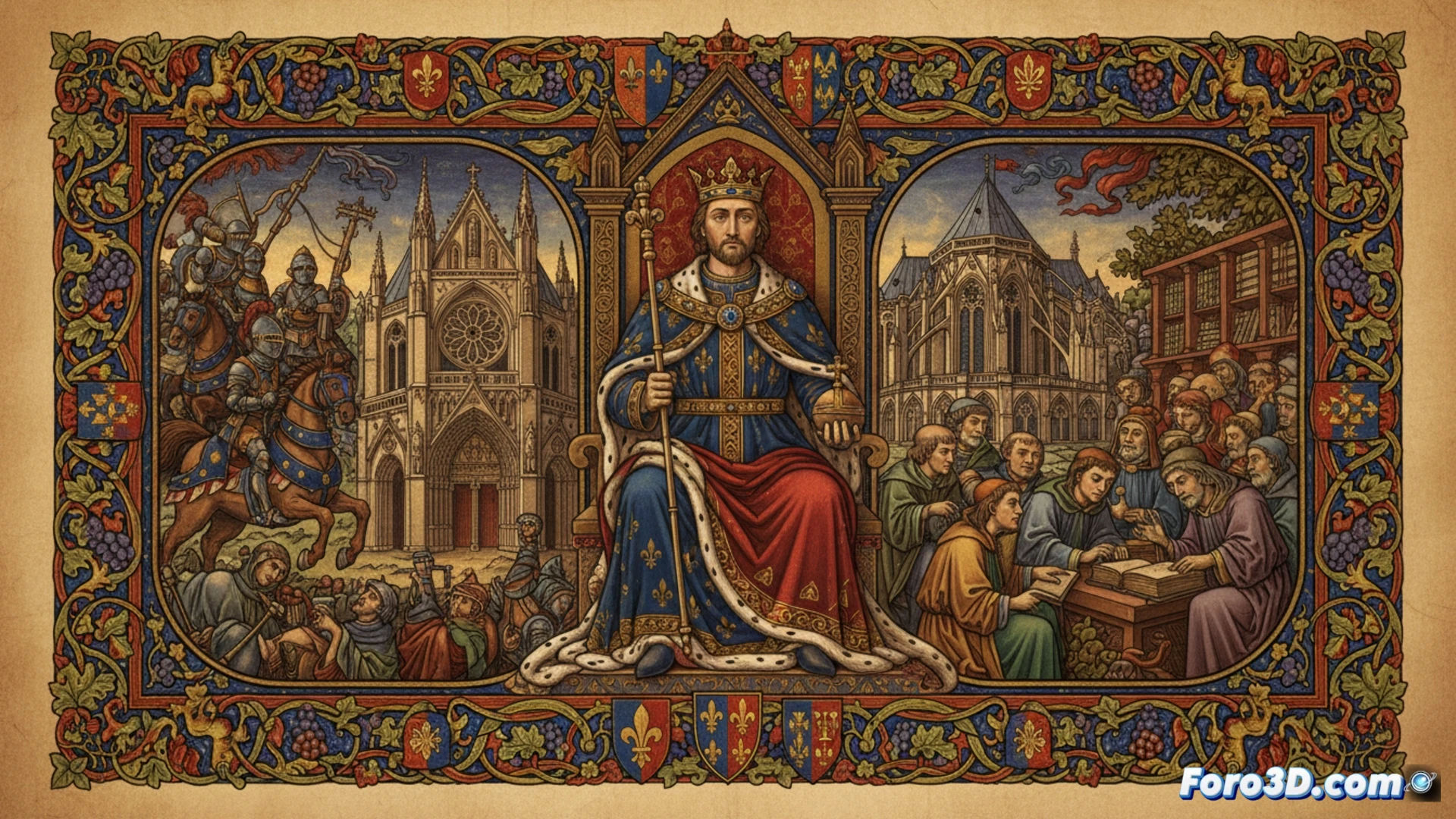
The Grandes Crónicas de Francia represent the foundational memory of the French monarchy, an invaluable medieval manuscript. Its preservation and study face the constant challenge of physical deterioration. Digital archaeology emerges as the key solution, enabling the creation of three-dimensional digital facsimiles that capture every material detail of the original, from the parchment texture to the ink relief, ensuring its legacy for the future.
Capture and modeling techniques for manuscripts 🛠️
The faithful digitization of a codex requires non-invasive technologies. High-resolution photogrammetry, with hundreds of photographs under controlled light, reconstructs the 3D geometry of each page, including deformations and folios. Complementarily, structured light or laser 3D scanning captures with micrometric precision the relief of illustrations and bindings. This data is integrated into a textured, navigable, and rotatable model, allowing researchers to study bindings, tool marks, or illustration sequences in ways previously impossible without handling the fragile original.
Beyond preservation: access and new research 🔍
The result transcends mere backup. This 3D digital facsimile democratizes access, allowing any user worldwide to explore the work with a level of detail that surpasses direct observation. For scholars, it opens new lines of analysis: the study of manufacturing through relief inspection, visualization of hidden marginal annotations, or virtual reconstruction of lost folios. Projects like this redefine archaeology, applying it to documentary heritage to revitalize our understanding of history.
How can 3D digitization with structured light scanning overcome the challenges of capturing the reliefs, textures, and ink degradations in illuminated manuscripts like the Grandes Crónicas de Francia without compromising their physical integrity?
(P.S.: If you dig at a site and find a USB, don't plug it in: it might be Roman malware.)