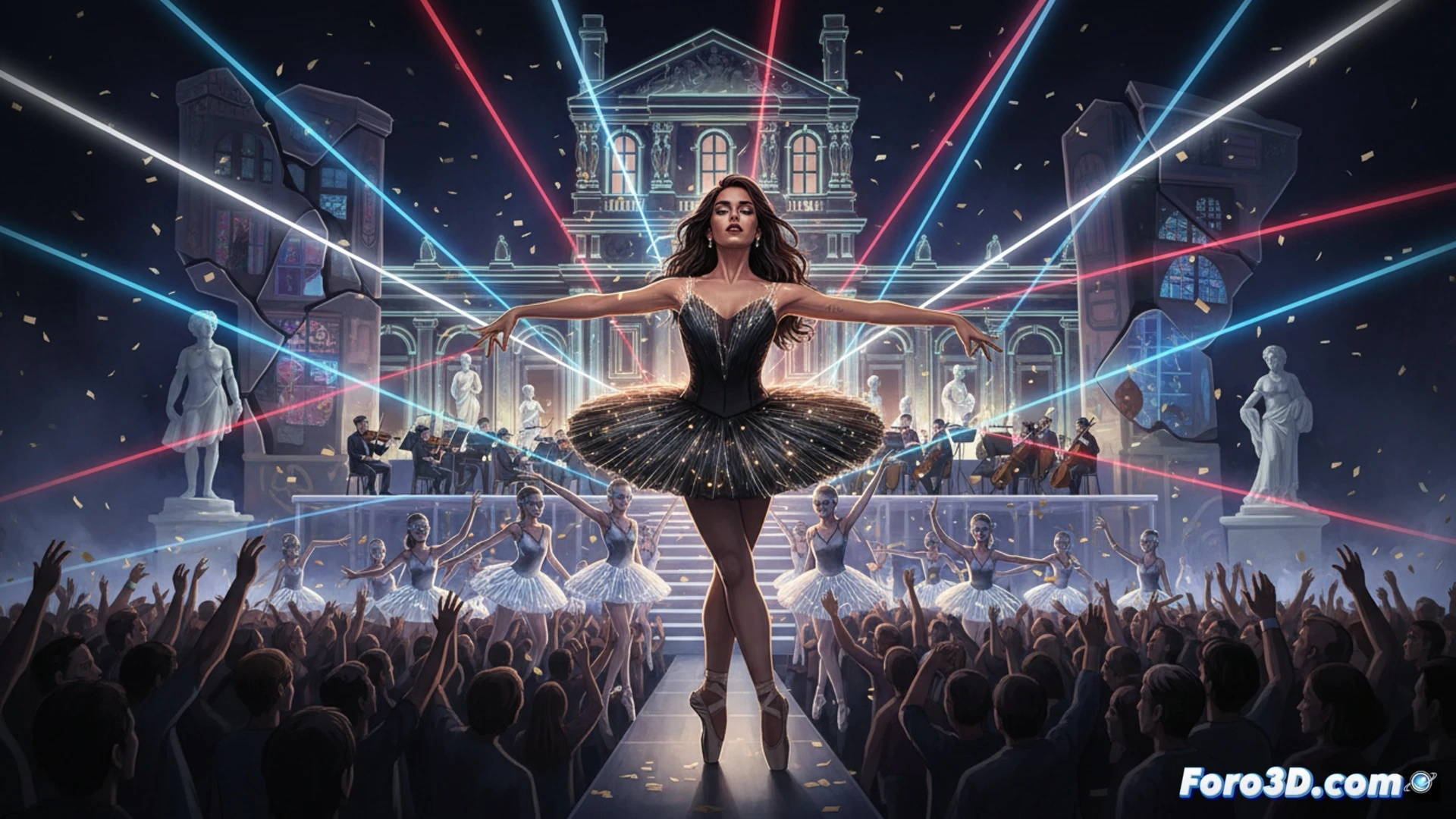
Rosalía's concert at the Movistar Arena was a milestone in scenic design, where 3D technology was the invisible protagonist. The scenography, which evolved from an intimate dollhouse to a monumental replica of the Louvre, was not just ephemeral art, but the result of a meticulous digital pre-production process. This analysis breaks down how 3D modeling and simulation enabled the orchestration of a show of such visual and logistical complexity, fusing ballet, techno, and extreme theatricality into an immersive experience.
Digital pre-production: from modeling to scene simulation 🎬
Before building any physical structure, the design team had to visualize and validate the entire staging in a virtual environment. This involved detailed 3D modeling of each scenography for the four acts, calculating their transformations and transition times. Simultaneously, video mapping was planned for the projections that enveloped the stage, adjusting the content to the changing geometries. 3D simulation was crucial for coordinating the dancers' choreography, the orchestra, dynamic lighting, and even the visual experience from different audience points, ensuring that each of the 15,600 attendees had an impactful perspective.
3D technology as the backbone of the modern show ⚙️
This concert demonstrates that scenography is no longer static scenery, but dynamic visual narrative. The technical challenges of a production with so many layers are only overcome with a robust 3D workflow in pre-production. These tools allow experimentation, problem detection, and resource optimization before reaching the costly assembly in the venue, establishing a new standard where digital and physical merge to create collective ecstasy.
How is parametric 3D modeling and kinematics simulation integrated into the design of transformable scenographies for live shows, like Rosalía's concert in Madrid?
(P.S.: architectural mapping is like putting Instagram filters on a building)