Andrés Javier Bello-Hernández's doctoral research seeks to create a fast and inexpensive diagnostic device for dengue, an expanding disease that affects regions with limited resources. This chemical engineering project, although it does not mention it explicitly, is based on fundamental tools of 3D design. From the conception of the microfluidic chip to the validation of its operation, modeling and digital fabrication are invisible but essential technological pillars for its development.
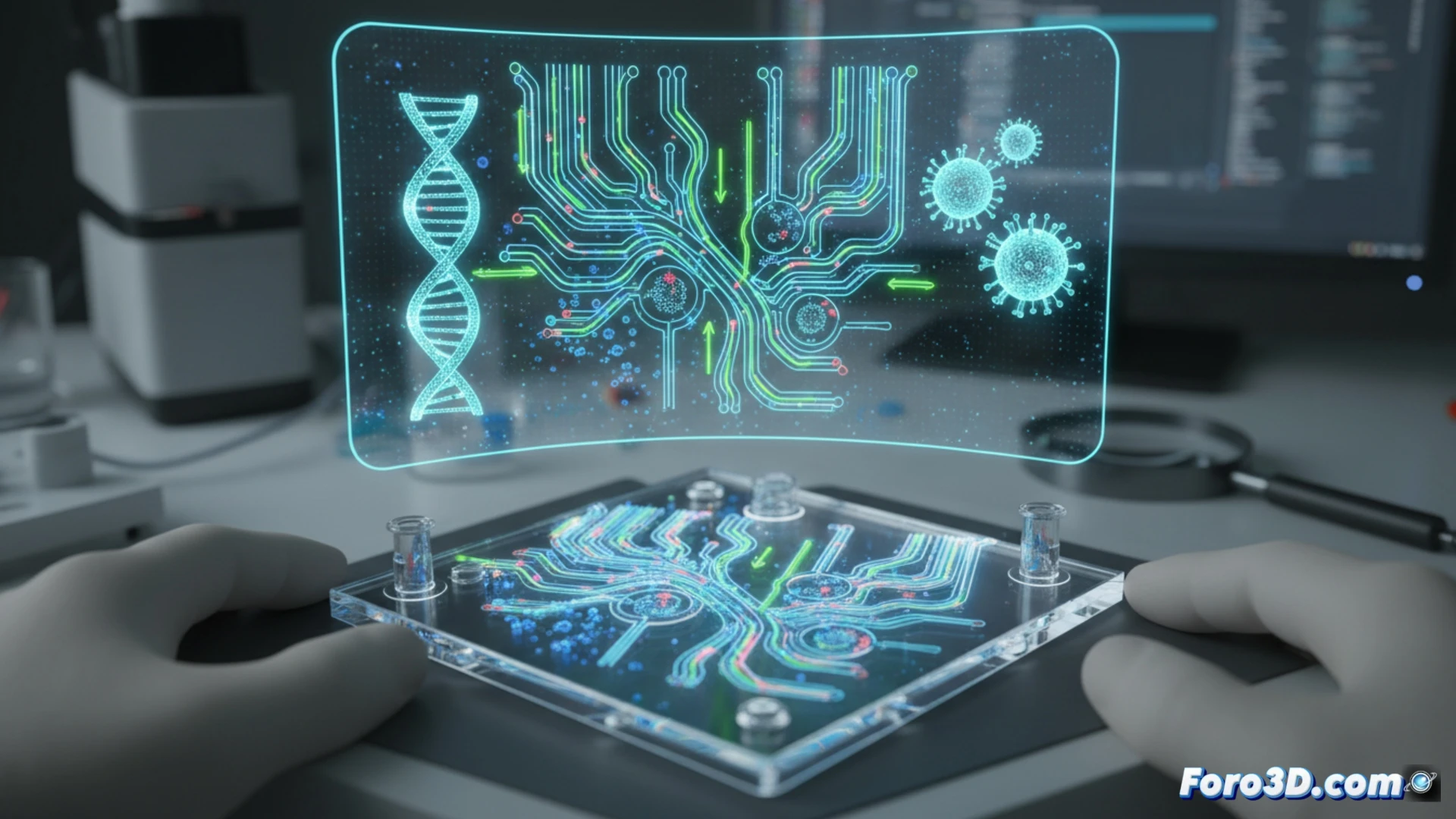
From CAD to 3D Printing: Agile Prototyping in Microfluidics 🛠️
The core of this device is a microfluidic chip, a network of tiny channels that manipulate biological samples. Its design begins in 3D CAD software, where geometries, connections, and volumes are optimized to guide fluid and reactions. 3D printing with resin or biocompatible materials allows for the creation of functional prototypes quickly and economically, iterating the design before producing final molds. This agility in prototyping is crucial for academic research and for reducing costs, bringing the technology closer to environments with fewer resources.
3D Simulation: Visualizing the Battle Against the Virus 🔬
Beyond manufacturing, 3D modeling allows simulating and visualizing critical phenomena, such as fluid flow or antibody binding to the virus within the microchannels. These simulations help predict the device's behavior and refine its sensitivity without consuming expensive reagents. Thus, 3D biomedicine not only builds but also models and understands, accelerating the path to accessible diagnostic solutions that can be adapted to other infectious diseases.
Would you use this digital twin for surgical planning?