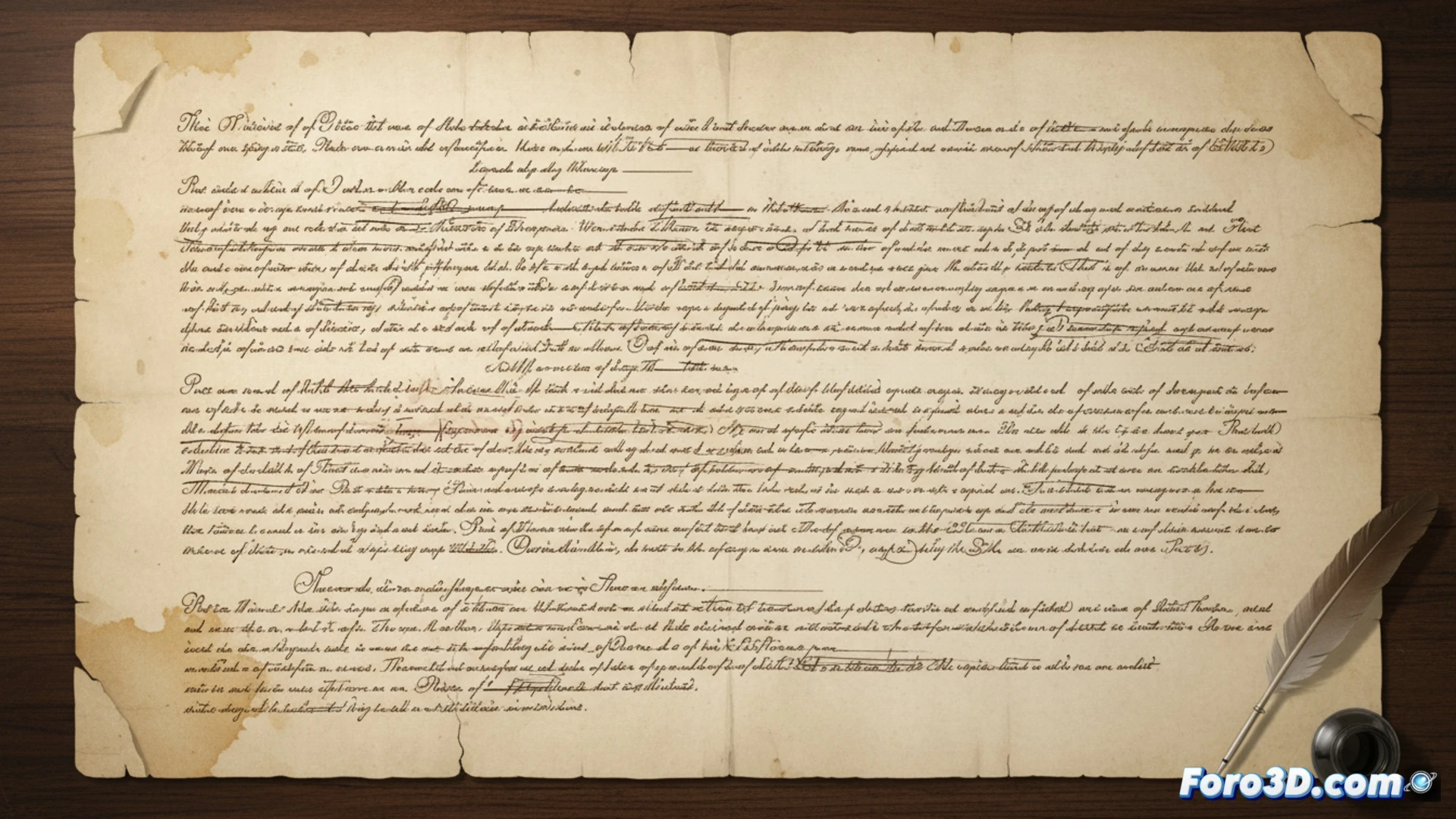
The recent focus on Jefferson's manuscript draft of the Declaration of Independence highlights a conservation challenge. This fragile document, with its strikethroughs and annotations, is a palimpsest that narrates the birth of a nation. Its physical preservation is a priority, but its study requires access, which inevitably causes deterioration. This is where 3D technology comes in not as an alternative, but as a fundamental and complementary conservation tool. 📜
Photogrammetry and 3D Scanning for Non-Invasive Document Analysis 🔍
The application of ultra-high-resolution photogrammetry or specialized 3D scanners would allow capturing this draft with millimeter precision. The resulting 3D model would facilitate the analysis of stroke depth, paper texture, and ink layers, revealing the order of corrections. Relief maps could be generated to distinguish between Jefferson's handwriting and contributions from Adams or Franklin, all without direct contact. Additionally, this 3D digitization is the basis for creating exact physical replicas using high-end 3D printing or CNC milling, ideal for public display, reserving the original in optimal conditions.
Beyond the Copy: Interactive Access and Digital Legacy 💾
The true power of the 3D model goes beyond replication. It becomes an interactive digital asset. Researchers worldwide could examine it online, apply light filters to highlight textures, and museums could integrate it into immersive educational experiences. This approach not only safeguards the physical object from handling but also democratizes access to a critical heritage, ensuring that its study and meaning endure for future generations regardless of the original's material fate.
How can 3D digitization and non-invasive spectral analysis reveal hidden layers of text and corrections in fragile historical documents like Jefferson's draft, without compromising its physical integrity?
(P.S.: Virtual restoration is like being a surgeon, but without bloodstains.)