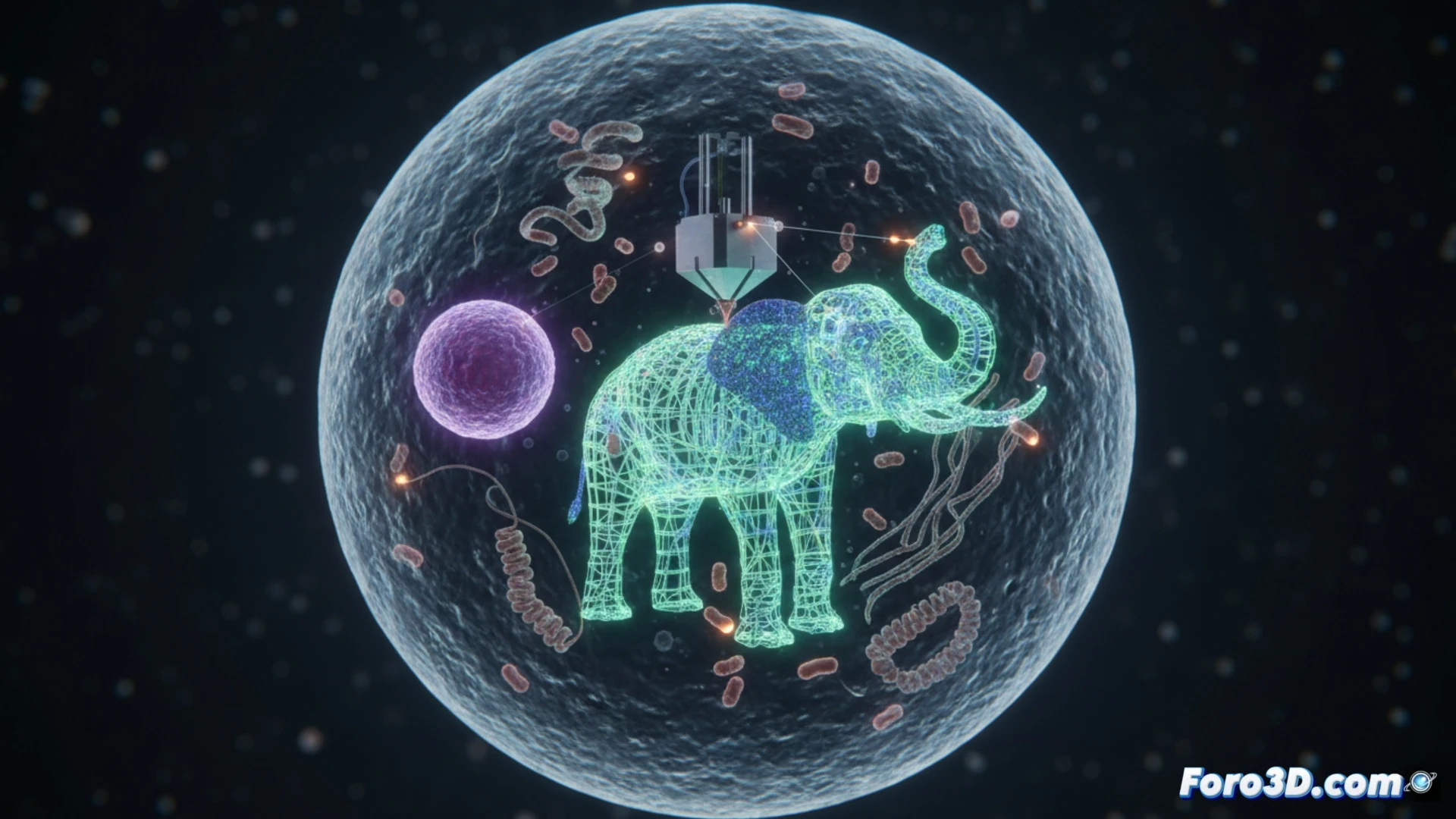
A team of researchers has achieved an unprecedented milestone: 3D printing a solid and complex structure, shaped like an elephant, inside a living cell without damaging it. This breakthrough demonstrates that it is now possible to fabricate customized and rigid 3D objects directly within biological systems. The technique overcomes the great challenge of nanofabrication in delicate cellular environments, opening a new chapter for bioengineering and biomedical research.
The principle of intracellular laser polymerization 🔬
The technique is fundamentally based on a high-precision laser polymerization process. Using a focused laser, researchers can induce the solidification of biocompatible materials injected into the cell, creating tiny and stable structures layer by layer. This method allows exquisite spatial control to fabricate complex 3D shapes, such as the demonstrative elephant, in an aqueous and living environment. The key lies in the precision and low energy of the process, which avoids damaging the host cell.
A future of micro-factories inside the body 🏭
The practical implications are revolutionary. This ability to build micro-structures in situ enables imagining new ways to mechanically study cells, administer drugs in an ultra-localized manner, or anchor internal sensors. In the long term, it lays the foundation for a new era in medicine: that of manufacturing therapeutic micro-devices or scaffolds for tissue engineering directly within the body, transforming the cells themselves into healing factories.
How does 3D bioprinting of a complex structure at the microscopic scale inside a living cell redefine the limits of tissue engineering and targeted drug delivery?
(P.S.: If you 3D print a heart, make sure it beats... or at least that it doesn't have copyright issues.)