Real Madrid took a giant step towards the quarterfinals of the Champions League after a resounding 3-0 victory over Manchester City. The night was the work of Federico Valverde, author of a hat-trick in the first half that elevates him in the club's history. Beyond the result, the match was a clear example of tactical superiority and intensity, with a dominant Madrid and an unusually subdued City. We analyze this key match from a unique perspective: 3D technology applied to sports analysis.
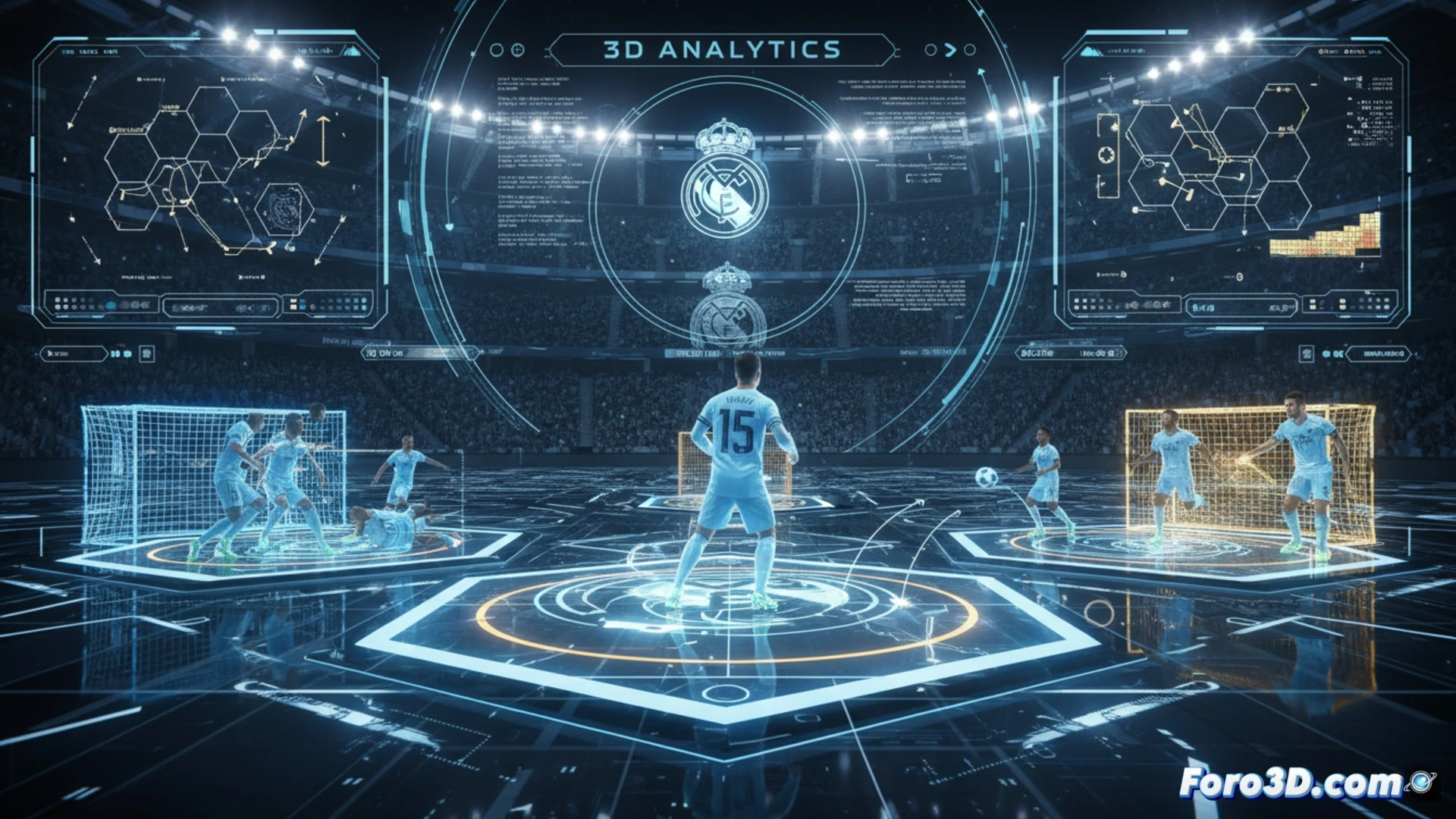
3D Reconstruction: The Geometry of the Treble and Tactical Flows 🧠
Through 3D reconstruction of the match, we can dissect Valverde's hat-trick with millimeter precision. By modeling ball trajectories, player positions, and shooting angles, the intelligence of his movements and the effectiveness of his finishes are revealed. This technology also allows visualizing in a dynamic model the tactical disposition of both teams. The compact structure of Madrid is evident, its pressing lines that suffocated City's build-up, and the spaces generated by the movements of Vinícius and Rodrygo. In contrast, the City 3D model shows misalignments, excessive distances between lines, and an inability to generate coordinated attacking flows, explaining their ineffectiveness.
Interactive Simulation: Historical Advantage and Outlook for the Return Leg 📊
An interactive 3D simulation of the tie reinforces Madrid's psychological advantage. By loading the historical data that the club has never let a three-goal lead slip, the visualization projects probabilistic scenarios for the return leg. This tool not only illustrates the solidity of the current position but allows analysts and fans to explore alternative tactics for City and possible Madrid responses. The technology transforms static analysis into a deep experience, confirming that the white team travels to the Etihad with their qualification virtually assured.
How can 3D analysis of trajectories and positions demonstrate Real Madrid's tactical superiority in Valverde's hat-trick?
(P.S.: 3D tactical simulation never fails, players on the pitch do)