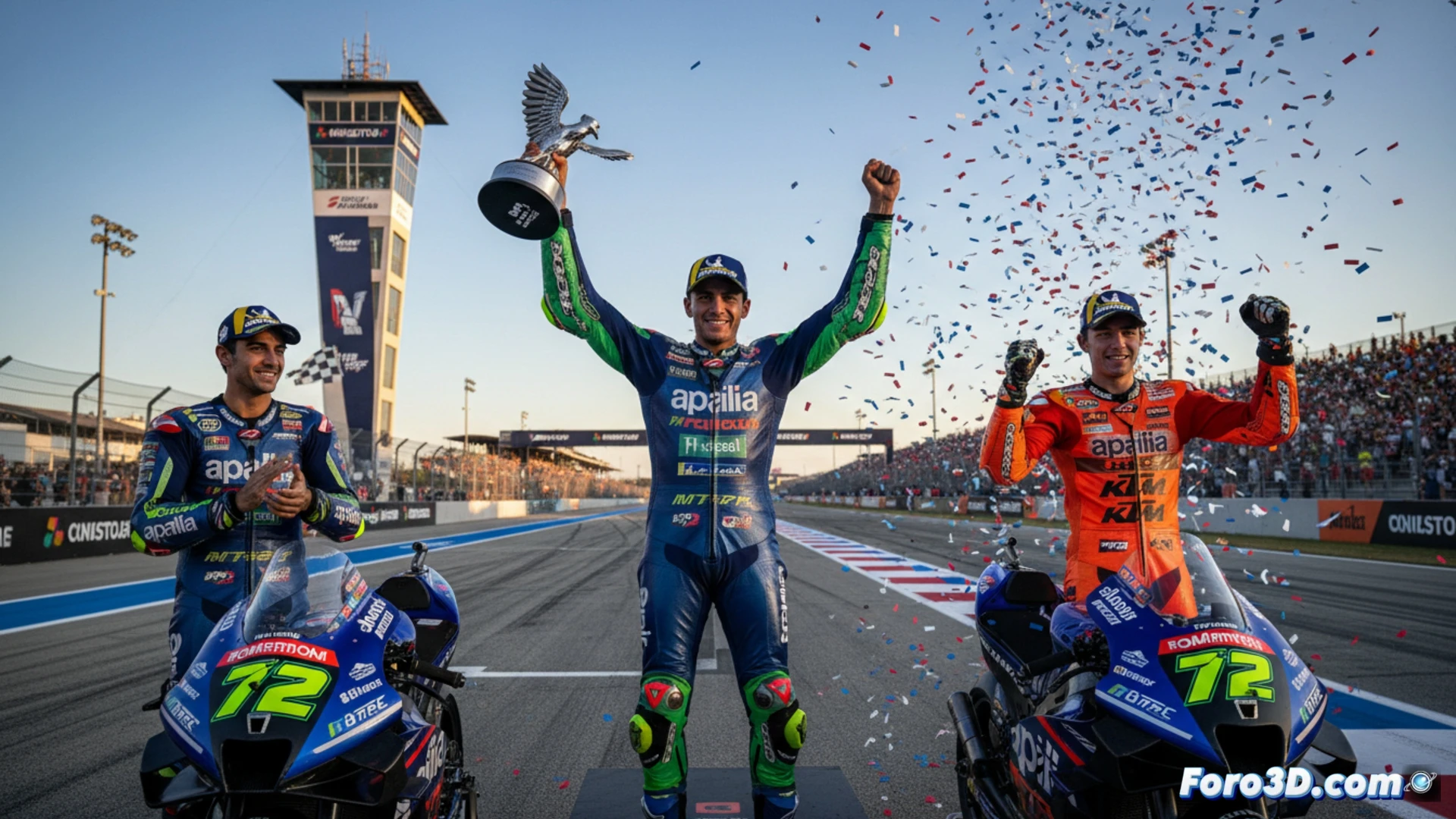
Marco Bezzecchi's victory in the United States GP, after a penalty and a comeback, and the serious accident in Moto2, are intense sports stories. But beyond the report, these events are pure spatial and dynamic data. In this article, we bring the race into the realm of 3D technology, exploring how the virtual recreation of key moments revolutionizes technical analysis, safety, and the spectator experience, transforming telemetry data into interactive models.
Virtual reconstruction: from trajectories to forensic analysis 🕵️
Imagine a precise 3D model of the Circuit of the Americas. Over it, we can overlay and compare the lines of Bezzecchi and his rivals, analyzing in detail how he managed his advantage. We can simulate the exact trajectory of Marc Márquez's long lap penalty, calculating the theoretical time loss versus the actual one. The most critical case is the forensic reconstruction of the multiple accident in Moto2. From images and data, a 3D model allows recreating the incident sequentially, analyzing angles, speeds, and points of contact to improve safety protocols and objectively understand causes, being an invaluable tool for stewards and teams.
3D simulation as a bridge between sport and technology 🌉
These applications demonstrate that motor sport is a laboratory of data in motion. 3D visualization goes beyond spectacle, offering a common language for engineers, riders, and fans. A rider can review their race in virtual reality; a commentator can explain a complex maneuver with an interactive model. This convergence between the physical and the digital enriches all aspects of the sport, from pure competition to technical disclosure, making every Grand Prix a three-dimensional case study.
What cameras and angles would you need to capture enough information?