Dorian Godon's victory in the first stage of the Volta a Catalunya, decided by the photo-finish review against Remco Evenepoel, is the perfect example of how technology is redefining cycling. Beyond the chronophotometer, 3D modeling tools would allow reconstructing that millimeter sprint with unprecedented precision. This approach transforms a moment of pure competition into an object of scientific analysis, opening the door to a deeper understanding of race dynamics.
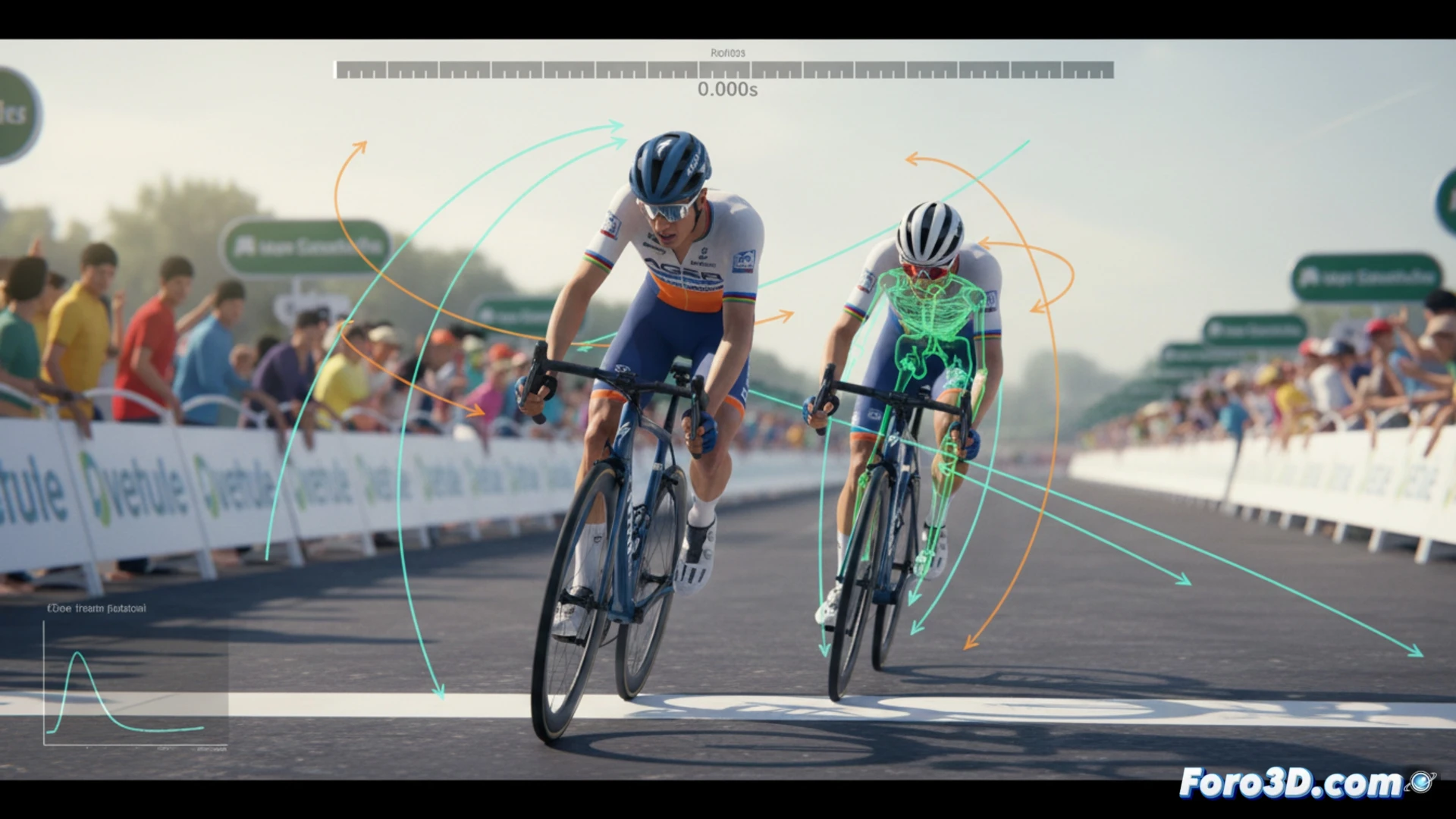
3D Reconstruction and Biomechanical Analysis of the Final Sprint 🏁
Imagine a complete volumetric recreation of the last 200 meters in Sant Feliu de Guíxols. From multi-camera video and sensor data, a synchronized 3D model could be generated showing the exact position of each cyclist, their aerodynamic posture, and the evolution of the gap between Godon and Evenepoel. Integrating power and cadence data, the model would allow a comparative biomechanical analysis: what torso inclination angle, what pedaling pattern, or what effort management on the ramp were decisive. This spatial visualization offers teams and coaches insights impossible to obtain with 2D graphs.
Beyond Analysis: Simulation and Immersive Training 🥽
The true power of 3D technology is not limited to post-race analysis. These models can feed simulators for tactical training, where riders relive key scenarios in virtual reality. Additionally, integrating route and performance data into immersive 3D environments allows planning strategies with superior spatial awareness. Thus, what began with a photo-finish can culminate in a tool that redefines preparation and decision-making in the peloton.
How can 3D photogrammetry analysis determine the position of the front wheel axis with greater precision than a fixed 2D photo in a tight cycling sprint?
(PS: 3D tactical simulation never fails, the players on the ground do)