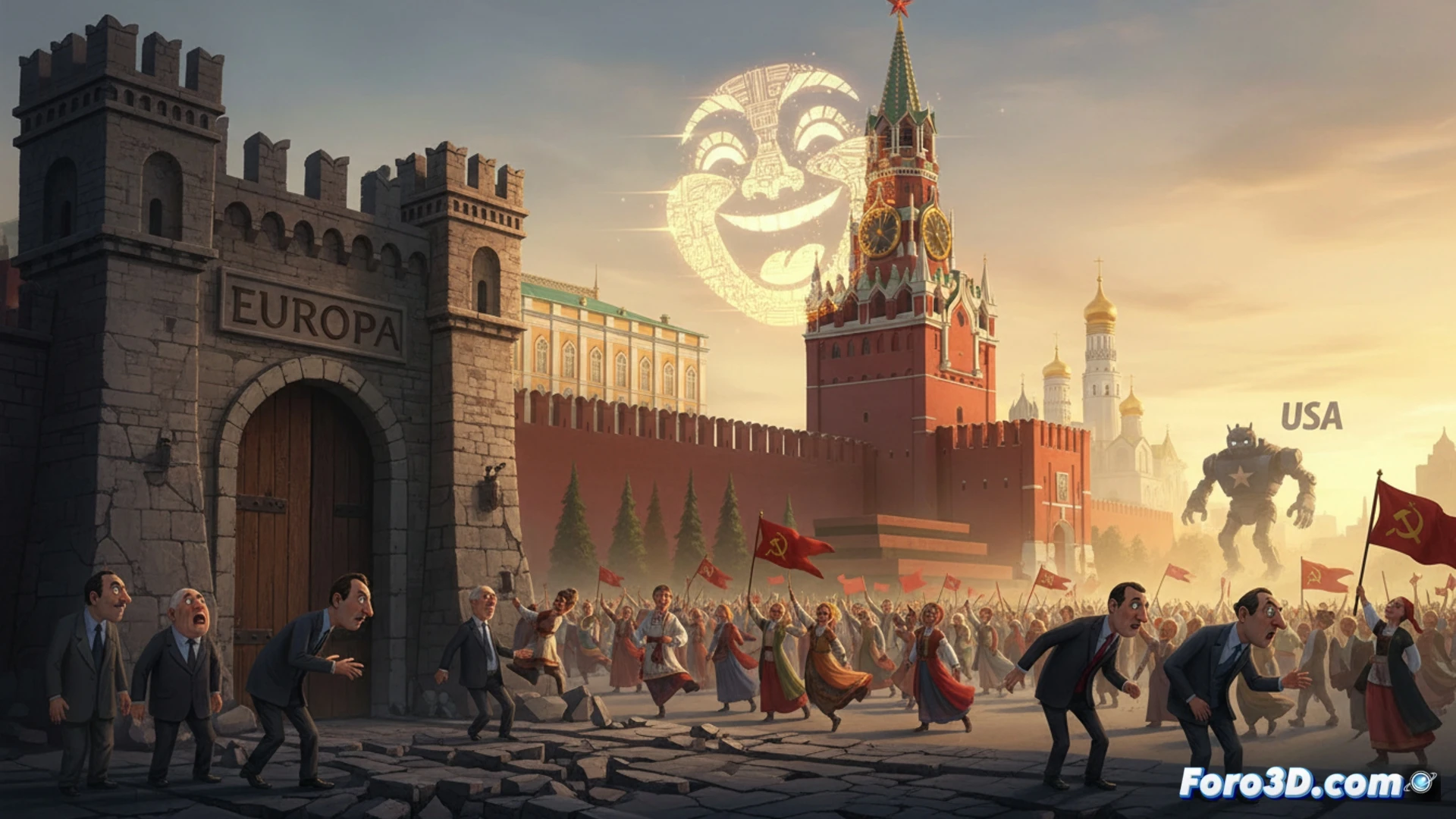
The recent public display of satisfaction from the Kremlin regarding the perception of a European retreat in military support for Ukraine is a calculated act of political communication. Beyond the verbal message, this analysis focuses on deconstructing the visual and spatial narrative employed. Using technologies inherent to 3D visualization and data analysis, we can transcend the anecdote and examine the power structures and informational strategy that Russia seeks to project at a moment of critical geopolitical tension.
Visual Deconstruction: 3D Models and Geopolitical Data Audit 🧩
The key tool would be an interactive 3D environment functioning as an analysis laboratory. In this space, multiple layers of information would be integrated. A digital globe would display animations of diplomatic flows and official Russian statements, contrasting them in real time with verified data on military material shipments. Node and connection models would illustrate the evolution of alliances. In parallel, computer vision would be applied for a visual audit of public appearances: analysis of microexpressions, 3D scanning of environments to study staging, and detection of possible manipulations in audiovisual material, thus breaking down the staging of joy into its technical components.
Vulnerability as a Constructed Narrative 🕵️
The ultimate goal of this technical analysis is not only to verify data, but to expose how a strategic perception is constructed. The Kremlin not only communicates a fact, but models a virtual political reality where Europe is visualized as weak and isolated. By using 3D tools to make this narrative tangible, we reveal its mechanisms. The true vulnerability may lie in the inability to discern between the projected narrative and the complex network of facts on the ground, a risk that visualization technology helps mitigate for observers and analysts.
What computer vision tools would you use to study non-verbal communication in press conferences?