Abraham Lincoln's Gettysburg Address is not a fixed text, but a living process captured in several handwritten copies with subtle variations. In the niche of Political Communication and Visual Analysis, we propose transcending flat reading. Through 3D technologies and data visualization, we can decompose, compare, and spatialize this fundamental speech, transforming philological analysis into an interactive experience that reveals the architecture of its rhetorical power.
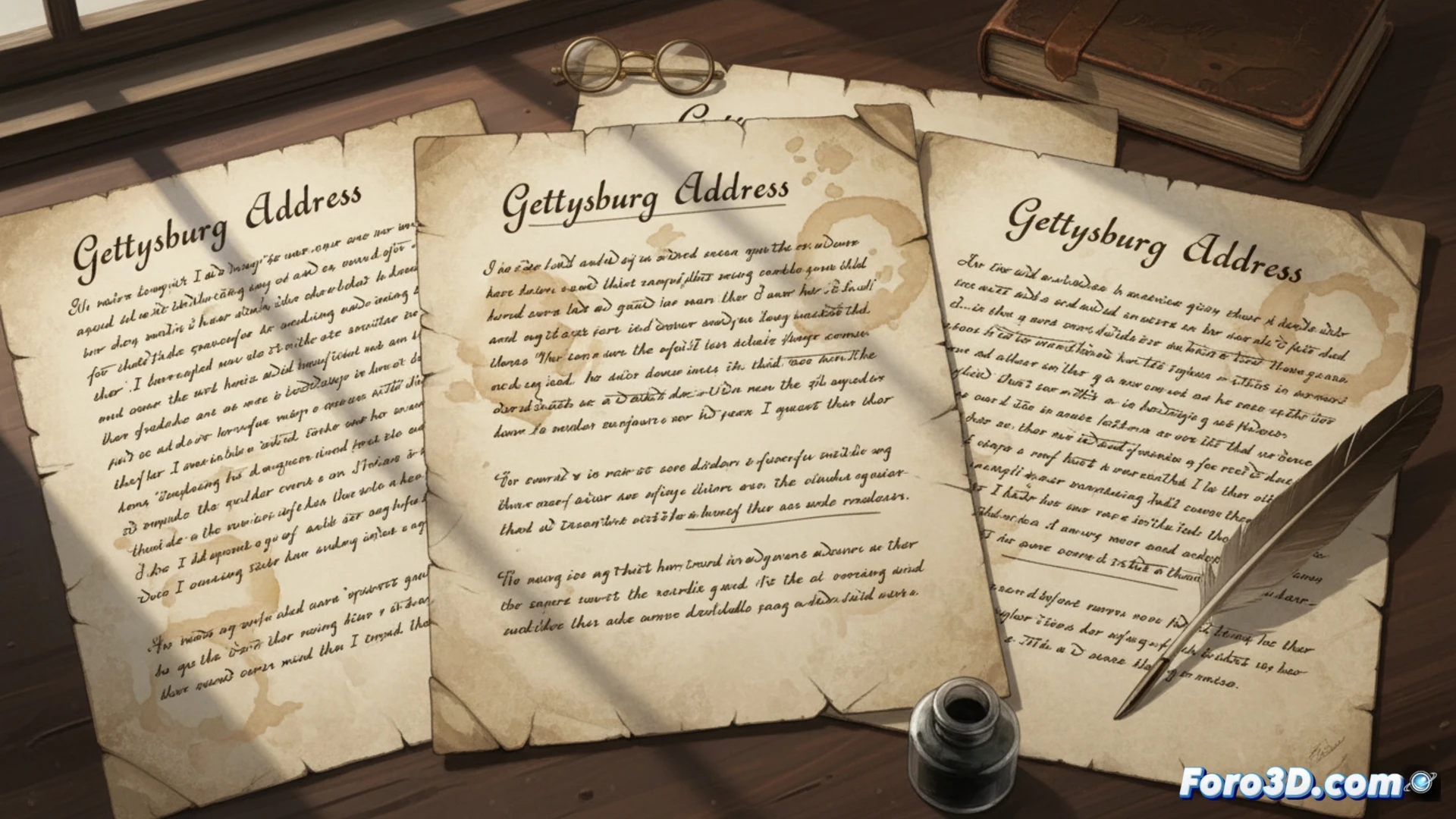
Technical Visualization: Overlay and Immersive Context 🧩
The technical proposal is based on two pillars. First, an interactive 3D model that digitally overlays the five key handwritten versions. Each modification, strikethrough, or addition would be visualized as a differentiable layer, allowing real-time tracking of the text's evolution. Second, contextualization in a virtually reconstructed environment of the Gettysburg National Cemetery in 1863. This spatializes the impact, enabling analysis of the relationship between the speech, the physical space, and the audience, and how the words constructed meaning in that exact place.
Rhetoric as a Spatial Object 🏛️
This approach not only preserves but redefines the analysis. By converting textual variations into visual and spatial objects, we make Lincoln's rhetorical decisions tangible. 3D technology serves here as a hermeneutic tool, allowing a deeper understanding of how a political icon was forged. Contextual immersion turns the viewer into an analyst, discovering layers of meaning that a static document cannot reveal on its own.
How can 3D modeling and data visualization reveal the strategic variations between the Gettysburg Address manuscripts to analyze political intentionality and message evolution?
(P.S.: at Foro3D we know that the only absolute truth is that the render always takes longer than expected)