Marco Bezzecchi won the Brazilian Grand Prix of MotoGP, achieving his fourth consecutive victory with Aprilia. His teammate Jorge Martín completed the one-two finish, while Fabio Di Giannantonio snatched third place from Marc Márquez in the final laps. A 23-lap race marked by extreme tire management, a factor that we will analyze using 3D technology to break down the keys to performance and the strategies that decided the podium.
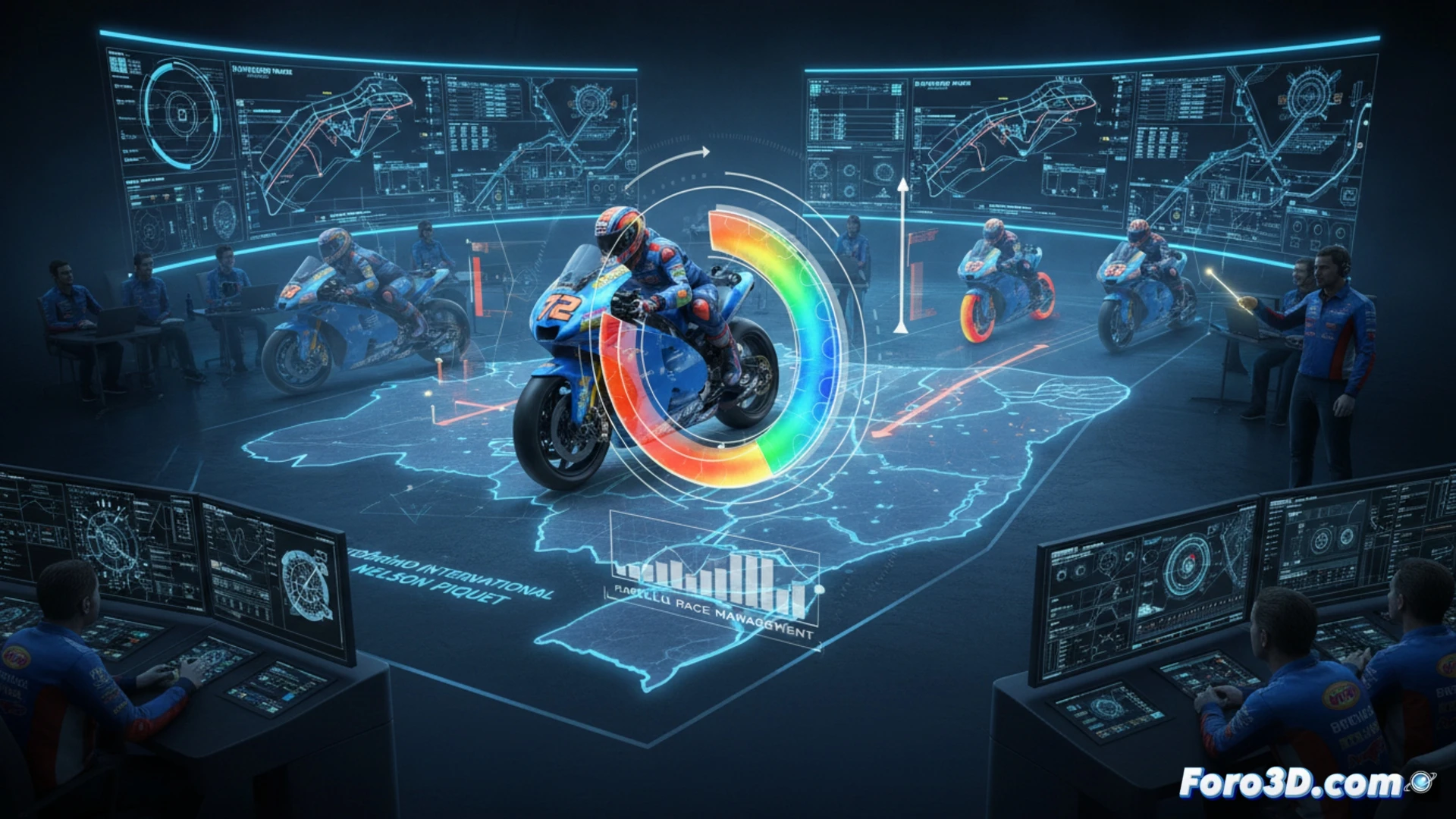
3D Reconstruction: Degradation and Key Trajectories 🏁
The high tire degradation was the invisible protagonist. Using 3D models of the compound and its interaction with the Interlagos asphalt, we can simulate differential wear by circuit section. This explains the riders' caution and why overtakes concentrated at the end. We will recreate Bezzecchi's optimal trajectory in 3D, comparing it with Márquez's to visualize differences in rubber consumption. Additionally, we will reconstruct Di Giannantonio's overtake, analyzing the braking point and the curve exit line with millimeter precision.
Data Visualization: The Championship Takes Shape 📊
The evolution of positions and gaps during the race transforms into a dynamic 3D map, where each rider is an avatar moving in real time. This visualization shows how Bezzecchi managed his lead and the battle behind. With this result, the Italian leads the world championship with 56 points, eleven more than Martín. Márquez, fourth, is 22 points behind. The 3D championship model, with spheres proportional to points, already illustrates the battle ahead.
How did the 3D analysis of tire dynamics influence the race strategy that led Marco Bezzecchi to victory in the Brazilian GP of MotoGP?
(P.S.: reconstructing a goal in 3D is easy, the hard part is making it not look like it was scored with the leg of a Lego doll)