Levante and Barcelona Femenino drew 0-0 in the first leg of the Copa de la Reina semifinals. The Blaugrana dominance was overwhelming, generating numerous scoring opportunities, but they came up against a wall: goalkeeper María Valenzuela. Her performance, key to keeping the tie open, is the perfect example to show how 3D technology analysis can transform our understanding of a match, moving from the report to the technical and interactive reconstruction of the decisive moments.
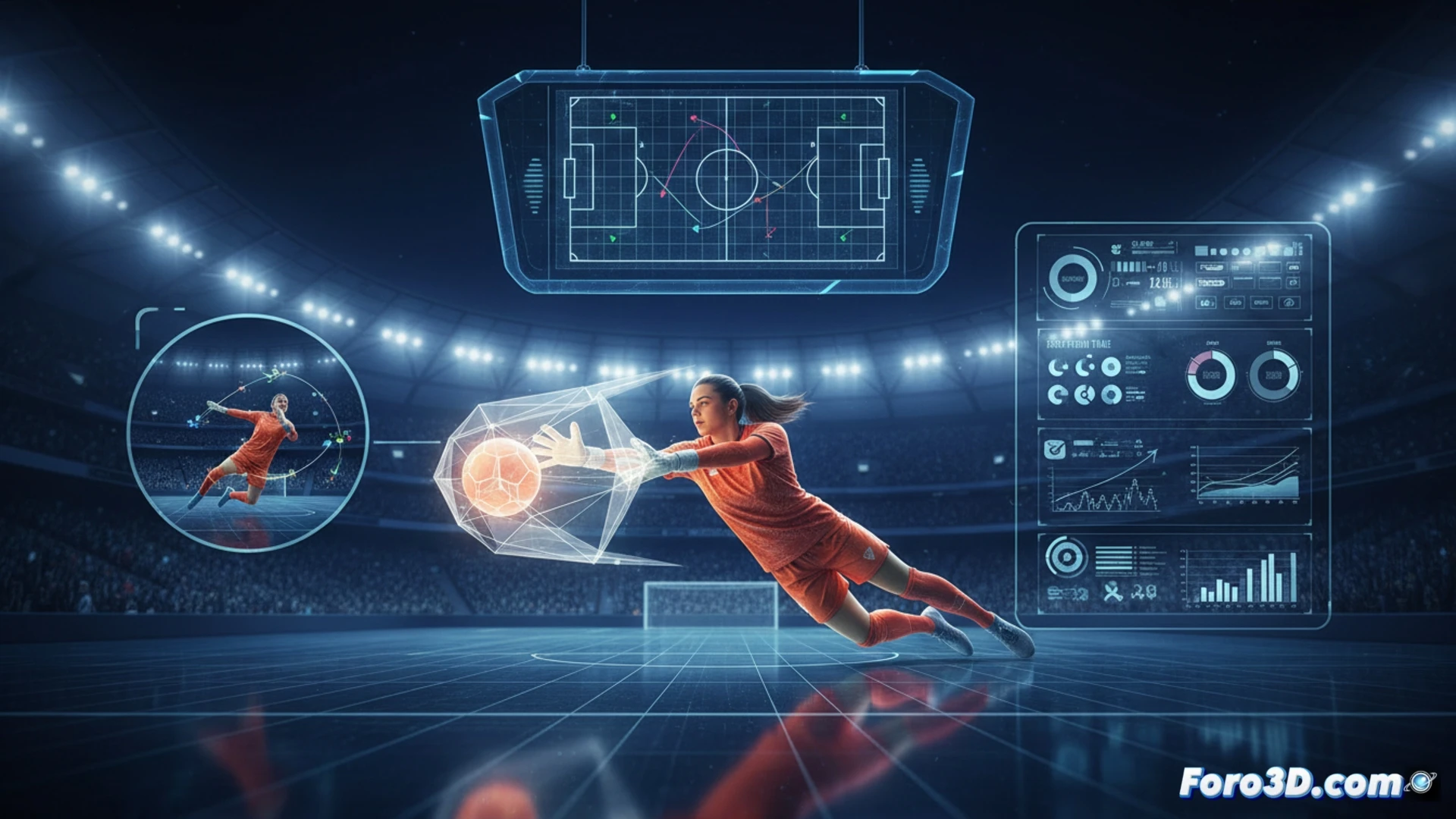
3D Reconstruction of Key Saves: The Valenzuela Factor 🧤
A simple saves statistic does not do justice to Valenzuela's exhibition. Using 3D reconstruction technologies, we could visualize with millimeter precision the ball's trajectory in each shot, the angle of the goal covered, and the biomechanics of her movement. Overlaying the position of attackers and defenders in a volumetric model of the area would reveal not only her reflexes, but her intelligent positioning and decision-making under pressure. This visualization would allow analyzing whether Barça failed in placement or was simply overcome by a goalkeeper in a state of grace.
Beyond the Result: Tactical-Spatial Simulation 🧠
The draw invites deeper reflection supported by visuals. A 3D heat map of game dominance or a flow diagram of attacks would show the areas where Barça was most dangerous and the channels that Levante managed to close. Even tactical variants could be simulated in a virtual environment: what would have happened with a different run? 3D technology turns post-match analysis into a laboratory, offering valuable insights for coaches and fans, and demonstrating that a 0-0 can be full of decisive information.
How can 3D analysis of positioning and trajectories explain Barcelona Femenino's lack of goal-scoring effectiveness against an ultracompact Levante?
(PD: VAR in 3D: now with replays from angles that didn't even exist)