The recent Spanish success at the Torun Indoor World Championships, with two medals in the 4x400 meters, is not just the result of talent. Athletes like Blanca Hervás and Markel Fernández have highlighted teamwork. This is precisely the field where 3D technology unleashes its potential, allowing the dissection and optimization of every millimeter and millisecond in an event where coordination is key. We analyze how these tools explain the achievements.
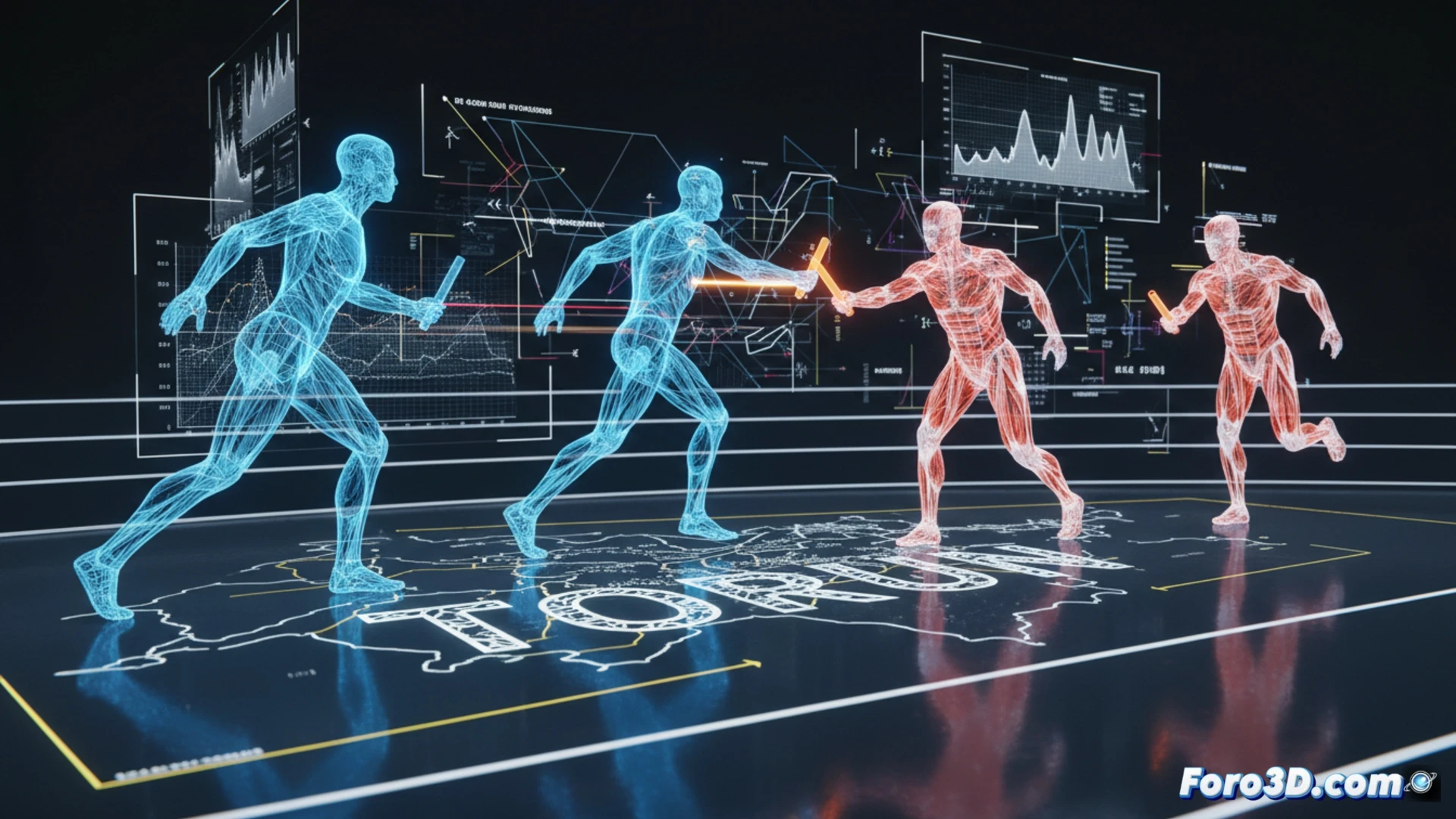
3D Simulation and Biomechanics in the Exchange Zone 🏃♂️
The baton exchange in a 4x400m is a critical moment that 3D technology can optimize. Through motion capture systems and three-dimensional reconstruction, it is possible to create an exact digital model of the exchange zone. This allows analysis of approach angles, relative speeds, and the biomechanics of each athlete. Different strategies can be simulated for athletes like Hervás, calculating the optimal reception point to avoid losing hundredths of a second while maintaining inertia, which is key in a mixed relay with speed differences between runners.
Tactical Visualization and Continuous Improvement 📊
Beyond analysis, 3D visualization is a powerful tool for preparation. A virtual model of the race, reconstructed from real data, allows coaches and athletes to review tactics immersively. Viewing the complete relay sequence from any angle, studying Fernández's acceleration or Hervás's curved start, consolidates collective muscle memory. This technology transforms anecdotal success into a reproducible pattern, laying the foundations for future joys.
How can 3D analysis of baton exchange technique optimize performance in 4x400 relays?
(PD: reconstructing a goal in 3D is easy, the hard part is making it not look like it was scored with the leg of a Lego doll)