The recent statement by President Pedro Sánchez, describing the military intervention against Iran as illegal and an extraordinary error, is a case study for the analysis of political communication. His speech, delivered in a bilateral forum, balances substantial criticism with avoidance of personal confrontation. This positioning, which seeks coherence with support for Ukraine, can be modeled and broken down using data visualization tools and 3D simulation to understand its rhetorical structure and alignment with public opinion.
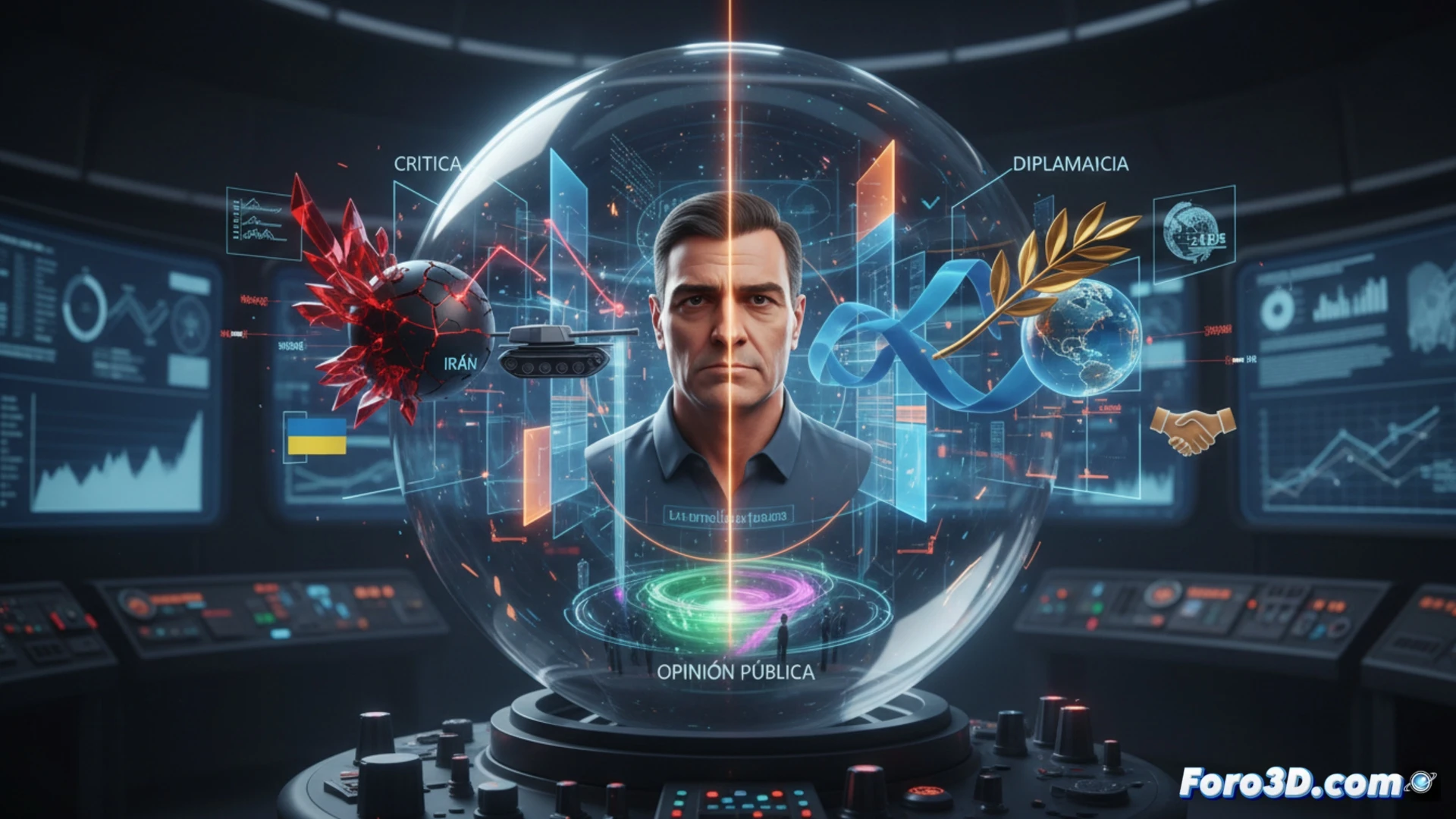
Geopolitical Modeling and Narrative Mapping in 3D Environments 🗺️
Computer vision technologies and 3D graphics enable the creation of dynamic maps of diplomatic positions. We could model a three-dimensional space where axes represent adherence to international law, speech tone, and alignment with allies. Each statement, like Sánchez's, would be located as a vector in this space, showing its relative distance to the positions of the US, Israel, or the EU. A particle system could visualize the impact of words on indicators like oil prices, creating an interactive infographic that translates abstract consequences into comprehensible spatial relationships. This breaks down complexity into analyzable visual data.
Simulation as a Tool for Diplomacy ⚙️
Beyond analysis, these tools offer proactive potential. Simulating in a 3D environment how international reactions or internal consensus evolve in response to different communication frameworks allows testing strategies. Technology does not replace political judgment, but it does provide a virtual testing ground to refine messages that, like Sánchez's, must balance principles, alliances, and citizen perception in high-tension scenarios.
What computer vision tools would you use to study non-verbal communication in press conferences?