Germany's preparation for the World Cup offers an ideal case study for sports analysis with 3D technology. Their victory against Ghana, with goals from Havertz (penalty) and Undav, and Nagelsmann's comments on patience and cohesion, reveal multiple tactical layers. Reconstructing this match in a 3D environment allows visually breaking down the collective improvement, moments of impatience, and key plays, transforming subjective observations into objective and actionable spatial data.
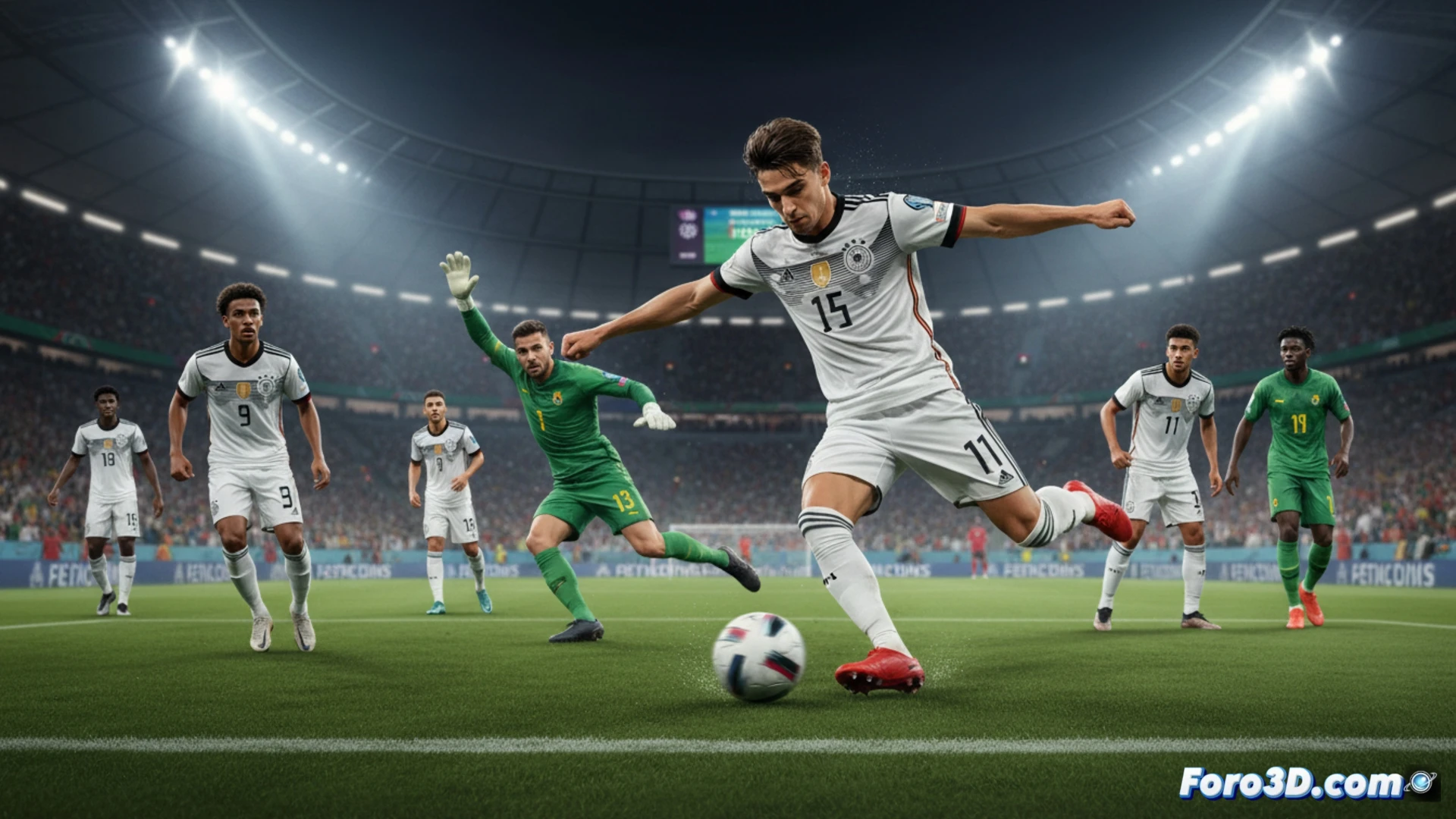
3D Reconstruction of Key Plays and Simulation of Tactical Alternatives 🎯
A 3D model of the match would allow precise analysis of decisive sequences. Havertz's penalty play could be examined from any angle, evaluating defensive positions and execution. Undav's goal would be visualized showing his off-ball movement and the disruption of the Ghanaian line. Additionally, simulation tools are key to testing the tactical alternatives suggested by Nagelsmann, modeling different positionings or pressure timings to quantify their impact and reduce the vulnerability observed in moments of impatience.
Visualizing Unity: The Collective Factor Beyond Talent 🤝
3D technology also serves to visualize abstract concepts like the collective strength highlighted by Kimmich and Nagelsmann. Heat maps of coordinated movements and player connectivity graphs could illustrate the team's improvement in unity. Even the support for Sané after the boos and his subsequent assist fit into an analysis of group dynamics. This visualization turns the perception of cohesion into an analyzable parameter, crucial for optimizing performance ahead of the tournament.
How can 3D analysis of movements and positions reveal the key changes in the German team's tactical system during their World Cup preparation?
(P.S.: reconstructing a goal in 3D is easy, the hard part is making it not look like it was scored with the leg of a Lego doll)