Juan Ayuso's abandonment in the 2026 Paris-Nice, when he was leading the race, was a tactical and sporting blow. His crash in the fourth stage, under extreme wind conditions, changed the fate of the competition, crowning Vingegaard. Beyond the journalistic narrative, this incident is an ideal case study for 3D technology. The digital recreation of the event allows dissecting factors such as the peloton's aerodynamics, the pavement geometry, and the biomechanics of the crash, transforming news into analyzable data.
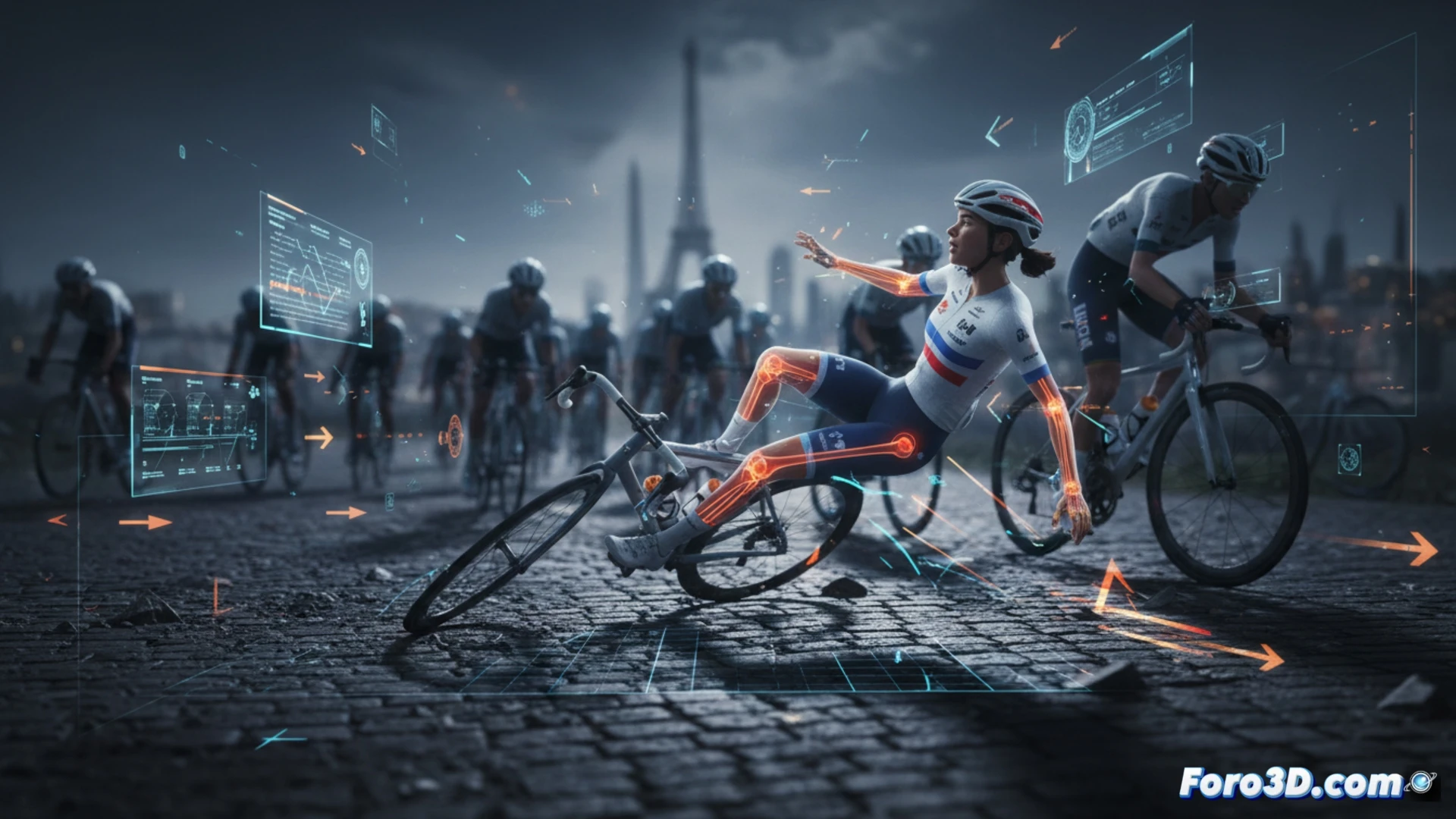
Forensic reconstruction of the incident with digital tools 🕵️♂️
A technical investigation with 3D software would begin by integrating multiple data. First, a laser scan or photogrammetry of the exact point on the road to model its slope, texture, and curves. Over this model, meteorological data on wind speed and direction would be imported for a CFD (Computational Fluid Dynamics) simulation that visualizes turbulences over the peloton. Then, 3D avatars of the cyclists, based on recordings, would be positioned to analyze distances, angles, and possible contacts. Finally, a physical simulation of rigid body dynamics could trace the crash trajectories, identifying the initial impact point and the transfer of forces.
From simulation to prevention and tactical analysis 🛡️
The value of this 3D analysis goes beyond mere reconstruction. For teams, it allows evaluating the positioning of their riders in risky conditions, optimizing safety protocols. For organizers, it helps identify critical points on the circuit where measures like barriers or warnings are crucial. Even for broadcasting, a clear 3D model improves the explanation to the public. Technology transforms a fortuitous event into applicable knowledge, making the sport more understandable and, potentially, safer.
How could 3D analysis of biomechanics and impact forces in a cyclist crash improve safety protocols and equipment design?
(PS: at Foro3D we know that a 3D simulated penalty always goes in... unlike in real life)