The recent and tragic fatal shark attack in La Piscinita, San Andrés, underscores the need to apply modern forensic methodologies beyond the autopsy. An analysis of the incident scene, using 3D technologies, could offer crucial insights. Precise digital documentation of the aquatic and coastal environment is fundamental to investigate contextual causes and design more effective prevention protocols.
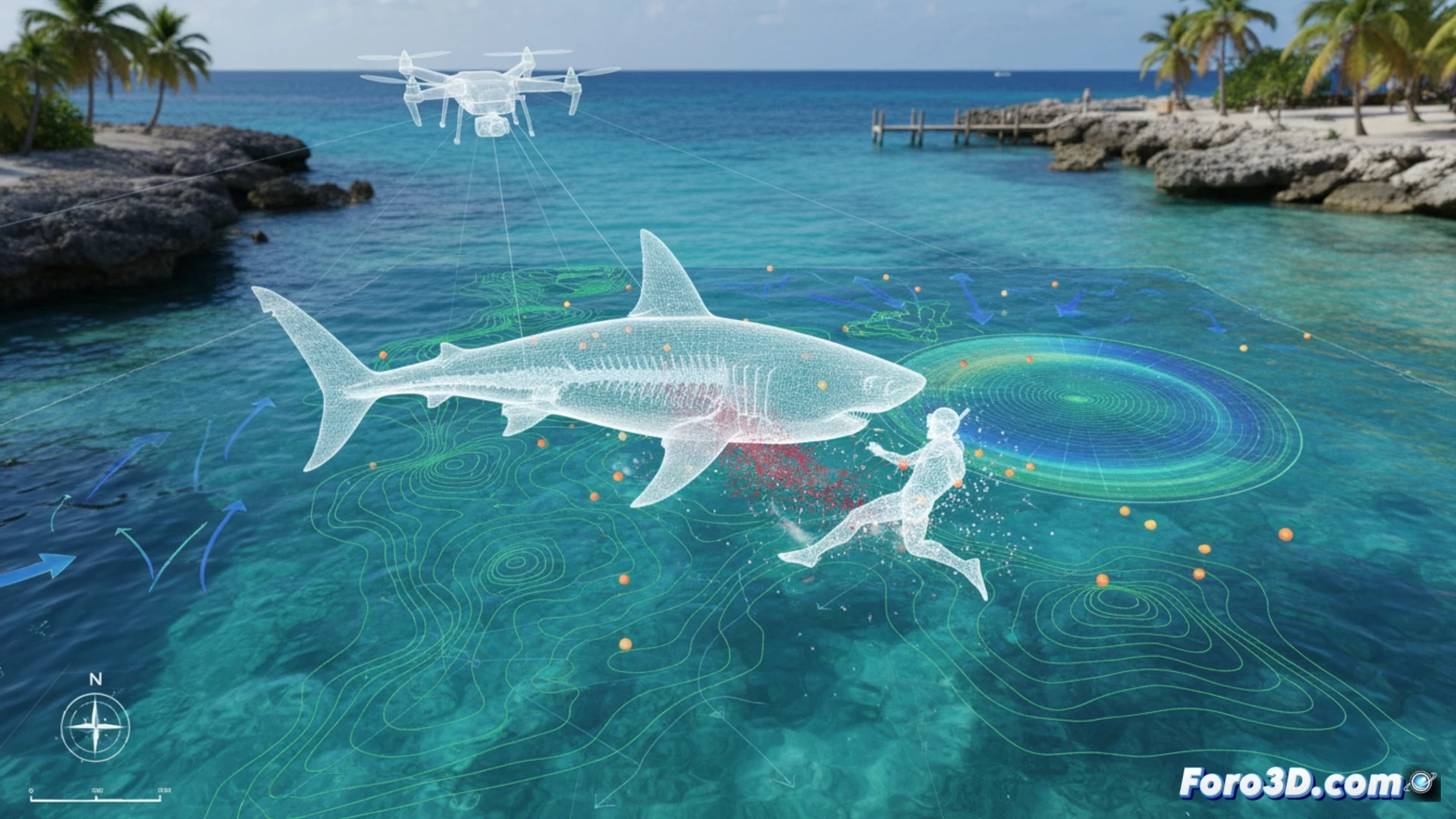
Photogrammetry and Underwater LIDAR: Forensic Documentation of the Environment 🦈
The technical reconstruction would begin with a comprehensive scan. Drones equipped with multispectral cameras would perform photogrammetry of the coast, generating a geo-referenced 3D model of the access area, rocks, and observers. For the underwater scenario, a side-scan sonar and a bottom profiler could map bathymetry and structures. The key would be a LIDAR or bathymetric laser scanner, capable of accurately capturing the topography of the seabed, visibility in the water column, and the exact location of the incident, integrating all data into a single investigable digital scene.
Simulation and Prevention: From the 3D Model to Future Safety 🛡️
This forensic 3D model would enable analyses impossible with traditional photographs. Conditions of light and water turbidity at that time could be simulated, access routes for rescue analyzed, and critical distances evaluated. Crossing these data with oceanographic information, currents could be modeled or factors attracting shark prey identified. The result would be a vital tool for determining causalities and planning mitigation measures, such as optimal signage or delimitation of safe areas, transforming a tragedy into knowledge to save lives.
How can 3D forensic analysis and digital reconstruction of the scene accurately determine the dynamics of the attack, the responsible species, and possible environmental causes in the La Piscinita incident?
(PS: In scene analysis, every scale witness is an anonymous little hero.)