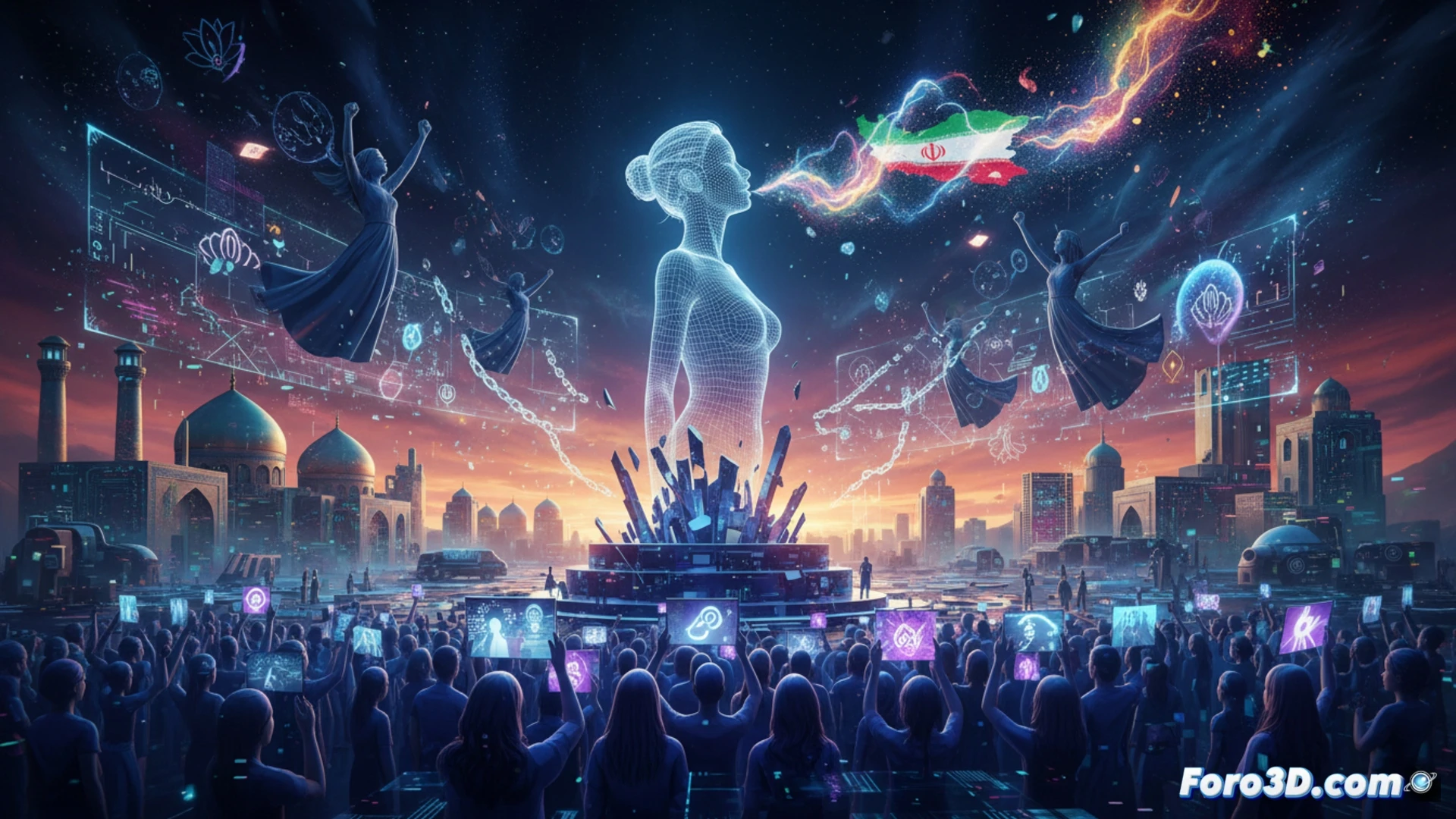
In Iran, a generation of highly educated young women is crashing against a wall of sociopolitical restrictions. This tension has found an unexpected and powerful channel of expression: digital art and 3D technologies. Far from being merely a technical field, modeling, virtual reality, and generative art are becoming essential tools for activism, allowing the visualization of protests, the recreation of resistance narratives, and the bypassing of censorship through symbolic and metaphorical universes created from scratch.
Technical Tools for Creative Resistance 🛠️
The potential of these technologies is vast. Artists and activists can use 3D modeling software to create virtual installations that denounce human rights violations, inaccessible in physical space. Virtual reality can immerse the viewer in emotional experiences that reconstruct stories of repression or longing for freedom. Generative art, through algorithms, can reflect the dynamics of collective protest. These tools, mastered thanks to their high education, allow them to encode political messages in abstract forms, distribute their work globally through NFTs or online galleries, and preserve their identity in a high-risk environment.
Education and Pixels: A Future of Resistance 🧠
This convergence between educational capital and digital activism marks a turning point. It is not just about protesting, but about symbolically reimagining and reconstructing a different society. Each render, each VR environment, becomes a political manifesto and proof that technical knowledge, when united with social awareness, can tear down barriers beyond the physical. The future of resistance in Iran and similar contexts may not be written only in the streets, but modeled, textured, and rendered silently, from a screen.
How are Iranian artists using 3D modeling and virtual reality to create symbols of protest and digital spaces of freedom inaccessible to physical censorship?
(P.S.: At Foro3D we believe that all art is political, especially when the computer freezes)