The 2-in-1 laptop category is torn between innovation and irrelevance. For the 3D professional, the question is crucial: can a hybrid device really be useful in modeling, sculpting, or rendering? Beyond portability, we must evaluate whether its performance, ergonomics, and compatibility make it a serious tool or simply a secondary device with limitations. 🤔
Technical analysis: performance, touch input, and connectivity 🔧
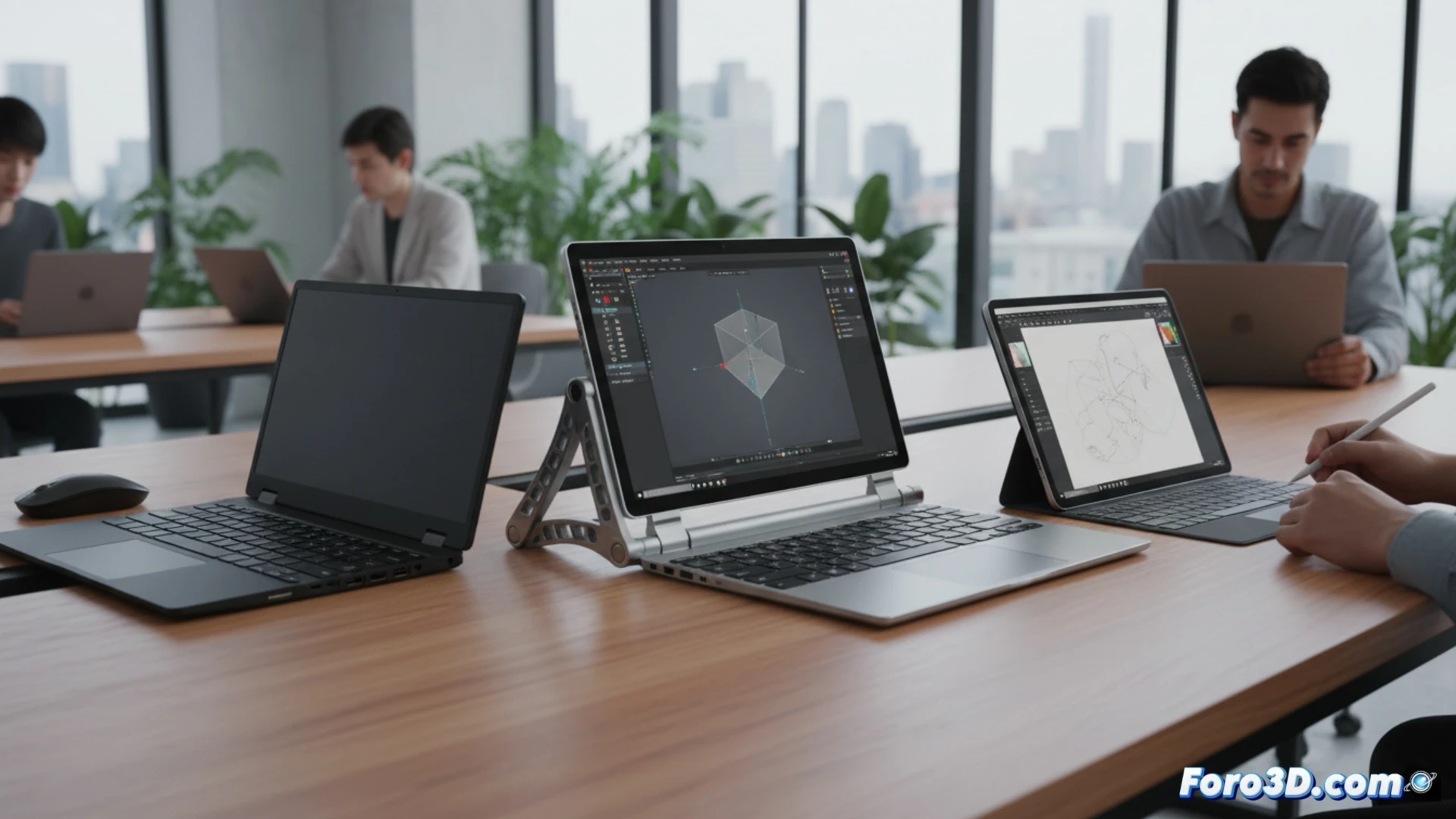
The real bottleneck is sustained performance. Although there are models with powerful CPUs and discrete GPUs, their slim design limits thermal dissipation, causing throttling during prolonged render loads. The touchscreen and stylus are genuine advantages for digital sculpting in ZBrush or sketching concepts, offering more stable ergonomics than a tablet with a case. Additionally, the selection of ports (USB-A, HDMI, card readers) surpasses that of tablets, facilitating the connection of essential peripherals like external graphics tablets. However, compatibility and driver optimization for the stylus in professional software can be irregular.
Final verdict: specific niche with uncertain future ⚖️
2-in-1s are not direct replacements for mobile workstations. Their viability depends on the workflow: they are ideal for artists who prioritize sculpting and conceptual modeling on the go, complementing a main setup. For intensive rendering or simulation tasks, they remain inferior. Their future requires manufacturers to prioritize cooling and mid-to-high-end GPUs, positioning them as a real and powerful alternative, not a compromise.
Can a modern 2-in-1 laptop with a dedicated GPU efficiently handle the full 3D modeling, sculpting, and rendering workflow, or does its thermal and power architecture impose insurmountable limitations for professional production?
(P.S.: Your CPU heats up more than the Blender vs. Maya debate)