Neutron instability is a key phenomenon in astrophysics and nuclear physics, where a free neutron decays into a proton, an electron, and an antineutrino. This process, known as beta decay, also occurs in extreme environments such as neutron stars, where gravitational pressure competes with neutron degeneracy pressure. Visually understanding these subatomic interactions is fundamental for science communication and research.
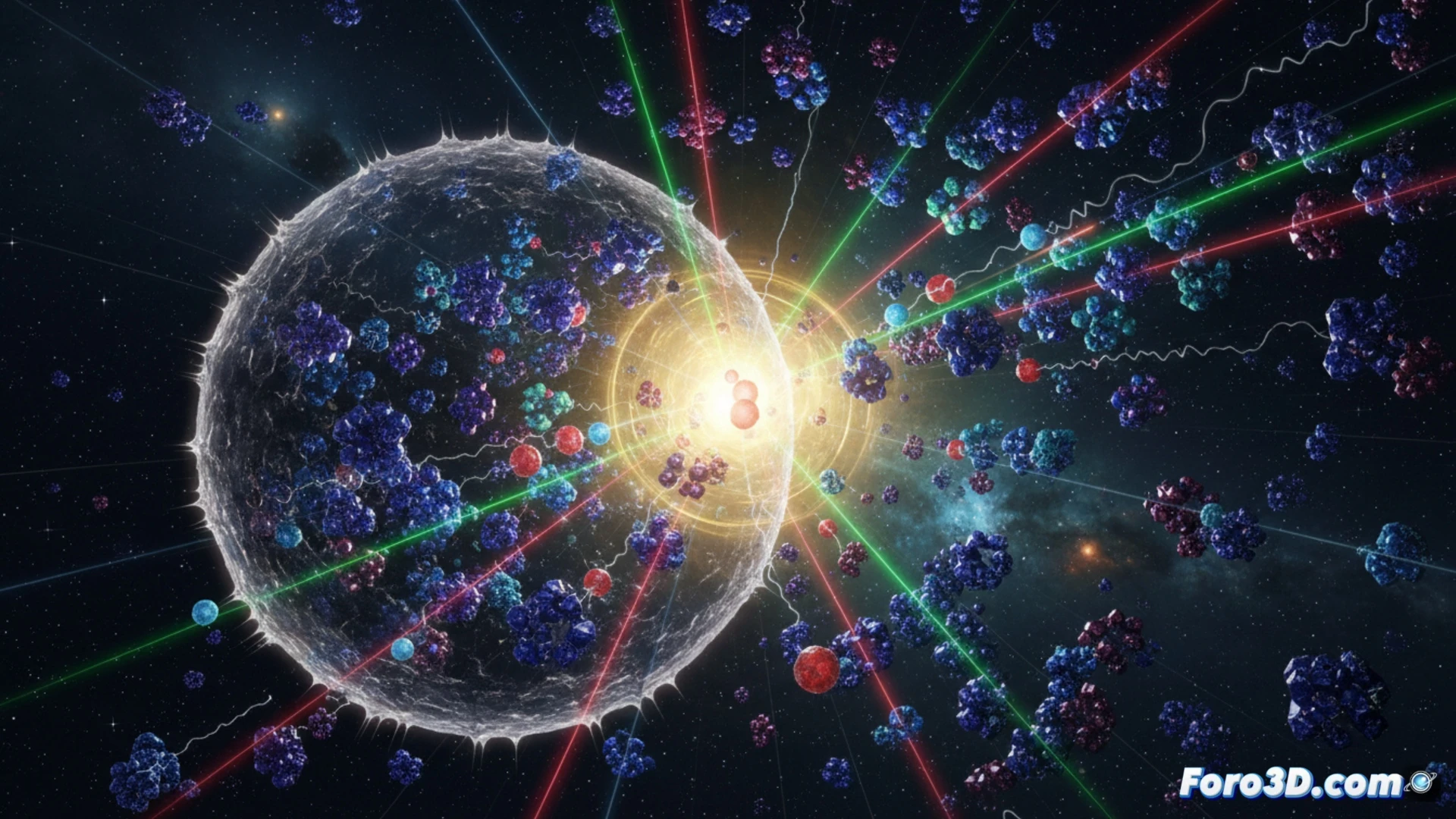
Volumetric simulation of beta decay 🚀
To represent neutron instability in an interactive 3D model, a volumetric particle approach can be used. The simulation begins with a spherical core representing the neutron, rendered with translucent shading to suggest its internal structure. When the animation is activated, the model dynamically decomposes: a smaller particle (the proton) remains at the center, while an electron and an antineutrino are ejected in opposite directions. The trajectory of these particles is traced with field lines and wake effects, allowing the user to rotate the scene and observe the conservation of linear momentum. Tools like Blender or Unity, combined with particle physics plugins, facilitate the creation of these educational environments.
The power of visualization in science 🔬
By abstracting a quantum process into a tangible 3D model, researchers and students can explore the dynamics of decay without the need for complex mathematical calculations. This visual representation not only facilitates the teaching of concepts such as the weak nuclear force or the Chandrasekhar limit, but also inspires new ways to communicate frontier physics. In a world where data is increasingly complex, scientific visualization becomes the bridge between the laboratory and public understanding.
How can the interaction between the weak nuclear force and the instability of a free neutron be modeled in 3D to visualize the quantum transition towards proton, electron, and antineutrino in real time?
(PS: if your manta ray animation doesn't excite, you can always add documentary music from channel 2)