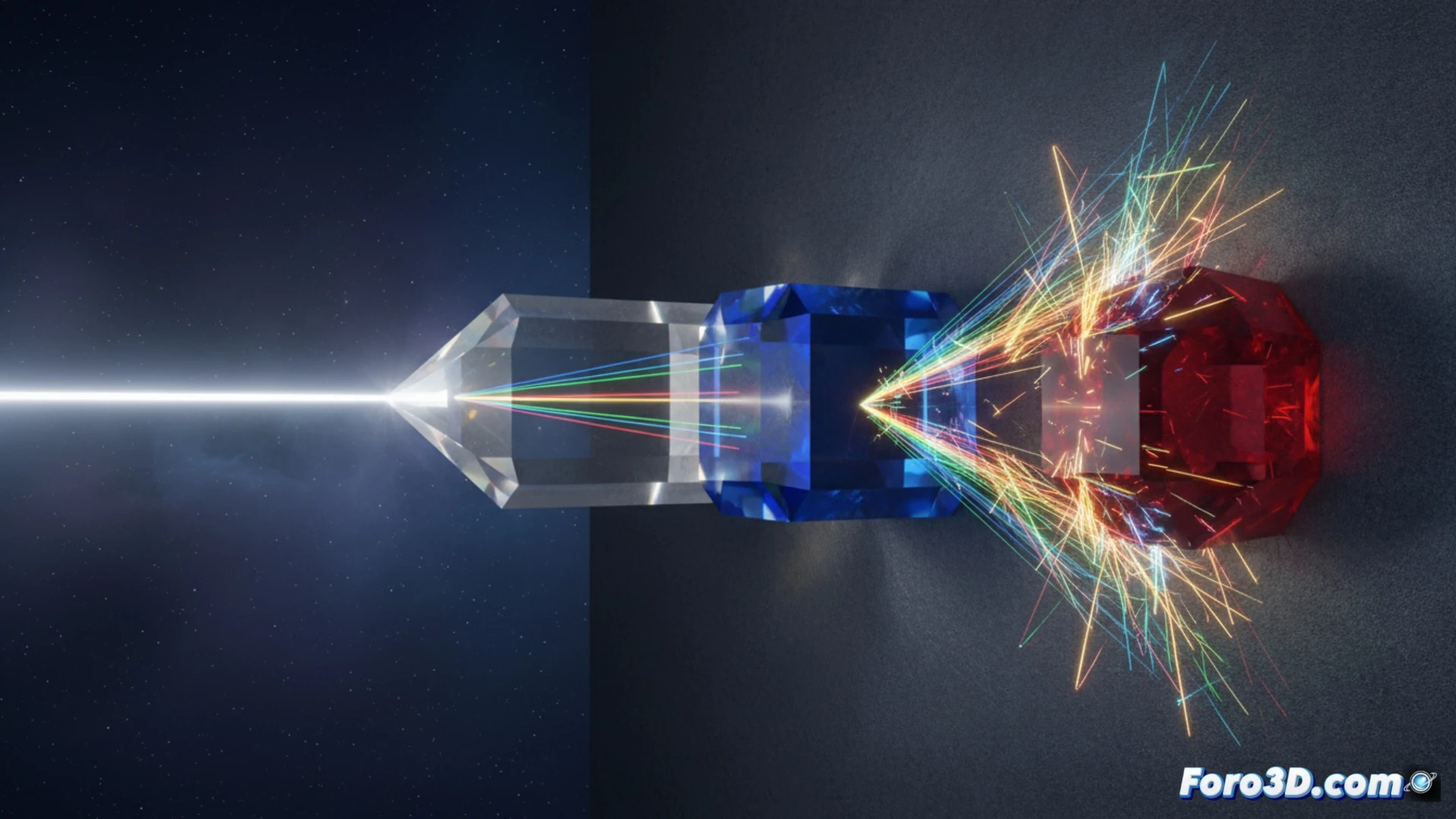
Simulating light paths through transparent media represents a fascinating challenge for scientific visualization. When a light beam passes through several crystals with different refractive indices, complex deviations occur that can be accurately modeled using ray tracing software. This article explores how to replicate this phenomenon in 3D for educational outreach.
Modeling refraction and dispersion in simulation engines 🔬
To represent light deviation in virtual environments, tools like Blender with its Cycles engine offer shader nodes that allow assigning specific refractive indices to each crystal. By configuring a solid geometry prism and applying properties such as the Abbe number, chromatic dispersion can be simulated. Ray tracing automatically calculates the angles of incidence and refraction according to Snell's law, generating curved or broken paths. It is crucial to adjust surface roughness and material absorption to avoid visual artifacts. For a more detailed analysis, the scene can be exported to specialized software like Zemax or LightTools, although Blender is sufficient for interactive educational demonstrations.
The hidden beauty of physics in every deviation ✨
By visualizing these phenomena, we not only better understand geometric optics but also appreciate the elegance of natural laws. Each change in the beam's direction reveals the interaction between light and matter at the atomic level. For a science communicator, recreating these effects in 3D allows showing how a simple ray can split into a fan of colors or deviate along unpredictable paths, turning an abstract concept into a captivating visual experience.
How can the interaction of light with multiple crystals of different refractive indices be visually represented in a 3D simulation to facilitate understanding of light path deviation?
(PS: at Foro3D we know that even manta rays have better social bonds than our polygons)