Nuclear fusion erosion represents one of the greatest technical challenges for the development of commercial reactors. Inside a tokamak, plasma at millions of degrees Celsius constantly bombards the reactor walls, stripping atoms from the structural material. This process not only degrades critical components but also introduces impurities that cool the plasma and drastically reduce reaction efficiency. Understanding this phenomenon at a microscopic level is essential for designing materials capable of withstanding extreme conditions over years of continuous operation.
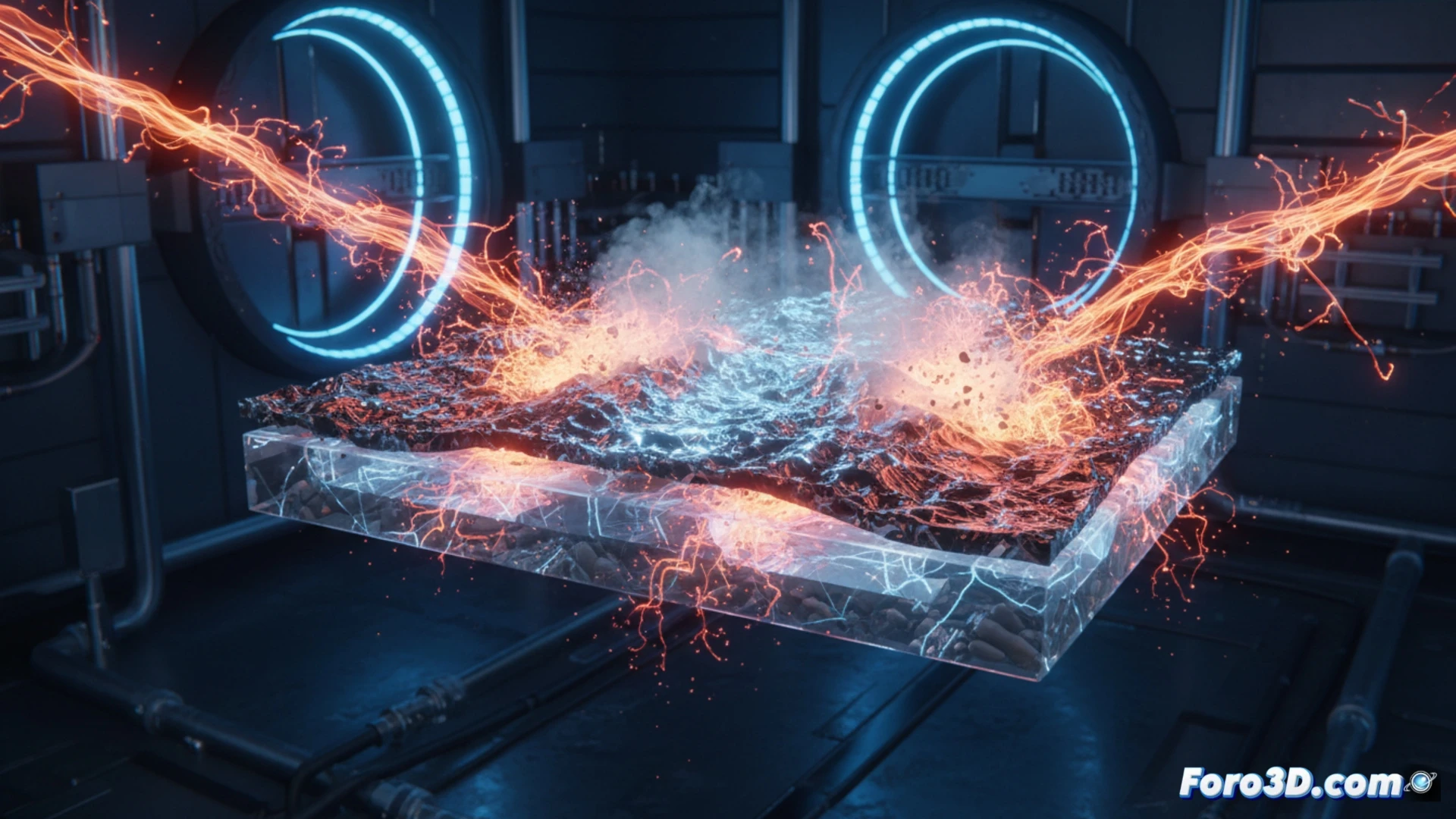
Computational modeling of plasma-wall interaction 🔬
To represent this process in 3D, we begin by modeling the reactor's vacuum chamber as a toroid with a high-resolution mesh in the areas of greatest plasma exposure. The simulation must include deuterium and tritium particles impacting the tungsten surface at hypersonic speeds, represented as dynamic traces with variable coloring based on their kinetic energy. The progressive erosion algorithm reduces the thickness of the surface layer in impact zones, while secondary particles (impurities) detach and follow turbulent trajectories toward the plasma center. For visual comparison, we implemented two materials: conventional tungsten, which shows craters and fissures after heat cycles, and a self-healing lithium-tungsten composite, where eroded areas regenerate through a color gradient simulating the surface diffusion of liquid lithium.
The hidden cost of energy efficiency 💡
By visualizing this phenomenon, we discovered that each detached tungsten particle represents a plasma temperature loss equivalent to thousands of euros in heating energy. The 3D animation reveals how small initial cracks turn into hot spots that accelerate catastrophic erosion. This graphical representation forces us to reflect: while we celebrate advances in magnetic confinement, the real battle is fought at the atomic scale on the reactor walls. Commercial nuclear fusion will not be viable until we learn to tame that invisible wear, and 3D visualization is our best tool to make visible what is imperceptible to the naked eye.
How the evolution of tungsten surface morphology subjected to fusion plasma can be accurately represented using 3D visualization tools to predict catastrophic failures in divertors of reactors like ITER
(PS: modeling manta rays is easy; the hard part is making them not look like floating plastic bags)