The phenomenon of vibration in glass observation decks is not just a matter of discomfort for visitors, but a critical indicator of structural instability. When pedestrian step frequencies coincide with the bridge's natural frequency, a resonance effect is generated that can multiply internal stresses. Analyzing this behavior through 3D simulations allows identifying failure points before a catastrophe occurs.
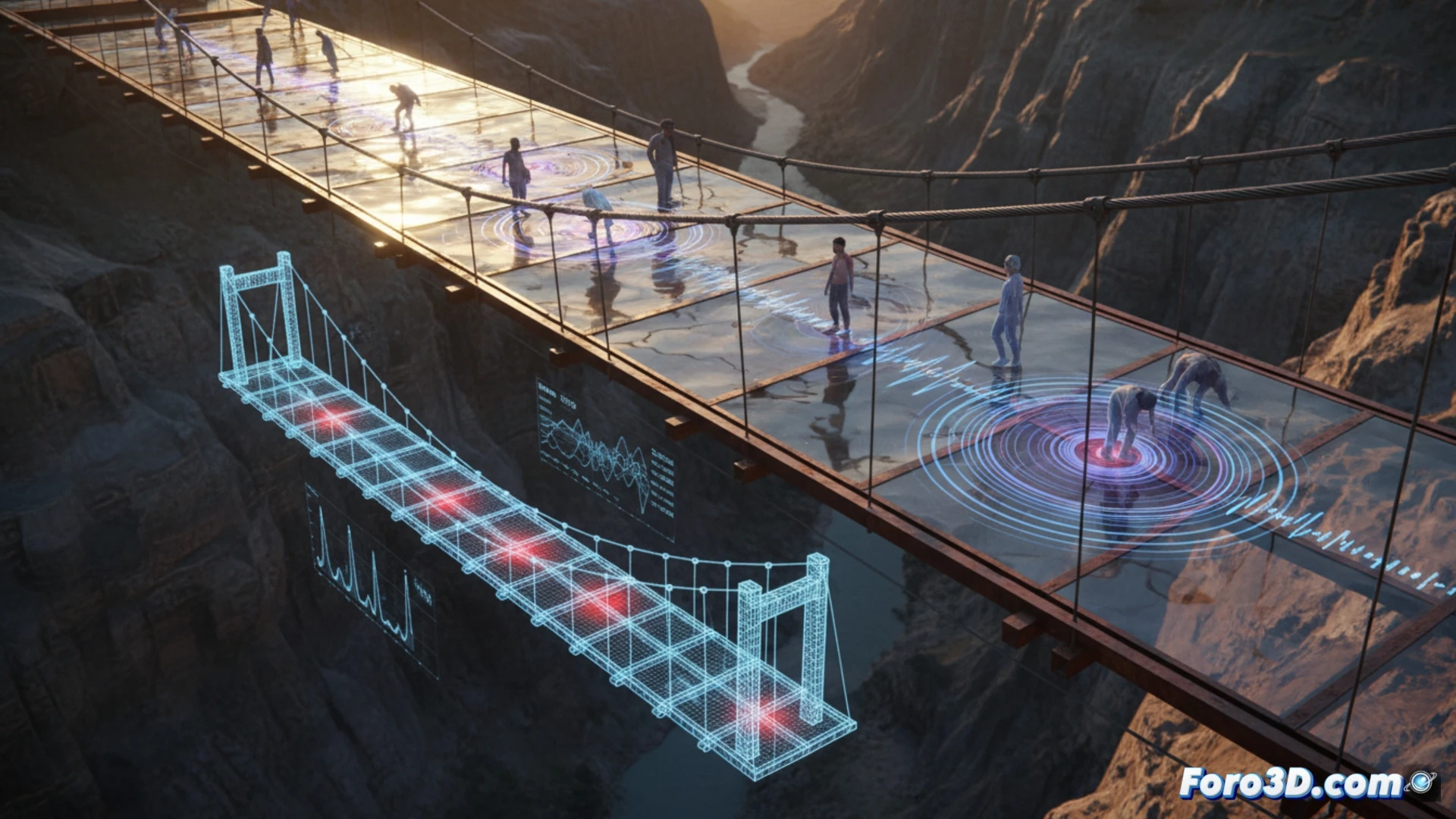
Modeling Stresses and Resonance Frequencies 🏗️
3D simulation tools allow digitally recreating the glass bridge, applying variables such as pedestrian load, lateral wind, and thermal changes. Finite element software calculates maximum stresses in anchors and panels, while modal analysis reveals dangerous frequencies. For example, in the case of the Zhangjiajie observation deck, simulations prior to closure showed that a 2.3 Hz vibration generated microcracks at the glass edges. Comparing with the collapse of the Tacoma Narrows Bridge, it is observed that the lack of damping is the common factor. Heat maps generated by the simulation highlight critical areas where laminated glass loses integrity, allowing for the redesign of metal reinforcements and tuned mass dampers.
Prevention as the Only Viable Strategy 🛡️
No indestructible material exists; structural glass has a fatigue limit that is only revealed under extreme conditions. 3D simulations not only predict failure but also educate engineers and managers about the need for constant monitoring. Every vibration recorded on the bridge is a piece of data that, when entered into the digital model, adjusts lifespan predictions. Thus, the catastrophe ceases to be a sudden event and becomes a manageable risk, where 3D technology acts as a silent sentinel.
Which 3D simulation parameters are most critical for modeling the resonance frequency in glass bridges and anticipating a vibration-induced collapse?
(PS: Simulating catastrophes is fun until the computer melts down and you are the catastrophe.)