The recent appearance of an apocryphal painting attributed to Vincent van Gogh has reignited the debate on authenticity in art. Beyond the scandal, this case exposes how 3D technologies, from photogrammetry to spectral rendering, have become key tools both for creating hyperrealistic forgeries and for unmasking them. We analyze the role of digital modeling in this new frontier of art and activism.
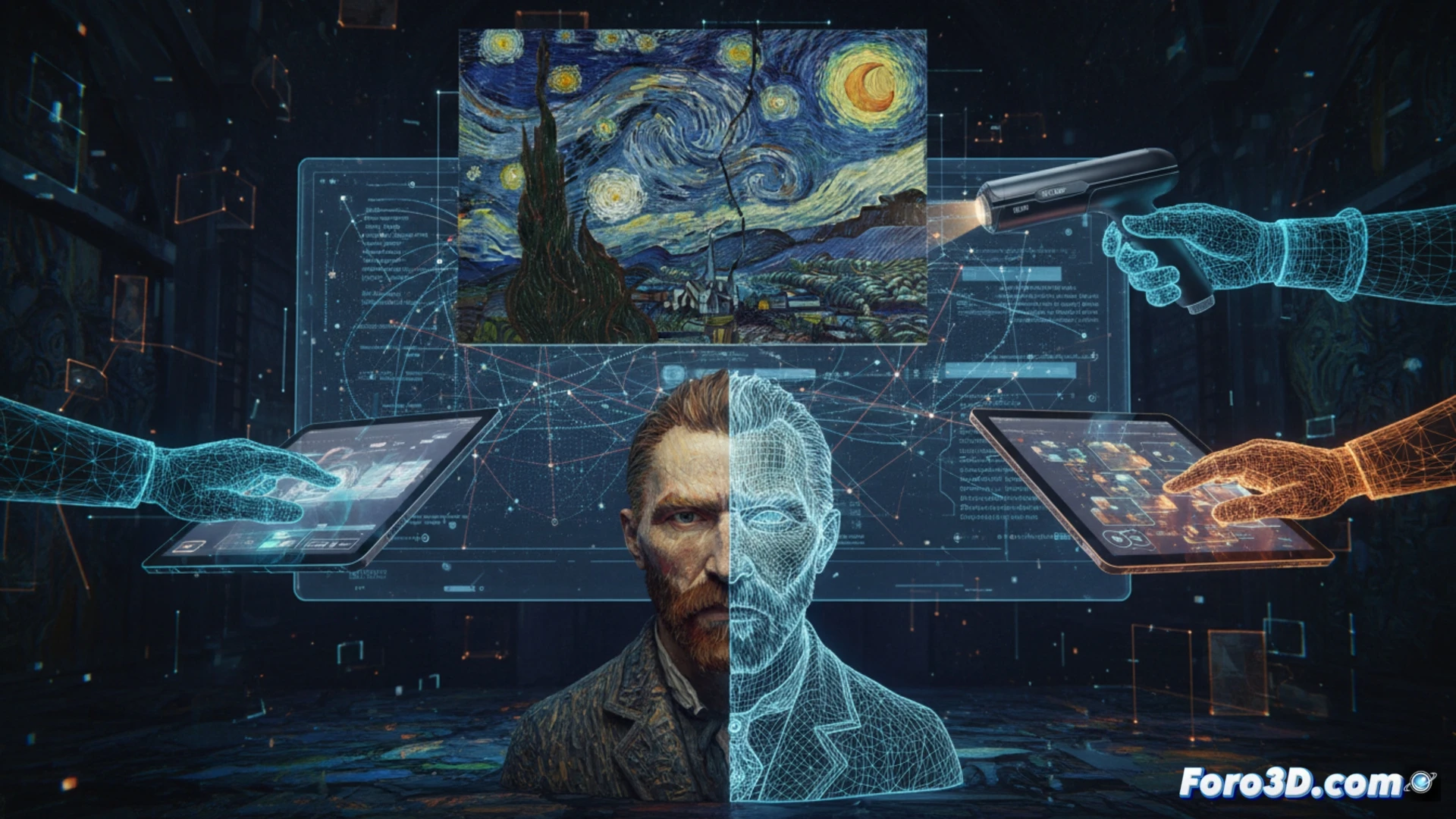
Photogrammetry and synthetic brushstroke: the 3D forger's toolkit 🎨
To emulate Van Gogh, a modern forger not only paints but also scans. High-resolution photogrammetry allows capturing the texture of the original impasto, while 3D modeling replicates the direction and thickness of each brushstroke. Using non-photorealistic rendering (NPR) algorithms, a virtual layer can be generated that mimics craquelure and the chemical aging of oil paint. However, the same technology serves the digital detective: by comparing depth maps of the surface with authenticated works, spectral analysis software can detect nanometric discrepancies in the relief, revealing the imitator's hand. The case of the fake Wheatfield with Crows in 2018 was solved thanks to a LiDAR scan that showed a mathematically perfect brushstroke pattern, something a human cannot achieve.
The paradox of authenticity in the digital age 🤖
This technological duality raises an ethical paradox: if with 3D tools we can create a copy indistinguishable from the original at a molecular level, what defines authenticity? Digital activism proposes using these same techniques to democratize art, releasing exact replicas into the public domain. But the art market resists, as digital scarcity does not exist. The real battle is not between the real and the fake, but between the creator's intention and the machine's ability to replicate the human gesture, a conflict that will redefine the value of the artwork in the 21st century.
How could 3D technology be used both to create convincing forgeries of artworks and to unmask them, and what is the role of digital activism in this new battlefield for authenticity?
(PS: if your virtual reality installation doesn't change the world, at least let it not lag)