Simulating the trajectory of a projectile in a narrow alley represents a fascinating technical challenge for 3D engines. Unlike an open space, where range and free fall dominate the calculation, the confined environment introduces critical variables such as wall bounces, surface friction, and material deformation. This analysis explores how real-time physics systems model these events to achieve millimeter precision. 🎯
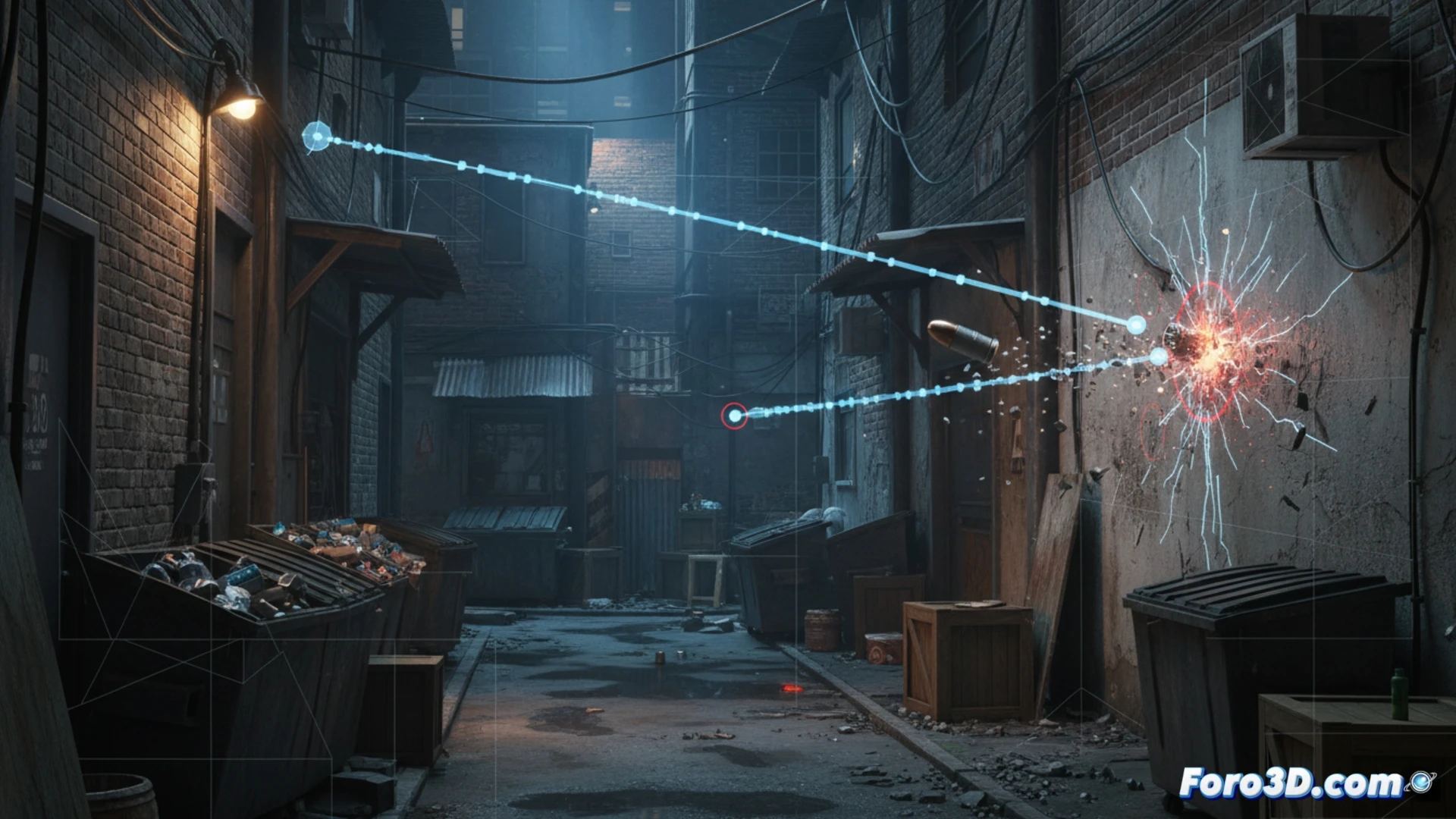
Physical variables and environment modeling in 3D engines ⚙️
In Unreal Engine or Unity, ballistic simulation in confined spaces requires adjusting parameters such as initial velocity (between 300 and 900 m/s for real firearms), the firing angle, and the coefficient of restitution of surfaces. The narrow alley, with concrete or brick walls, demands a detailed collision model: the engine must calculate the bounce vector considering material roughness and kinetic energy loss. Additionally, aerodynamic drag within a closed tunnel can alter the projectile's gyroscopic stability, an effect that forensic simulators replicate using particle systems and rigid body physics. Tools like PhysX or Chaos Physics allow these calculations to be iterated in real time, ideal for tactical training or incident reconstruction.
Implications for tactical training and forensic recreation 🔍
Precision in simulating trajectories in alleys not only improves tactical shooter video games but also has real forensic applications. For example, when recreating a shooting in a narrow hallway, experts can use these 3D engines to determine the origin of the shot based on impact and bounce patterns. The ability to visualize angles impossible in the real world makes these tools indispensable allies for justice and security, demonstrating that virtual physics can save lives or solve crimes.
When simulating the ballistic trajectory of a projectile in a narrow alley, how does the collision mesh resolution affect bounce accuracy and impact detection on edges and corners?
(PS: Simulating trajectories is like playing billiards, but without having to clean the table afterward.)