TCL has broken the mold of gaming monitors with the unveiling of its new range in Paris, led by the imposing 32X3A. This panel not only promises a competitive refresh rate for gamers but also introduces OLED+ technology and the Bang & Olufsen audio signature. For the 3D modeling professional, the question is inevitable: are we facing a serious work tool or just a luxury peripheral? We analyze its technical depths to find out.
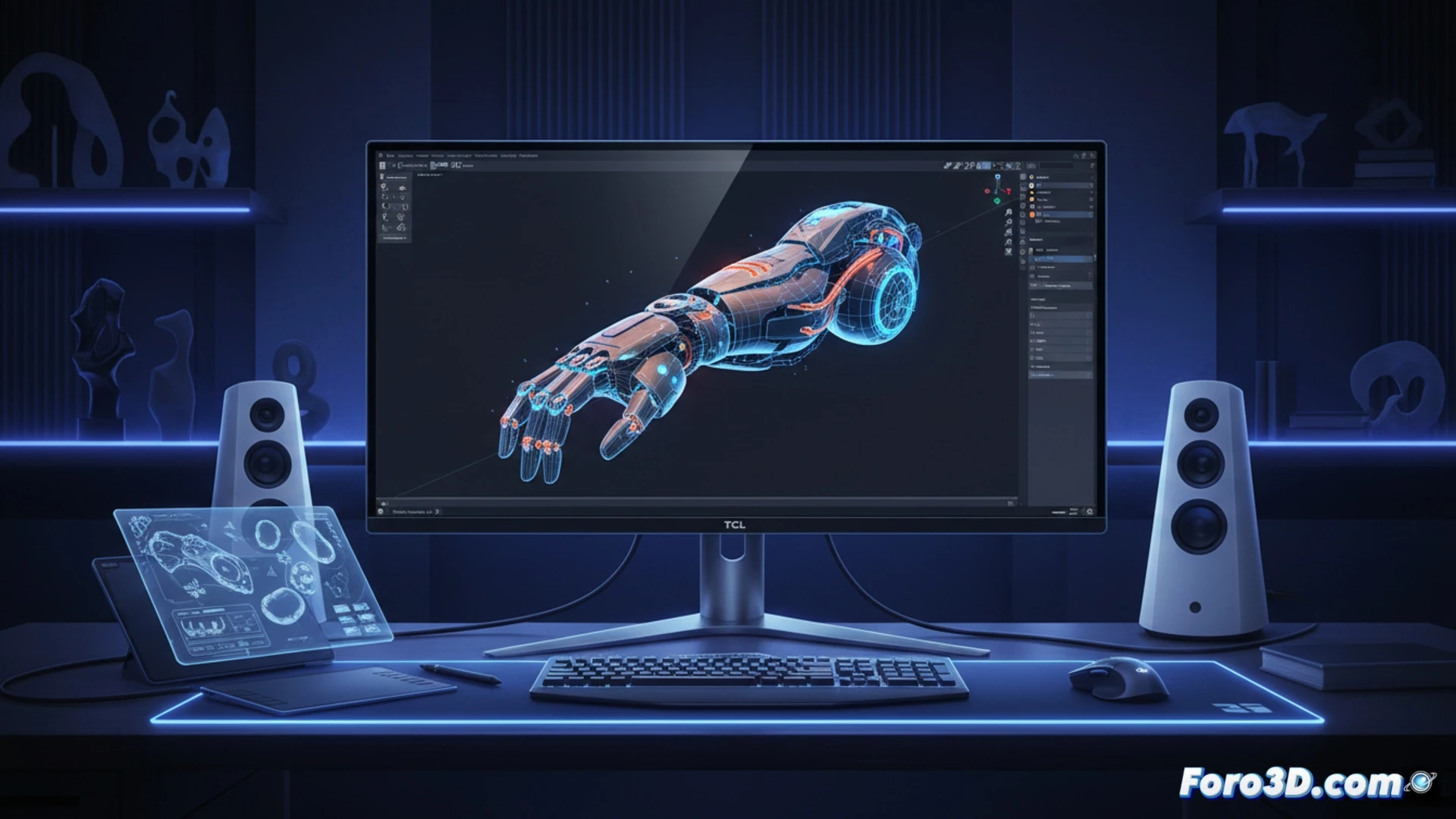
Technical analysis: OLED+ vs. IPS and MiniLED in rendering 🎨
The true star of the TCL 32X3A is its OLED+ panel. This means absolute blacks and an infinite contrast ratio, ideal for viewing dark scenes or volumetric lighting work without light halos. Compared to a traditional IPS monitor, color accuracy in shadows is superior. However, here the debate arises: texturing and UV modeling professionals have historically relied on IPS or MiniLED panels for their sustained brightness and lower risk of burn-in. TCL's OLED+ will need to demonstrate a Delta E color management of less than 2 to be viable for long-duration work. The refresh rate, although designed for gaming, benefits navigation through complex viewports, reducing tearing when rotating dense polygonal meshes.
Premium audio: A luxury or a necessity in the 3D workstation? 🔊
Integrating Bang & Olufsen speakers into a monitor aimed at creators is a risky move. In a 3D workstation, audio is usually relegated to reference headphones to avoid auditory fatigue. However, for quick reviews of animations or real-time simulations requiring audio feedback, having a high-fidelity system without taking up desk space is a plus. The real test will be whether these speakers offer a flat response without distortion at low volumes, something critical for prolonged work sessions. If TCL manages to avoid the typical saturation of built-in speakers, this monitor could justify its price as a central multimedia and professional hub.
Considering the demands of latency and refresh rate in interactive 3D environments, how does the TCL 32X3A OLED+ perform with adaptive sync technologies like G-Sync or FreeSync in scenes of high geometric complexity?
(PS: Your CPU heats up more than the debate between Blender and Maya)