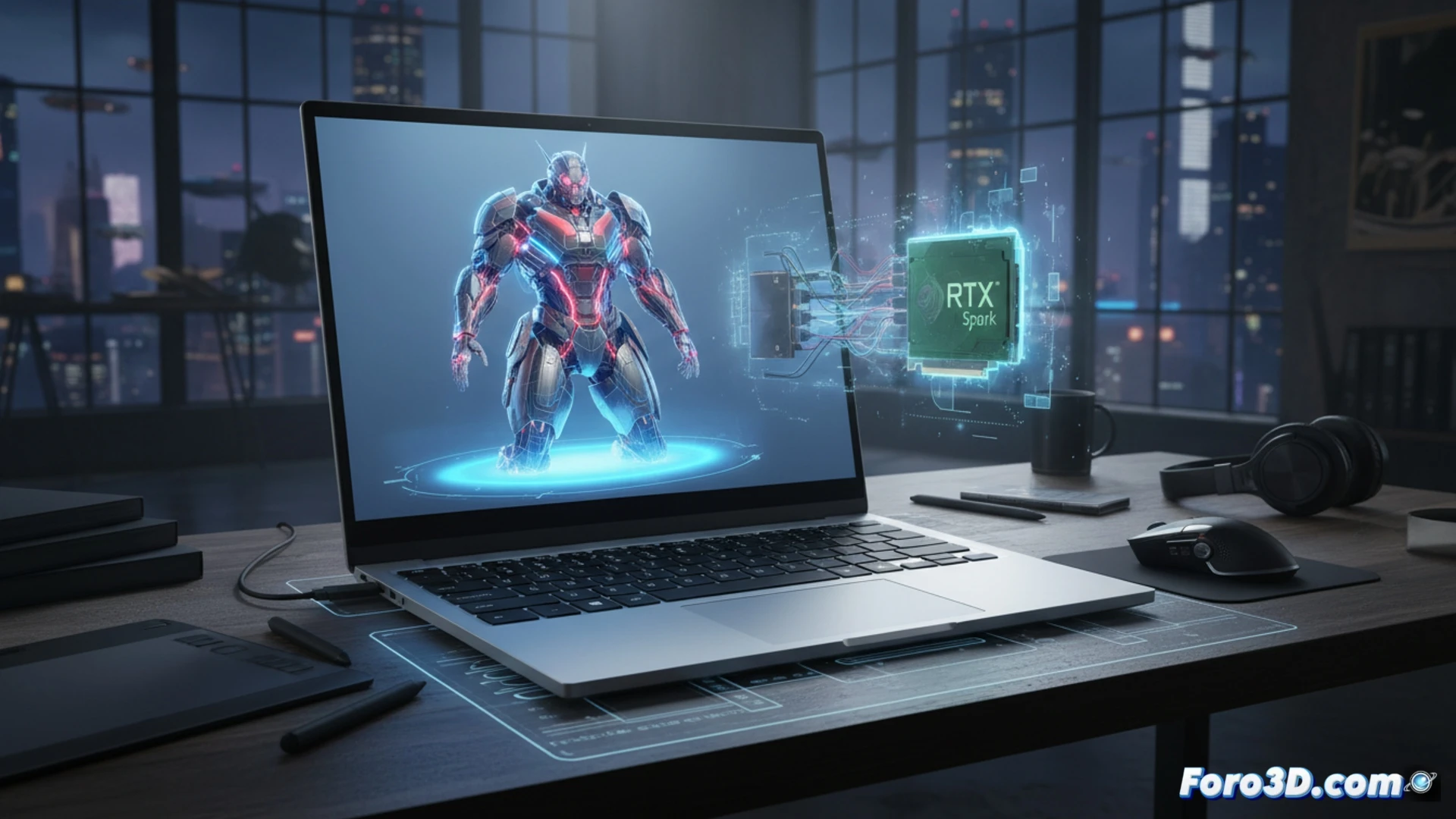
Microsoft and Nvidia have joined forces to launch the Surface Laptop Ultra, a device that integrates the new Nvidia RTX Spark chip. With a 15-inch mini-LED touchscreen and a large trackpad, this device promises high-level graphics and extended battery life. For the 3D hardware niche, the question is obvious: are we looking at a real portable workstation or just a premium consumer device? Let's analyze its components under the lens of professional modeling and rendering.
RTX Spark vs. Desktop: Performance and Thermal Limitations 🔥
The heart of this Surface is the RTX Spark GPU, an architecture that Nvidia positions as a bridge between mobile and desktop series. In synthetic benchmarks, its rasterization performance is close to a desktop RTX 4070, but with significantly lower TDP. This is critical for 3D rendering: in engines like Cycles or V-Ray, calculation speed will be limited by the thermal management of the slim chassis. Real-time simulations with Unreal Engine could suffer from throttling in complex scenes. Additionally, the RAM, likely soldered and non-expandable, represents a bottleneck for projects with 4K textures or dense geometry. The mini-LED display offers excellent contrast and DCI-P3 coverage, ideal for material review, but its factory calibration will be decisive for texturing work.
Revolution or Mirage for the Digital Artist? 🎨
The Surface Laptop Ultra is, without a doubt, the most powerful Surface ever created. However, for the 3D professional seeking a workstation, the equation is complex. The graphical power is there, but it sacrifices the modularity and active cooling of a gaming laptop or a workstation like the Dell Precision. If your workflow demands absolute mobility and fast rendering in the boardroom, this device is a hit. But if you need fluid simulation sessions or farm rendering, the high price and thermal limitations make it a niche option, more attractive for presentations than for heavy production.
Considering the thermal and power limitations of such a thin laptop, how does the RTX Spark performance on the Surface Laptop Ultra affect render times in engines like Cycles or V-Ray compared to a workstation with a desktop RTX 4070?
(PS: remember that a powerful GPU won't make you a better modeler, but at least you'll render your mistakes faster)