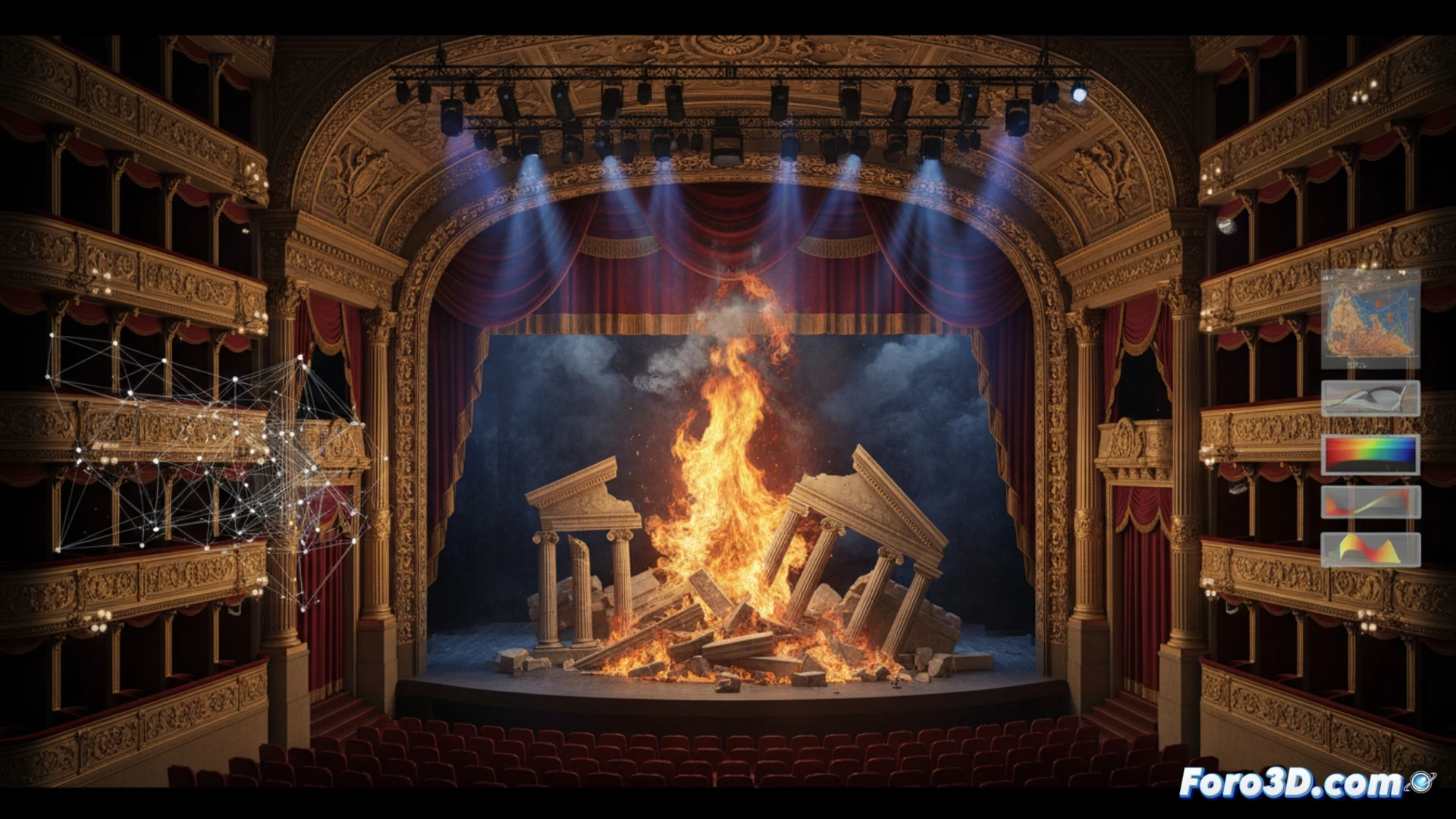
The digital recreation of a fire in an opera house represents one of the most complex challenges in visual effects. Not only must we simulate the physical behavior of fire and smoke, but we must also respect the ornate architecture of the venue, the acoustic materials, and the dramatic stage lighting. This article analyzes techniques using particle engines and fluid dynamics to achieve believable realism in this very specific environment.
Particle and fluid engines for stage combustion 🔥
To simulate fire in a theater, particle engines allow controlling the emission of flames from point sources, such as chandeliers or curtains. However, an uncontrolled fire requires computational fluid dynamics (CFD) to model the dense smoke rising towards the dome and the hot air currents spreading between boxes. Integration with pre-existing 3D scenes requires correctly mapping the reflectance of materials like velvet, wood, and plaster, as fire alters the global illumination. Render bracketing techniques and volume passes are essential to separate smoke from static geometry. In productions like The Phantom of the Opera or La La Land, hybrid systems were used: particles for stylized fire and smoke simulations in Houdini for the wide shots of the auditorium.
Realism vs. stylization: the dilemma of fire in the theater 🎭
The choice between realistic or stylized fire depends on the narrative tone. A documentary-style fire requires precise combustion simulations with calibrated temperature, oxygen, and colorimetry, optimizing renders with low-resolution proxies to avoid excessive calculation times. In contrast, a fantasy opera allows for artistic fire with saturated color particles and translucent smoke, sacrificing physics for visual impact. The key lies in balance: too much realism can saturate the scene, while excessive stylization breaks immersion in a space as iconic as a theater.
How is the synchronization between the fluid dynamics of a simulated fire and the real stage lighting technically addressed so that the audience perceives a single coherent light source in an opera production?
(PS: VFX are like magic: when they work, no one asks how; when they fail, everyone sees it.)