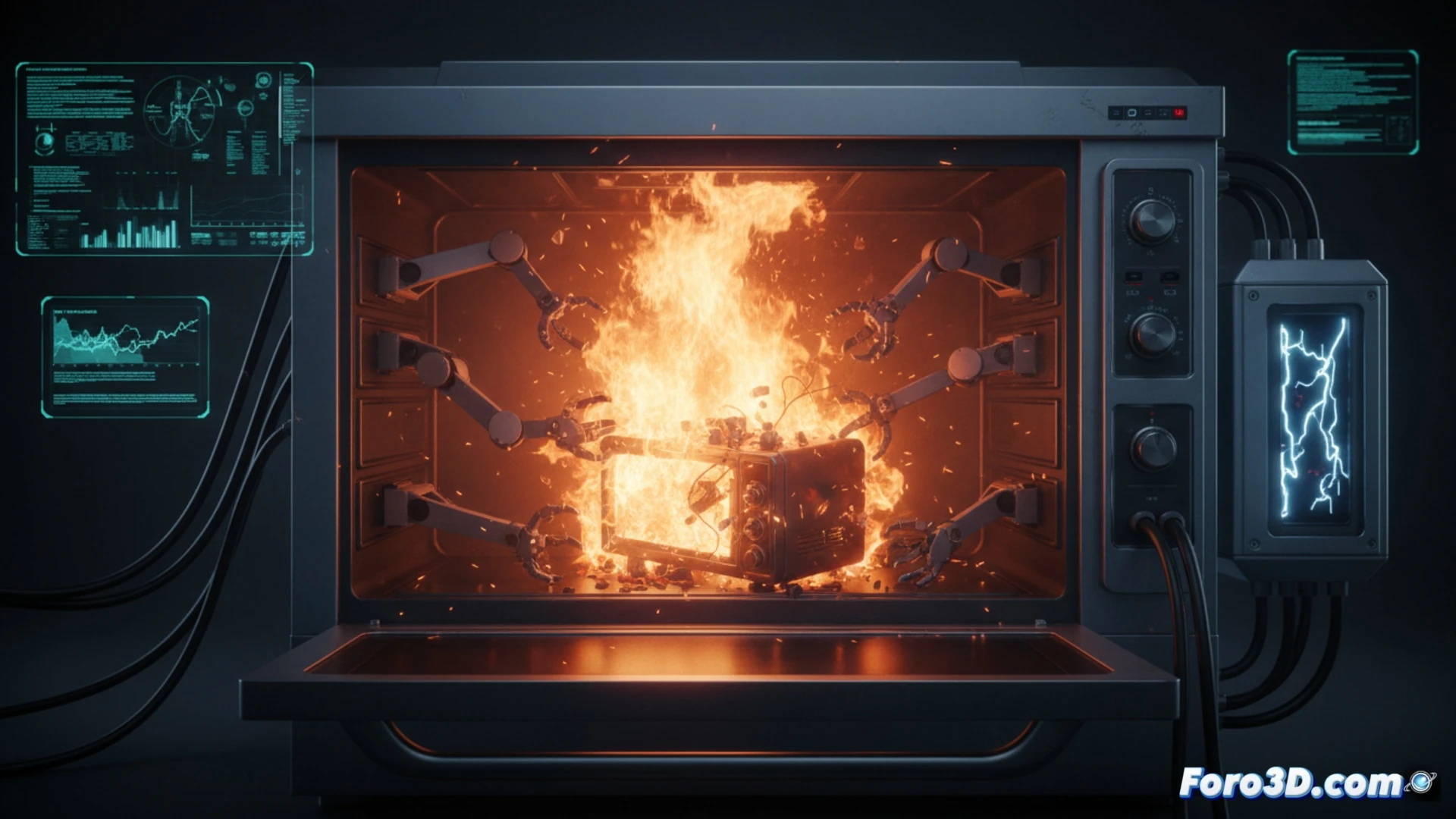
The recent news about a fire in a robotic kitchen oven has captured the attention of the VFX world. Although the event is real, its technical analysis opens up a range of possibilities for procedural simulation. In this article, we will break down how to digitally recreate a confined fire inside a smart appliance, using particle engines and thermal physics to achieve striking realism. 🔥
Particle Workflow and Thermal Damage in Houdini 🛠️
To simulate fire in a robotic oven, the first step is to model the appliance's interior with precise geometry, including metal trays and plastic panels. In Houdini, we use a Pyro solver for smoke and flames, configuring the ignition source as a volumetric emission point within the sealed cavity. The procedural physics must account for the lack of oxygen: the fire becomes dense and slow, with black, oily smoke. For thermal damage, we employ an attribute system that deforms the plastic (melting edges) and discolors the metal (creating a heat map in textures). Tools like Embergen can complement the final render, offering real-time simulation to adjust smoke turbulence without lengthy baking sessions.
Realism vs. Reference: The Challenge of Confined Fire 🎯
The biggest challenge is not the fire itself, but its interaction with the robotic structure. Real recordings of incidents show how plastic expands before burning and how metal oxidizes instantly. In VFX, we often fall into the temptation of making fire too cinematic. For this case, the key lies in subtlety: using low-resolution simulations for dense smoke and highly localized spark particles. An effective trick is to add a slight simulated camera movement (shake) to emulate the appliance's vibration as it expands, a detail that separates a generic render from a piece worthy of a technical documentary or a realistic video game.
How can the dynamics of an uncontrolled fire in a robotic oven be realistically simulated, including the interaction of fire with electronic and mechanical components, using fluid and particle tools in engines like Houdini or Unreal Engine?
(PS: VFX are like magic: when they work, no one asks how; when they fail, everyone sees it.)