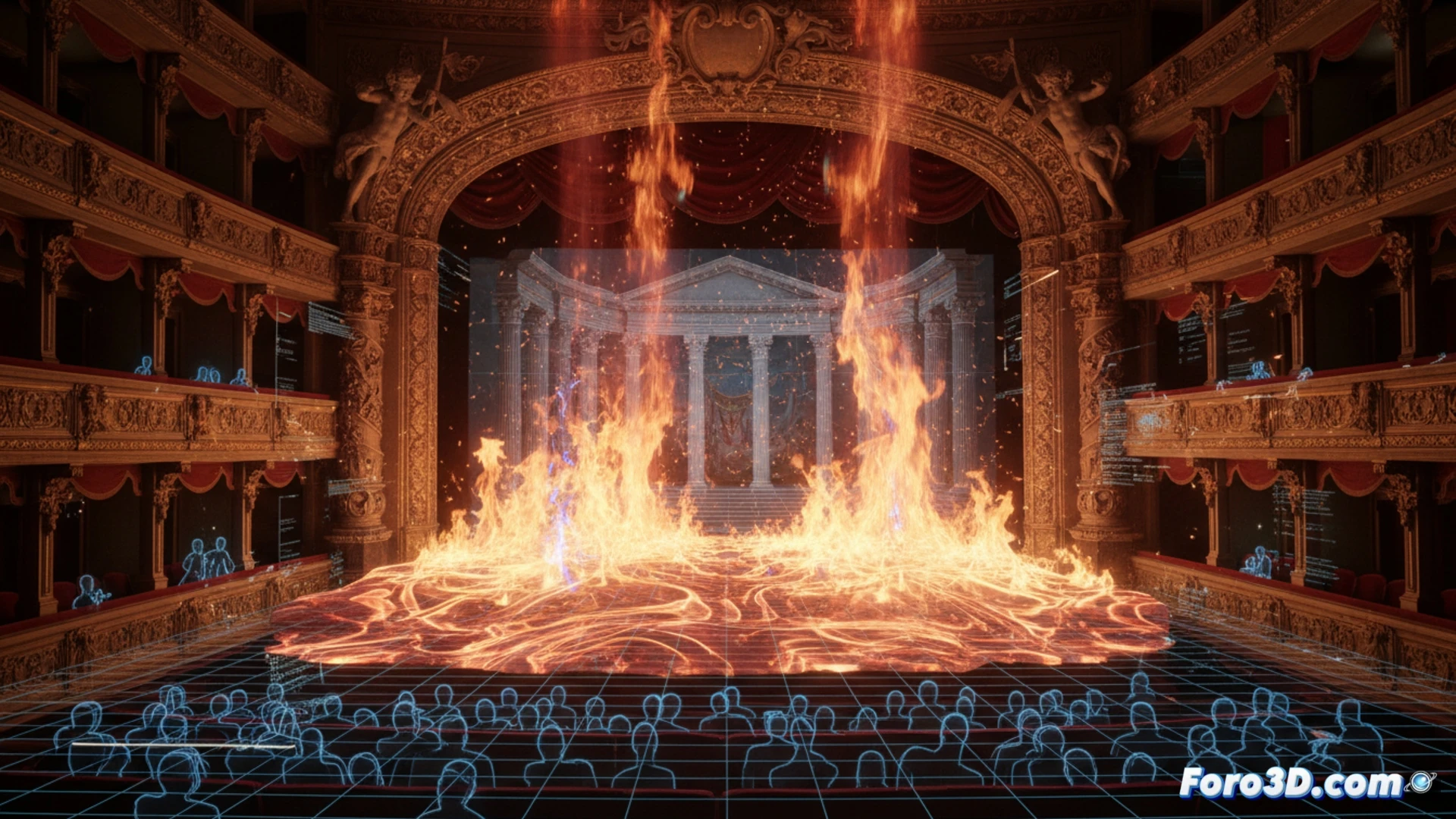
The recreation of fires in opera houses represents one of the greatest challenges in visual effects, as it combines complex fluid dynamics with the ambient lighting of an enclosed space. In film productions and video games, fire must not only look real but also behave consistently with the stage's architecture. This article analyzes the 3D simulation techniques that allow VFX artists to master this element, from particle systems to dynamic fluids, applied to the virtual safety of cultural heritage. 🔥
Particles and dynamic fluids in simulation engines 💨
To capture the essence of fire in a historic theater, modern simulators employ two complementary approaches. On one hand, particle systems emit sprites that represent base flames, ideal for real-time rendering in engines like Unreal Engine or Unity, where performance is critical. On the other hand, dynamic fluid simulation (using tools like Houdini or Phoenix FD) solves Navier-Stokes equations to model the turbulent movement of smoke and flames. In practice, a fire scene in a theater like the Opéra Garnier combines particles for the main fire with fluids for the dense smoke rising towards the domes. The key is to adjust the fluid's viscosity and temperature so that the smoke respects the columns and boxes, avoiding unrealistic collisions. For offline rendering, Arnold or RenderMan are preferred, allowing volumetric scattering and soft shadows, achieving photographic realism that real-time engines still cannot match in complex scenes.
Virtual safety and visual narrative in heritage scenarios 🎭
Beyond the technique, simulating fire in historic theaters has a narrative and conservation purpose. In productions like The Phantom of the Opera or period video games, the fire not only generates tension but also allows exploring how the structure would react to a disaster without real risk. VFX artists must balance physical realism with visual legibility: the fire should not completely darken the scene or hide the ornamental architecture. By mastering these techniques, creators make the viewer feel the heat of danger while digitally preserving the majesty of these unique spaces.
How can the simulation of fire in a historic theater, with all its architectural and acoustic details, meet virtual realism standards without compromising the scenic narrative or the safety of the digital heritage?
(PS: VFX are like magic: when they work, no one asks how; when they fail, everyone sees it.)