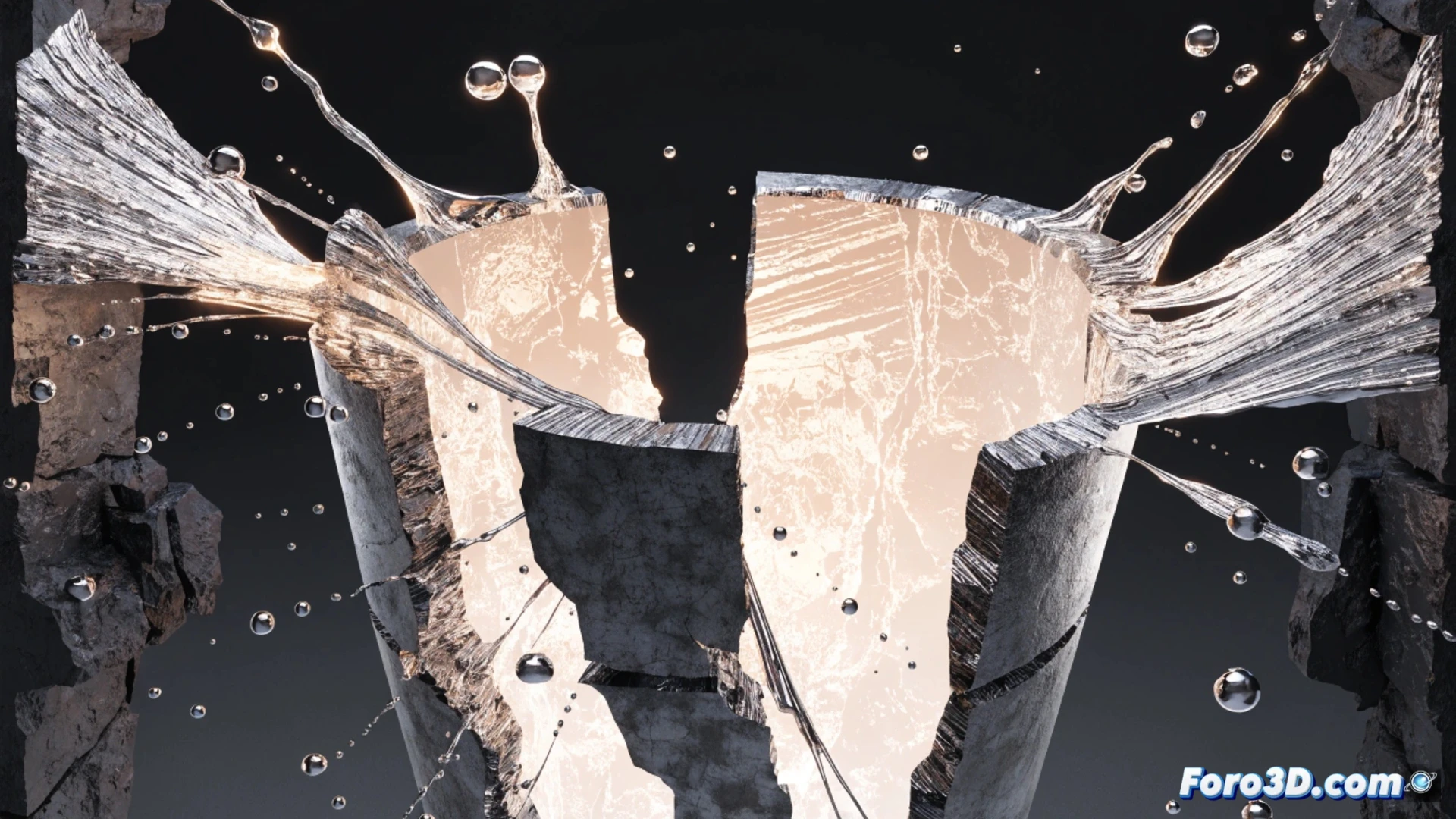
The explosion of liquid metal represents one of the most violent failures in the metallurgical industry, where a crucible subjected to extreme thermal cycles collapses, releasing molten material at high pressure. This phenomenon, far from being random, responds to a cumulative process of thermal and mechanical fatigue that can be accurately modeled using 3D finite element simulation, allowing anticipation of rupture points and the dynamics of metal dispersion.
Modeling thermal fatigue and creep in crucibles 🔥
To simulate this collapse, finite element software must integrate three critical variables: thermal fatigue generated by heating and cooling cycles, material creep under sustained loads at high temperatures, and embrittlement from exposure to corrosive elements in the molten bath. In practice, a material model with temperature-dependent properties is defined, applying cyclic loads that represent the casting process. The mesh must be refined in areas of highest thermal gradient, such as the interface between the liquid metal and the crucible wall, where stresses exceed the elastic limit and generate microcracks that progress until final fracture.
Visualizing the damage cascade and dispersion 💥
The visual representation of this failure requires two phases: first, an animation of damage progression with heat maps showing stress concentration and crack evolution from the internal to the external surface; second, a fluid dynamics simulation for the explosion, where molten metal disperses at high speed. This sequence not only serves to identify failure modes but also allows redesigning geometries and materials to extend equipment lifespan, preventing catastrophic accidents in foundries.
How can 3D simulation predict the nucleation and propagation of fatigue cracks in metal crucibles before a catastrophic liquid metal explosion occurs? 🤔
(PS: Material fatigue is like yours after 10 hours of simulation.)