The detachment of a lithium battery is not a simple mechanical failure; it is the trigger of a chain reaction that can collapse entire structures. In this article, we analyze how 3D simulation allows modeling thermal runaway, the ignition of adjacent materials, and the spread of fire in vehicles and buildings, providing critical data for disaster prevention.
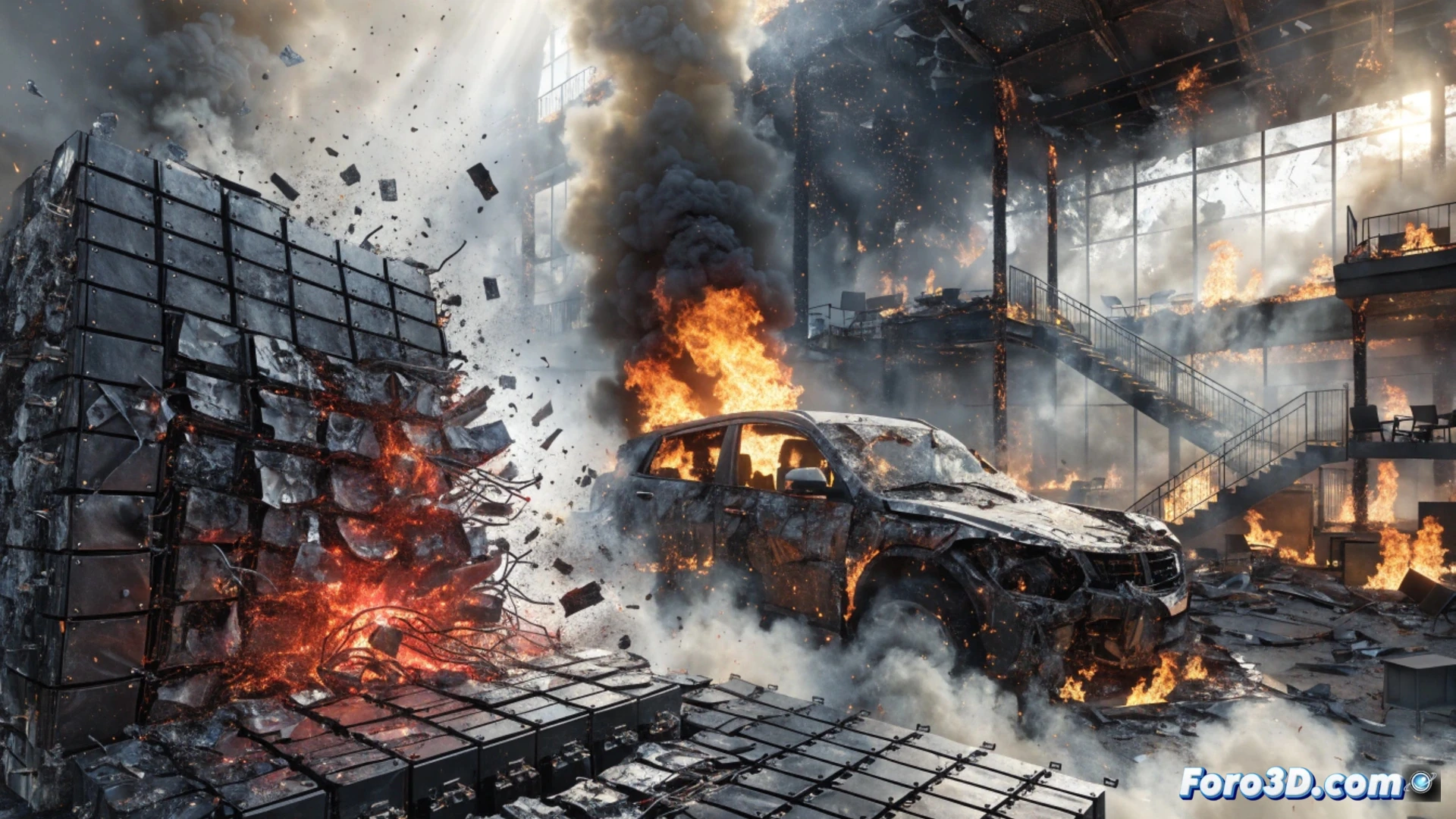
Modeling thermal runaway and structural collapse 🔥
Using computational fluid dynamics (CFD) software and finite element analysis (FEA), we have recreated a scenario where a lithium-ion battery detaches from its anchor in an underground garage. The simulation reveals that, in less than 90 seconds, the surface temperature of the module exceeds 600 degrees Celsius, initiating the pyrolysis of the surrounding polyurethane. The 3D model shows how toxic smoke (hydrogen fluoride) stratifies, blocking upper evacuation routes, while radiant heat weakens steel beams to 40% of their load capacity, simulating the progressive collapse of the slab.
Risk visualization for emergency teams 🚨
The volumetric representation of the fire allows firefighters to identify thermal blind spots and potential flashover zones. By integrating IoT sensor data into the digital twin, a dynamic risk map is generated that prioritizes extinguishing from the perimeter. This methodology reduces intervention time by 30% and minimizes exposure to lethal smoke, transforming a catastrophic event into a controllable incident through predictive planning.
How would you model in 3D the transition from a battery detachment to a catastrophic thermal runaway without simplifying the physics of the chain reaction?
(PS: Simulating catastrophes is fun until the computer melts down and you are the catastrophe.)