Two companies have tested a technique that aims to thicken Arctic ice by pumping water onto its surface to accelerate freezing. The trials reveal that only one of the projects managed to delay summer melting, demonstrating very limited effectiveness. For the public, this confirms that geoengineering solutions are not a silver bullet. The conclusion is clear: without a drastic reduction in carbon emissions, any technical patch will be insufficient to stop the climate catastrophe.
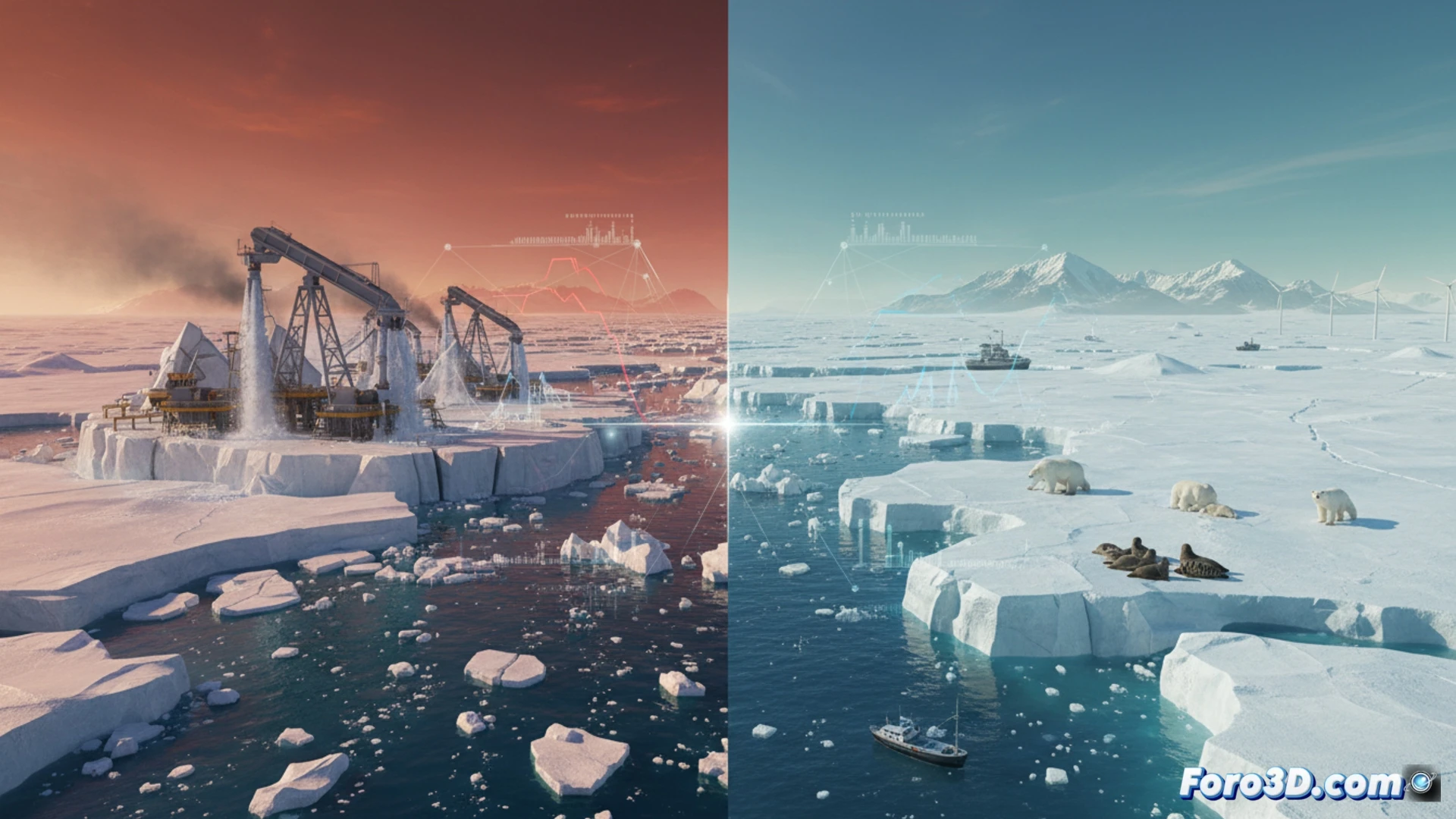
Data modeling and comparative 3D animation 🧊
To visualize this reality, I propose a 3D simulation comparing two scenarios in the Arctic. The first model will show the current baseline of ice melt, using satellite data on seasonal ice mass loss. The second will incorporate the effect of the pumping technique, using the results of the successful trial to calculate the additional thickness and delay in melting. The animation should contrast both scenarios in a 10-year time loop, where it is evident that the intervention only slightly shifts the melting curve. The ice color will change from white to translucent blue as it loses density, while a global emissions indicator (in red) rises relentlessly.
Visual lesson: geoengineering does not replace emission reduction 🌍
The key point of the simulation is to show that, even if pumping achieves an extra thickness of a few centimeters, the ice still disappears in summer. The animation should include a third scenario simulating a 50% reduction in current emissions. Here, the ice remains stable and the pumping technique is barely necessary. This visual comparison is the most powerful tool to communicate that the only real solution is to attack the root cause of warming, not to mask its symptoms with temporary patches.
Considering the planetary scale of the problem, is the 3D simulation of the pumping technique to thicken Arctic ice a tool to optimize a temporary patch or a true plan B in the face of inaction on emission reduction?
(PS: Simulating catastrophes is fun until the computer crashes and you are the catastrophe.)