Tool wear in demolition represents a critical challenge for the construction and demolition industry. Each impact cycle on concrete or rock generates micro-deformations that, accumulated, fracture the steel of picks and pneumatic hammers. Finite element simulation allows visualizing in 3D the evolution of these internal stresses, anticipating the exact point of failure before it occurs on site.
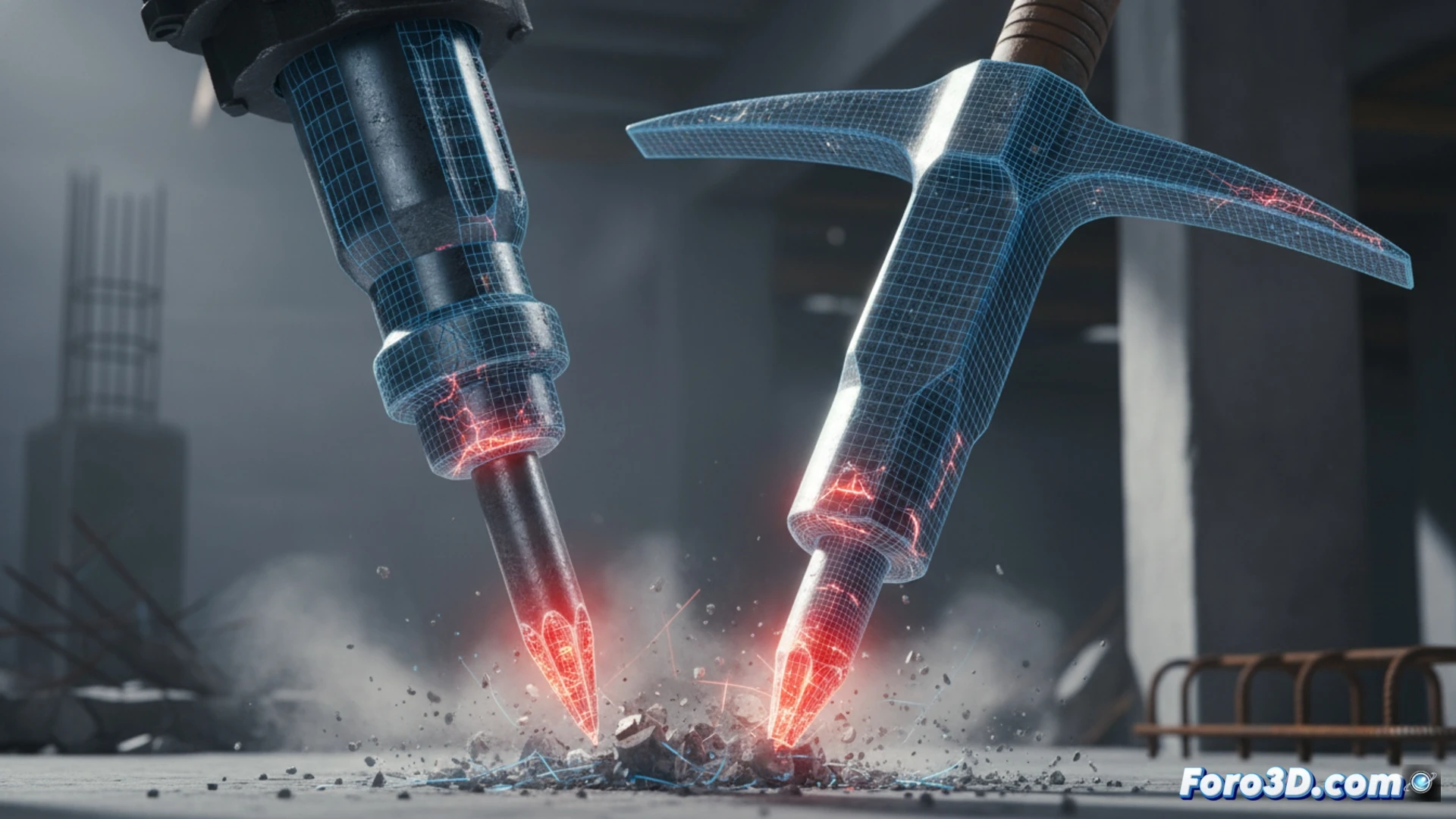
Modeling of stresses and progressive microcracks 🔧
Using tetrahedral meshing and cyclic boundary conditions, engineers digitally reproduce the repetitive impact on the tool. The software assigns fatigue properties to the material, such as the yield strength and Young's modulus, to calculate damage accumulation according to Miner's rule. Volumetric visualization reveals how microcracks nucleate in stress concentration zones, typically at the fillet radius between the shank and the tip of the tool. This analysis allows redesigning geometries to better distribute the load, extending the service life by 30% to 50% according to recent studies.
Towards smarter and more durable tools 💡
3D simulation not only predicts wear but transforms the way demolition tools are conceived. By virtually validating new microalloyed steels or ceramic coatings, the need for costly physical prototypes is drastically reduced. The future points to digital twins that monitor the tool's condition in real time on site, adjusting usage parameters to maximize its resistance. Material fatigue ceases to be a mystery and becomes a visual and actionable data point.
How can 3D simulation of material fatigue accurately predict the exact point of failure in demolition tools subjected to repetitive impact cycles?
(PS: Material fatigue is like yours after 10 hours of simulation.)