The concept of a lunar collapse evokes images of cosmic catastrophes, but it goes beyond science fiction. In the realm of 3D modeling, we can analyze this event as a structural collapse on the Moon's surface, whether of a crater, a lava tube, or a hypothetical base. This technical article explores how to simulate such a process, considering the unique variables of low gravity and lack of atmosphere, to visualize the dispersion of debris and the impact on the selenite landscape. 🌙
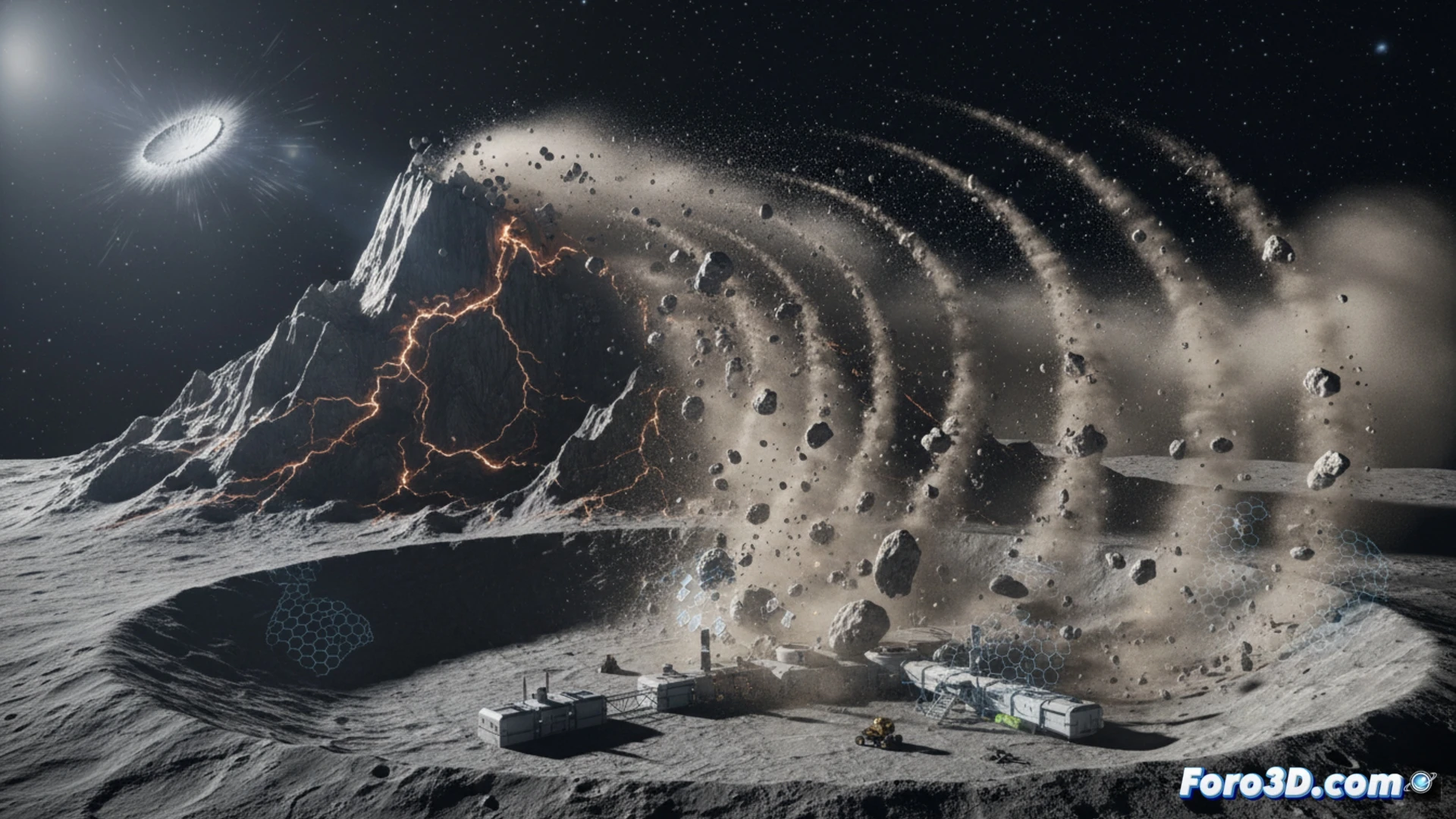
Modeling the Collapse and Debris Dynamics 💥
To recreate the lunar collapse in 3D, it is crucial to define the initial causes, such as a deep moonquake or the impact of a micrometeorite. Using physics engines like Bullet or Havok, we set gravity to 1.62 m/s² and eliminate air resistance. The simulation must capture the fragmentation of basaltic rock, with particles moving in elongated ballistic trajectories. Modeling the debris requires high-resolution textures for the regolith and dynamic shadows that reflect direct solar illumination, creating a dust cloud that expands slowly without being dispersed by wind.
Visual Lessons for Catastrophe Prevention 🛡️
Beyond aesthetics, this simulation serves as a risk analysis tool. Visualizing the collapse of a lunar base or a lava tube helps identify weak points in structures against quakes or impacts. Low gravity modifies collapse patterns, generating slower but longer-reaching landslides. This approach allows engineers and mission planners to anticipate emergency scenarios, improving the design of safe habitats and evacuation protocols in future lunar colonies.
How would you optimize the simulation of the gravitational collapse of a lunar structure in 3D to accurately reflect low-gravity physics and regolith behavior?
(PS: Simulating catastrophes is fun until the computer crashes and you are the catastrophe.)