The use of directed energy defense systems, such as laser beams or particle beams, introduces a new type of catastrophic risk: collateral thermal damage. When a defensive beam impacts a non-target structure, the instantaneous heat transfer can cause melting points, material embrittlement, and progressive collapses. Analyzing this phenomenon through 3D simulation is key to predicting the extent of the disaster and designing more effective safety protocols.
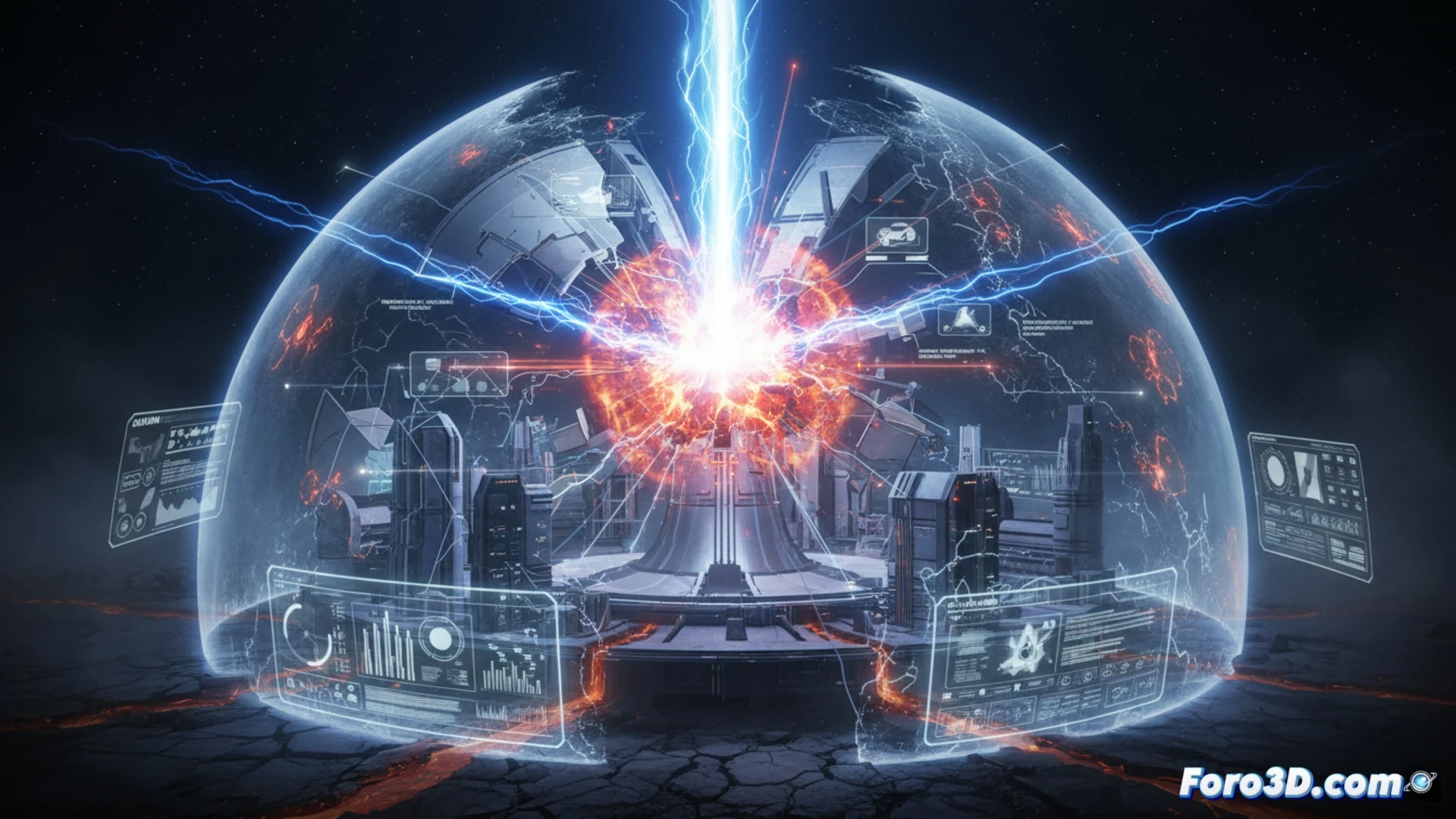
Modeling heat transfer and damage propagation 🔥
To simulate the incident, the energy deposition of the beam onto a specific material (structural steel or reinforced concrete) is modeled. The 3D simulation solves transient heat conduction equations at each node of the mesh, considering surface reflectivity and beam absorption. The results generate volumetric temperature maps that identify critical zones where the ignition or melting point is exceeded. From this data, the propagation of damage is visualized: from surface ablation to the degradation of load-bearing capacity, allowing estimation of the time until partial or total collapse of the structure.
Lessons for catastrophe prevention 🛡️
Simulations reveal that thermal damage is not limited to the point of impact; heat diffuses radially, creating a gradient that weakens adjacent areas. In a real scenario, this could trigger cascading failures in critical infrastructure. Understanding these patterns allows engineers to reinforce vulnerable points and defense operators to adjust the beam's power or duration. 3D visualization thus becomes an indispensable tool for mitigating the risk of disasters caused by defensive systems.
How can the temperature profile and structural damage propagation be accurately modeled in a 3D simulation when a directed energy defensive beam impacts a composite material used in critical infrastructure?
(PS: Simulating catastrophes is fun until the computer melts down and you are the catastrophe.)