The failure of a tensioned cable during an earthquake is not a simple tear; it is the culmination of a cascade of micro-deformations that modern engineering attempts to predict. When the Earth's crust shakes, suspension bridges, tram lines, or high-voltage power lines undergo differential stress that can exceed their elastic limit. News about a seismic cable cut reminds us that these seemingly simple elements are often the weakest link in a critical structural chain.
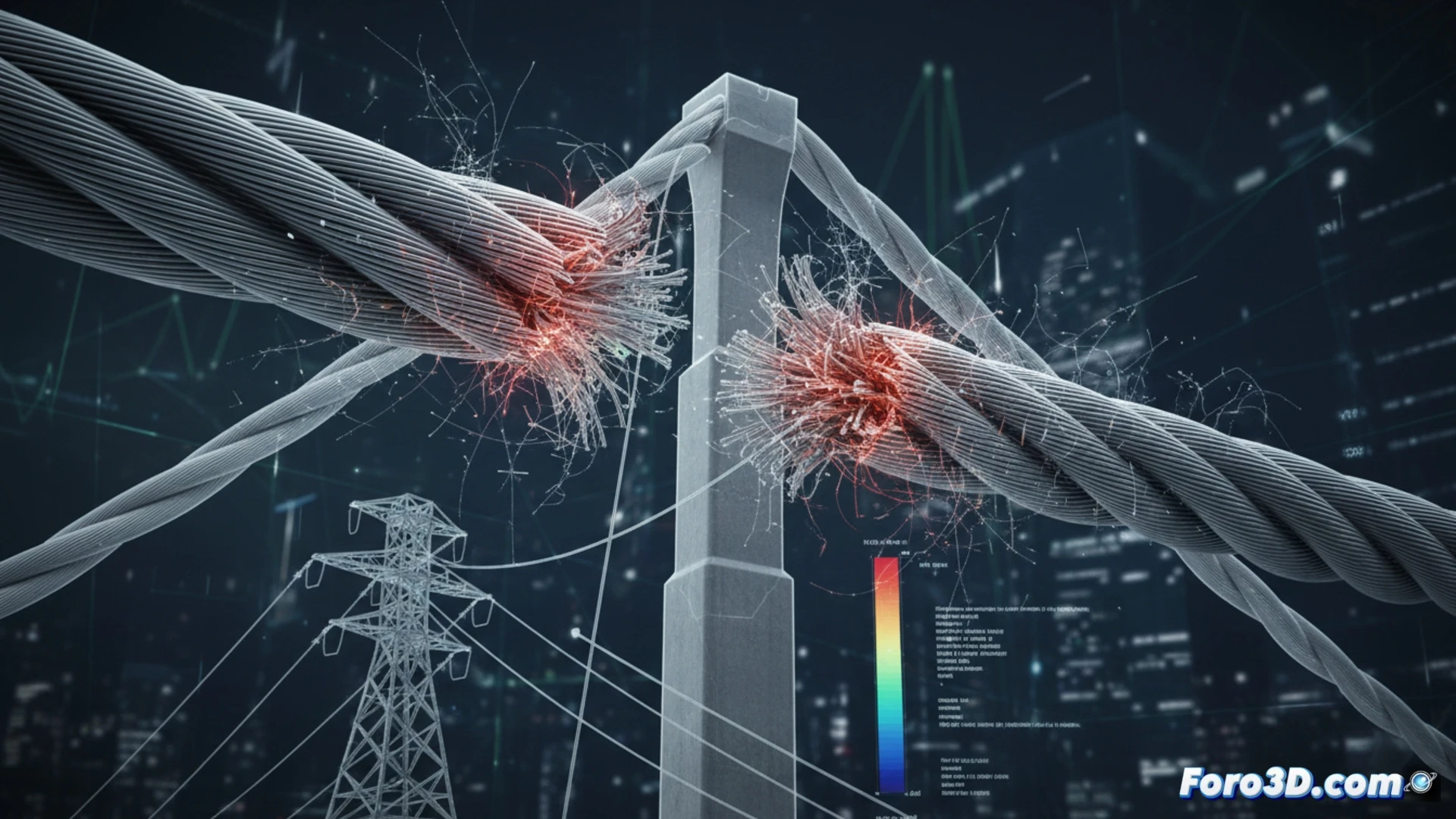
Modeling stresses and material fatigue under P and S waves 🧠
To recreate this phenomenon in a virtual environment, digital twins are used that integrate geotechnical data from the terrain and mechanical properties of the steel or composite material. The process begins with the import of a finite element model (FEM) that discretizes the cable into thousands of nodes. Seismic waves (primary and secondary) are then applied as dynamic loads at the base of the anchorage. The software calculates the Von Mises stress and material hysteresis in real time. By simulating cyclic fatigue, the exact point where stress concentration exceeds the rupture threshold is identified, showing how a resonant vibration can cut the cable in milliseconds, even if the earthquake is not of great magnitude.
Collapse prevention through predictive simulation 🛡️
The usefulness of these simulations goes beyond diagnosis. By visualizing the failure in 3D, engineers can redesign damping systems or anchorage points to dissipate seismic energy. Materials with shape memory or anti-friction coatings can be virtually tested without the need to build physical prototypes. Ultimately, the ability to anticipate a seismic cable cut on a computer allows saving lives by reinforcing infrastructure before the ground actually shakes, transforming an impending catastrophe into a correctable design datum.
How can 3D simulation of the cascade of micro-deformations in tensioned cables predict the exact failure point during an earthquake and redefine safety protocols in critical infrastructure?
(PS: Simulating catastrophes is fun until the computer crashes and you are the catastrophe.)