The integration of pollinator drones into agricultural ecosystems promised a solution to the natural pollinator crisis. However, last Tuesday, a swarm of 15,000 ApisMach-4 model units suffered a catastrophic failure in the Almendros del Valle crop area. The sequence, captured by environmental sensors, shows a cascading collapse that destroyed the irrigation infrastructure and caused a low-intensity forest fire. This article reconstructs the mechanics of the disaster in 3D to identify critical points of fatigue and protocol error.
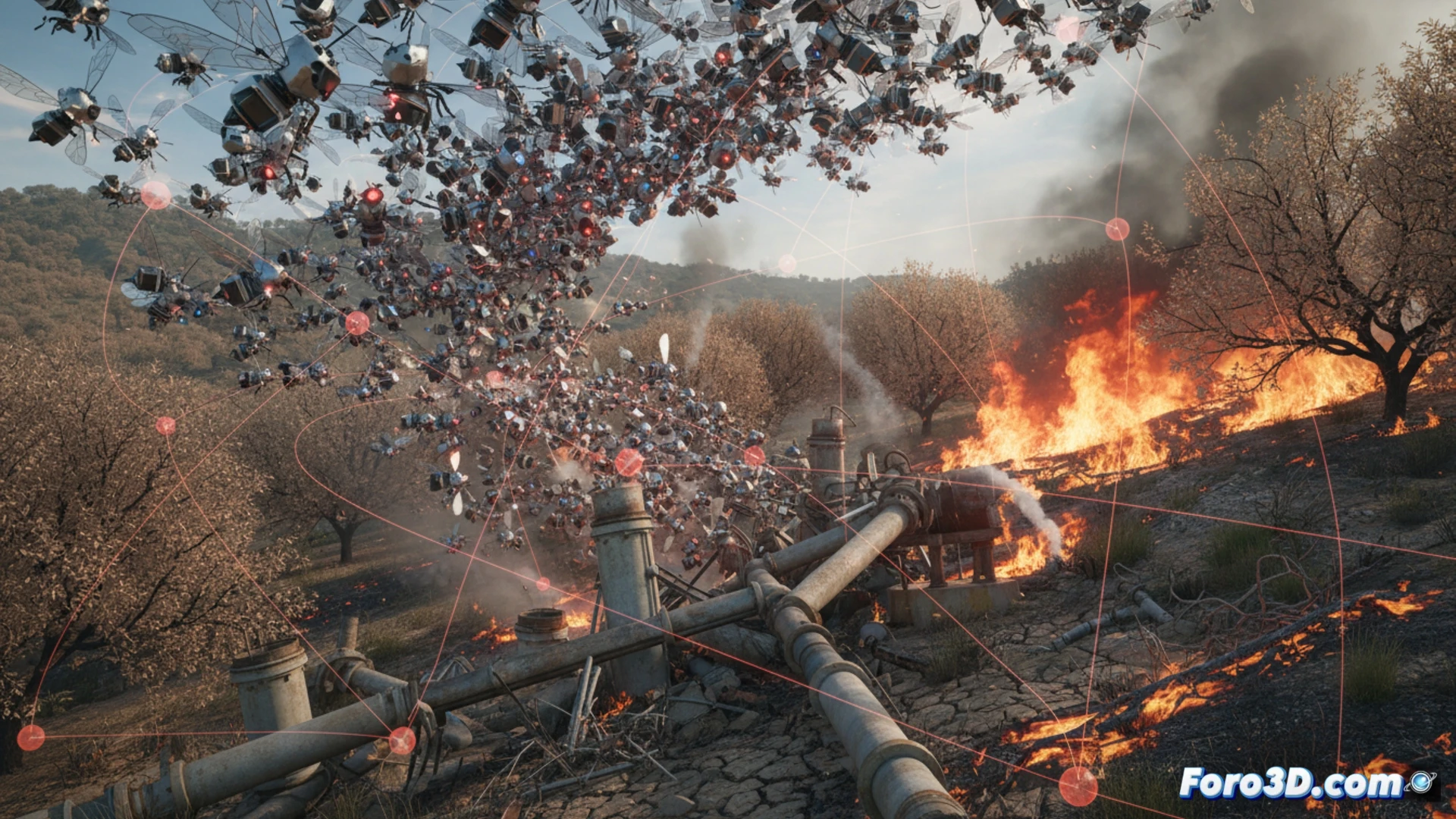
Technical reconstruction of the failure: material fatigue and link loss 🛠️
Using the Blender catastrophe simulation software with the Bullet Physics engine, the fall trajectory of 200 representative drones was modeled. The analysis reveals a failure pattern initiated by fatigue of the composite material in the polymer wings, which began to fracture after 14 hours of uninterrupted flight. The loss of lift generated chain collisions at a height of 12 meters, triggering an overload in the mesh communication system. Upon losing 40% of the nodes, the swarm entered emergency landing mode, but the instruction arrived too late: 60% of the units impacted the ground at 8 m/s. The simulation shows that the design flaw lies in the rigidity of the chassis, which does not absorb kinetic energy, propagating damage to the adjacent lithium batteries.
Lessons for simulating technological disasters in ecosystems 🌍
This collapse demonstrates that 3D visualization of catastrophes serves not only to document but also to predict failure modes. The reconstruction allows engineers to identify that the real danger is not the fall itself, but the chain reaction of thermal batteries. The visual impact of the simulation, with smoke particles and curved trajectories, reinforces the need to include material fatigue variables in swarm models. Without these analyses, the next collapse could occur in an urban environment or a protected nature reserve, with even more severe consequences.
What critical interaction parameters between drones should be modeled to predict a domino effect of cascading collisions during a coordinated swarm failure?
(PS: Simulating catastrophes is fun until your computer melts down and you become the catastrophe.)