The detachment of a living wall is not a simple landscape accident; it is a structural failure that can trigger a localized catastrophe. When the weight of the saturated substrate exceeds the anchoring capacity, collapse is imminent. This article analyzes the phenomenon from a disaster engineering perspective, using parametric 3D modeling to dissect critical variables and propose predictive monitoring systems.
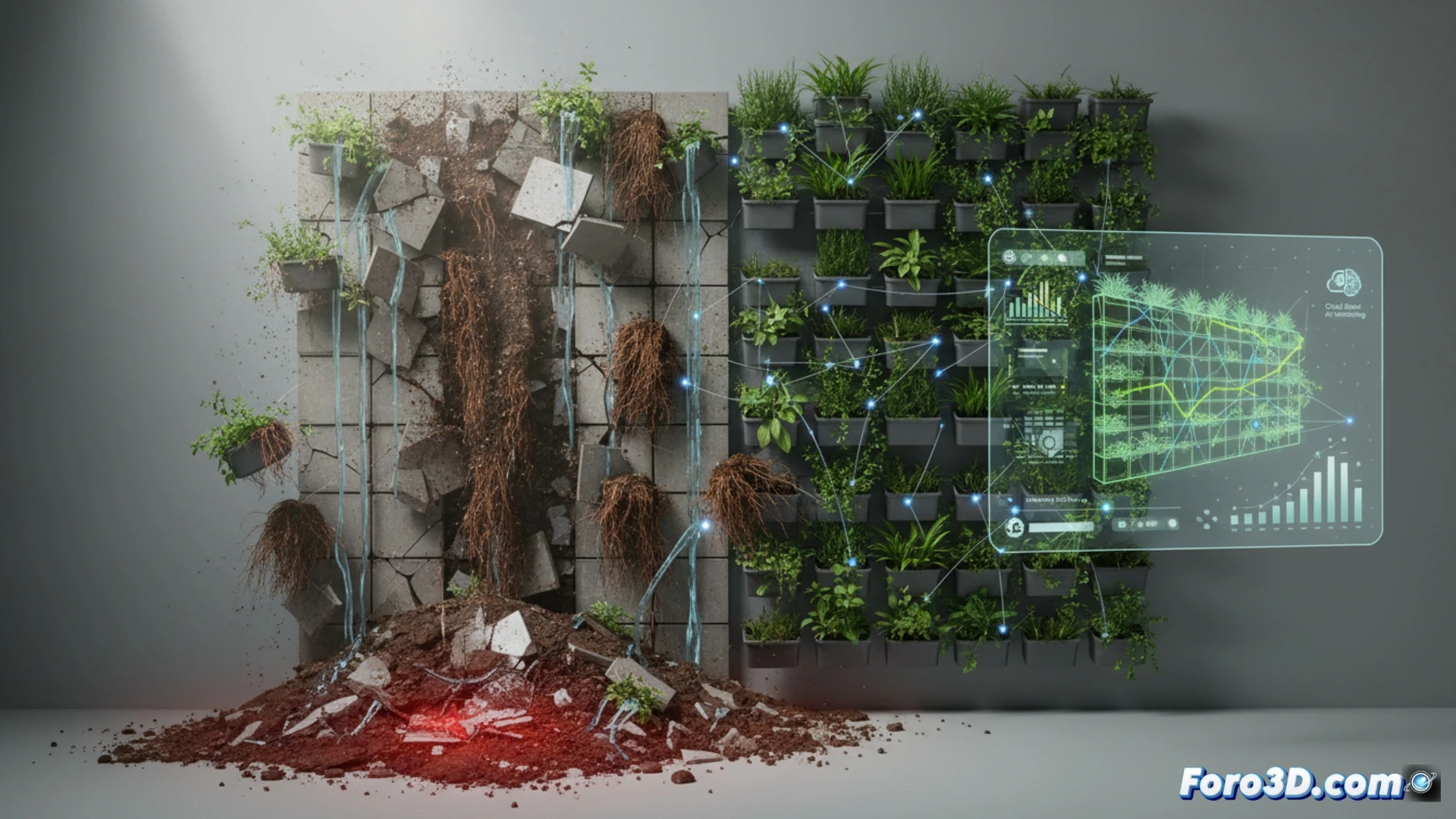
Parametric modeling of failure due to saturation and overload 🧱
To simulate the detachment, a digital twin of the living wall is built in a finite element method (FEM) simulation environment. The key variables are: the wall's inclination angle, the substrate density after water absorption (from 800 kg/m3 dry to 1,600 kg/m3 saturated), and the tensile strength of the geotechnical anchors. The simulation reveals that failure typically initiates at the base of the wall, where hydrostatic pressure generates a shear crack that progresses upward. When visualizing the process in 3D, it is observed how the block of soil and vegetation detaches as a homogeneous mass, dragging the drainage system along with it. This analysis allows identifying that the critical point is not the weight of the foliage, but the water retention in the substrate, which doubles the load.
Lessons for urban green infrastructure 🌿
Preventing this disaster does not require eliminating living walls, but rather equipping them with structural intelligence. The implementation of moisture sensors and tensiometers integrated into a digital twin allows anticipating the critical saturation point. If the 3D model projects a deformation greater than 2% in the anchors, forced drainage or a reduction in vegetative load should be activated. The living wall is not a static element; it is a dynamic system that demands continuous monitoring. Ignoring its hydromechanical behavior is turning an ecological asset into a controllable but uncontrolled threat.
What critical parameters of the 3D simulation of a living wall allow accurately predicting the tipping point between controlled deformation and catastrophic collapse?
(PS: Simulating catastrophes is fun until the computer crashes and you are the catastrophe.)