The recent detachment of a silent wind turbine has brought the safety of these structures into the spotlight. This event, which could be classified as a technological catastrophe, offers a perfect case study for analysis through 3D simulation. The virtual recreation of the collapse allows for breaking down the variables that led to the failure, from material fatigue to adverse weather conditions, facilitating the understanding of the disaster's mechanics.
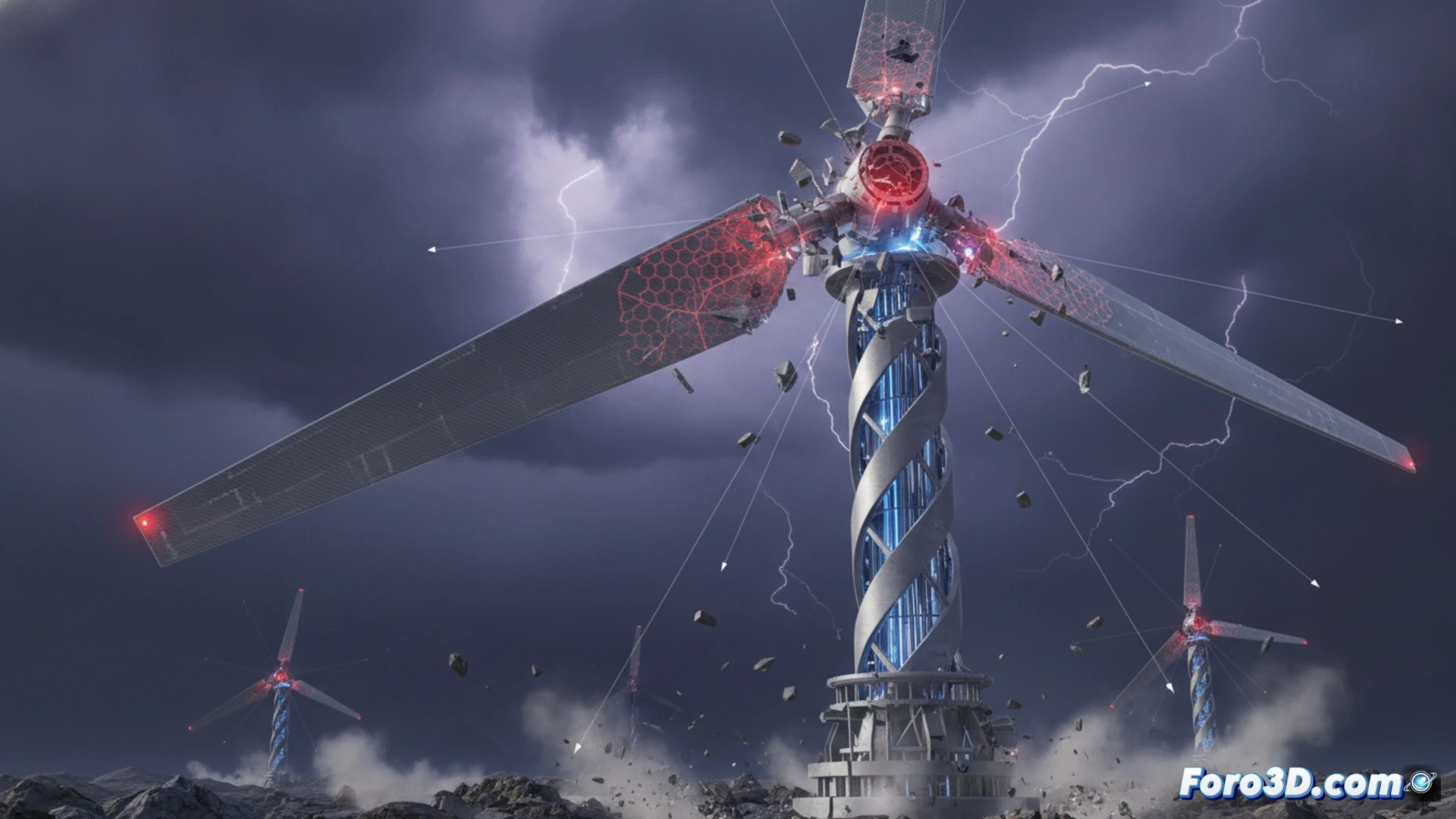
Technical analysis of structural failure using digital twins 🛠️
To understand the detachment, it is crucial to model in 3D the interaction between harmonic vibrations and steel fatigue. Finite element simulation can replicate the cyclic stress at the tower base and the hub, where microcracks propagate until reaching a critical point. Furthermore, the ballistic trajectory of the blades upon detachment can be calculated using computational fluid dynamics, visualizing the impact radius and collateral damage. A digital twin of the wind turbine, fed by IoT sensors, would allow detecting anomalous vibration patterns before the collapse, activating predictive maintenance protocols that prevent the catastrophe.
Lessons for designing resilient infrastructure ⚡
Beyond the mechanical failure, this event forces us to reflect on the fragility of our energy infrastructure. 3D simulation is not only useful for reconstructing the accident but also for redesigning the anchorages and damping systems. Incorporating composite materials with greater fatigue resistance and control algorithms that respond to extreme wind gusts is the way forward. Prevention is no longer just a matter of visual inspection; it is a task of continuous digital modeling to ensure that a wind turbine's silence is not the prelude to its collapse.
Considering that the collapse is attributed to a failure in the silent aerodynamic braking system, how can 3D simulation accurately model the behavior of a composite material subjected to cyclic fatigue and harmonic vibrations to predict critical breakage points not detectable in conventional visual inspections?
(PS: Simulating catastrophes is fun until the computer crashes and you are the catastrophe.)