The recent news about the Ballistic Ice Impact Expertise has opened a new field of study in the forensic reconstruction of conflicts. This technical analysis, which combines materials physics with terminal ballistics, requires advanced 3D simulation tools to determine the trajectory, velocity, and energy of a projectile, even when it fragments or changes state. At Foro3D, we break down how modeling technology allows researchers to validate hypotheses about damage to military structures or armored vehicles.
Photogrammetry and Trajectory Analysis in Hostile Environments 🧊
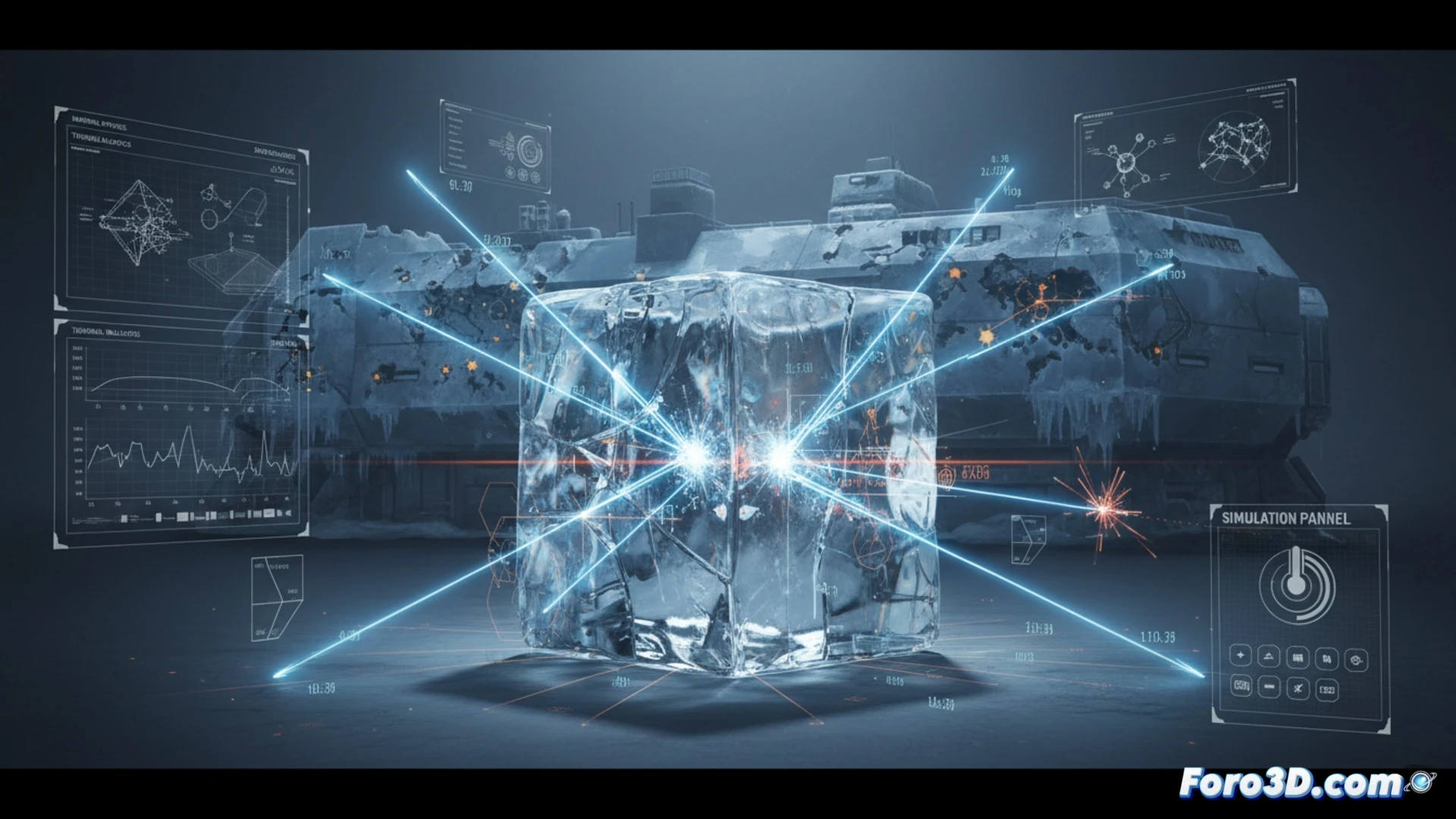
The technical process begins with capturing the impact scene using high-resolution photogrammetry, generating a precise 3D mesh of the crater or deformation. Subsequently, the ice projectile is modeled as a non-homogeneous body, assigning variable mechanical properties (density, Young's modulus) that simulate its fragility. Computational fluid dynamics (CFD) and finite element analysis (FEA) software allow recreating the ice fission upon impact with a ballistic steel target. This method is crucial for differentiating between a real ice impact and one from a conventional projectile, analyzing fragmentation patterns and momentum transfer. Submillimetric precision in 3D reconstruction allows experts to calculate the angle of incidence and impact velocity with a margin of error below 2%.
Strategic Implications of Cold Reconstruction 🎯
Beyond physics, this technical expertise reveals a troubling reality in asymmetric conflicts. The ability to simulate ballistic ice impacts allows analysts to discern between an intentional attack with conventional ammunition and collateral damage caused by extreme weather phenomena or experimental ammunition. In the field of military intelligence, mastering this 3D simulation not only clarifies the authorship of an attack but also exposes vulnerabilities in armor against non-metallic projectiles. The precision of these forensic models thus becomes a tool for deterrence and verification in conflict zones.
How 3D simulation can differentiate between a ballistic ice impact and one caused by other projectiles in a war conflict environment.
(PS: reconstructing virtually is the first step to reconstructing in reality)