Water mist is a critical technology in fire protection for high-risk buildings such as hospitals and data centers. However, partial or total nozzle blockage due to sediment, corrosion, or maintenance failures can severely compromise its effectiveness. This article analyzes, through 3D simulation, how these blockages alter particle flow dynamics and water dispersion, affecting extinguishing capacity.
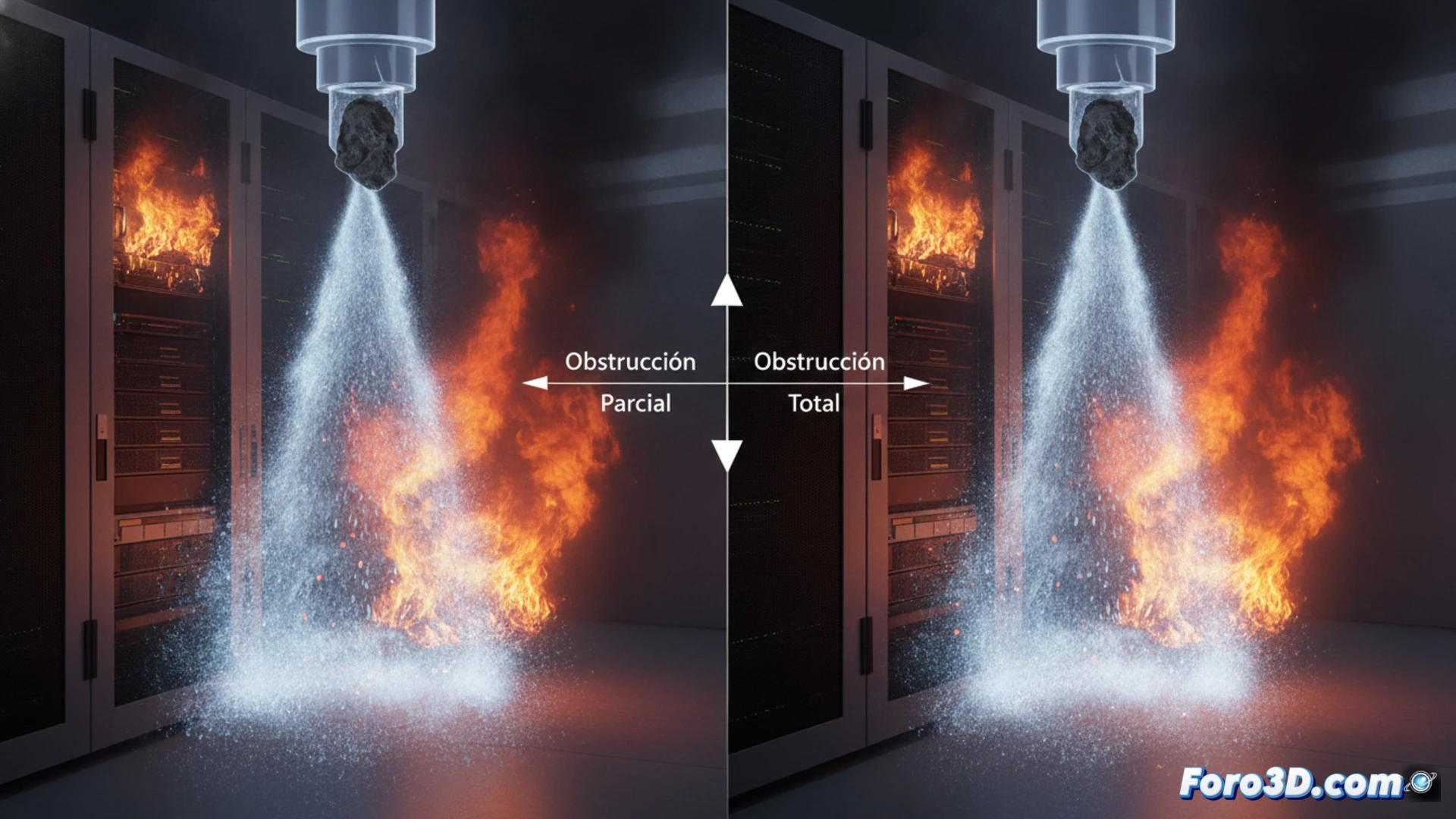
Modeling Flow and Dispersion in Blockage Scenarios 💧
To visualize the impact of blockage, a sprinkler system was modeled in a 3D environment using computational fluid dynamics (CFD). Two scenarios were simulated: a system operating at 100% and another with 40% of nozzles obstructed. Results show that blockage causes a drastic reduction in mist coverage, creating dead zones where fire can spread unopposed. Droplet velocity decreases and atomization becomes irregular, preventing the heat absorption necessary for suppression. In data centers, this could mean total server loss; in hospitals, the inability to evacuate safely.
Lessons for Prevention and Predictive Maintenance 🔧
3D simulation reveals that blockage is not a binary failure but a gradual process that silently reduces safety. Visualizing these failure patterns allows engineers to design more precise maintenance protocols, prioritizing nozzle cleaning in critical areas. This approach not only mitigates the risk of catastrophes but transforms prevention from a reactive task into a proactive strategy, safeguarding lives and assets in essential infrastructures.
How can 3D simulation of blockage in water mist systems predict catastrophic failures in hospitals during a real fire?
(PS: Simulating catastrophes is fun until the computer melts down and you are the catastrophe.)