The explosion of an electrolysis system represents one of the most complex scenarios to model in the field of industrial safety. The uncontrolled mixture of hydrogen and oxygen, generated by a failure in the separator membrane or by excessive differential pressure, produces a deflagration that can devastate an entire plant. In this article, we analyze the 3D reconstruction of a real incident, focusing on fluid dynamics and material fatigue to understand the chain of failures.
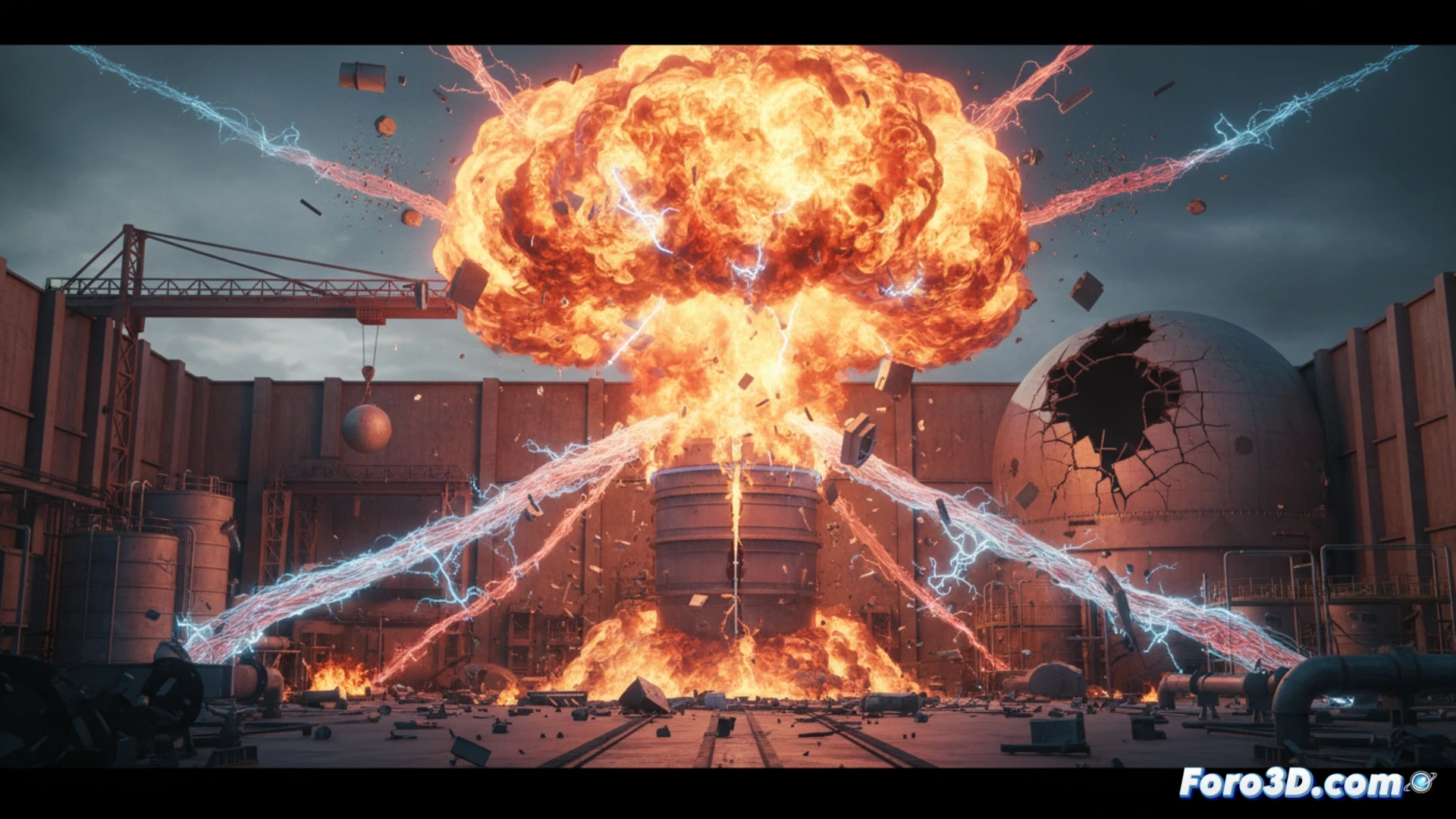
Volumetric reconstruction and gas dynamics using CFD 💥
For the simulation, we started from a detailed CAD model of the alkaline electrolyzer, including the gaskets, electrodes, and recirculation pipes. We used a computational fluid dynamics (CFD) solver to recreate the abrupt release of gases. The hexahedral mesh was refined in the area of the degraded gasket, where the leak began. The results showed an accumulation of gas in the annular space between cells, reaching the explosive concentration in 0.8 seconds. The simulation of the shock wave, using SPH particles, revealed pressure peaks of 15 bar on the frame walls, exceeding the elastic limit of 316L stainless steel. Validation was performed by comparing the plastic deformation of the 3D model with the visible fractures in forensic photographs of the incident.
Lessons from the model: cyclic fatigue and prevention 🔧
The finite element method (FEM) fatigue analysis identified that microcracks in the welds of the bipolar plates, caused by repeated thermal cycles, were the starting point of the failure. The visualization of the sequence shows how a small crack allowed the mixing of gases, leading to detonation. In conclusion, the 3D model allows for the redesign of passive ventilation systems and differential pressure sensors, demonstrating that catastrophe simulation not only reconstructs the past but is the most effective tool to prevent future disasters.
How can 3D simulation predict the propagation of the shock wave and the dispersion of flammable gases after the catastrophic explosion of an industrial electrolyzer, and what critical parameters must be modeled to ensure accuracy in safety scenarios?
(PS: Simulating catastrophes is fun until the computer melts down and you are the catastrophe.)