Erosion in the blades of a hydroelectric turbine is not just an energy efficiency problem; it is a silent threat that can trigger catastrophic failures. Constant exposure to solid particles and cavitation generates microcracks that, as they propagate, compromise the structural integrity of the machinery. This progressive wear, if not monitored, can lead to blade fracture, causing a violent imbalance that affects the turbine shaft and, in the worst-case scenario, creates a crack in the dam itself. Modeling this phenomenon in 3D allows visualizing the evolution of damage and anticipating the point of no return.
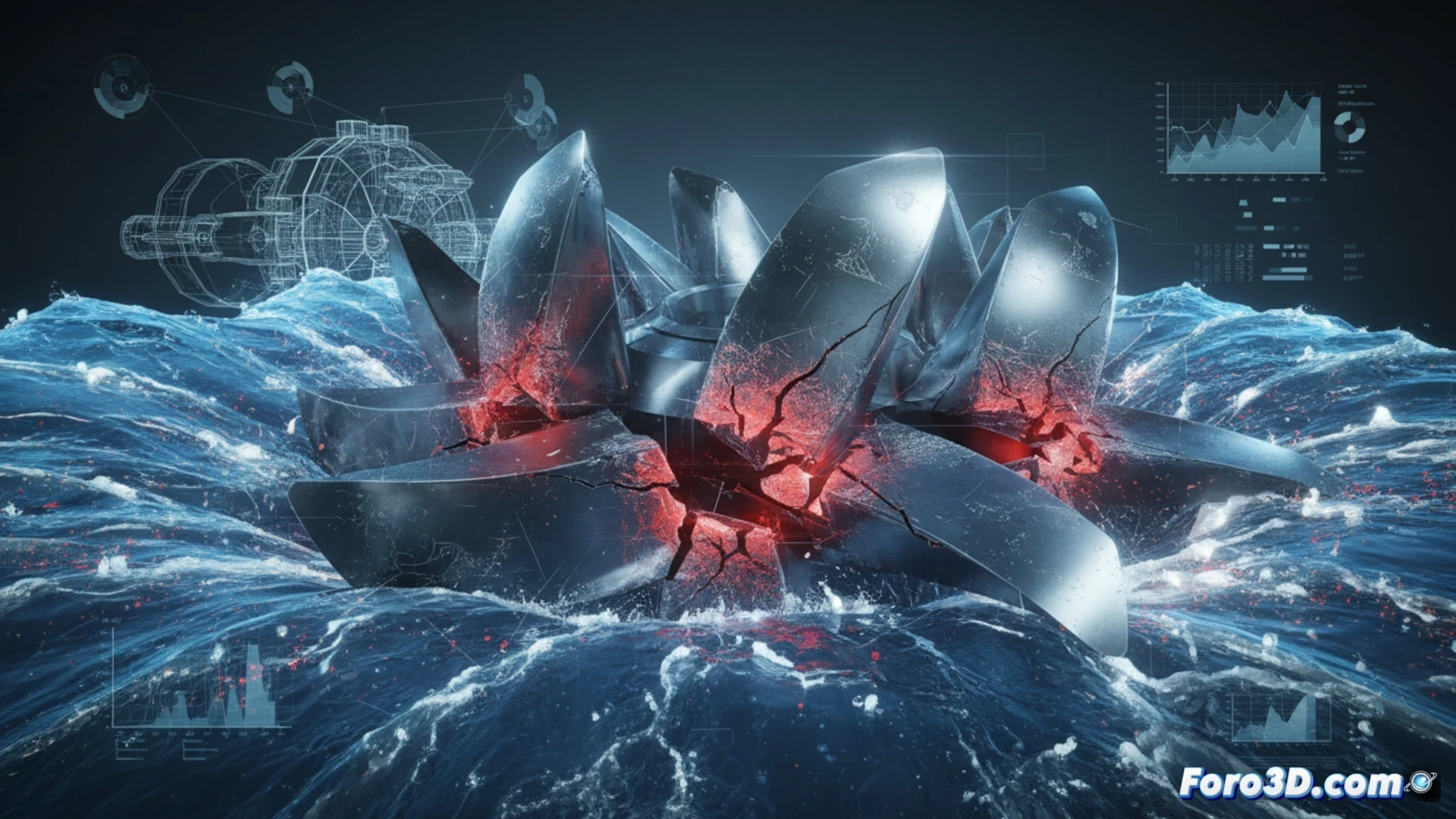
Parametric modeling and fatigue analysis for failure prediction ⚙️
To simulate erosion, a 3D parametric model is used that replicates the blade geometry and its hydraulic load conditions. Using finite element method (FEM) software, a wear algorithm is introduced that reduces material thickness in critical areas, such as the leading edge and blade tip. The simulation applies variable load cycles to represent the fatigue of stainless steel or alloys used. The results generate heat maps showing the concentration of residual stresses. By comparing temporal visualizations (0 hours, 10,000 hours, and 50,000 hours of operation), it is observed how mass loss modifies the hydrodynamic profile, increasing cavitation and accelerating structural collapse.
Visualization of fracture scenarios and their impact on disaster prevention 🚨
Once critical erosion is modeled, the next step is to recreate the blade fracture scenario in 3D. The animation shows the release of the metal fragment, its impact against the diffuser, and the resulting vibration in the dam foundation. These simulations allow engineers to design safety anchoring systems and emergency shutdown protocols before a real disaster occurs. By visualizing the progression of wear, operating companies can plan predictive maintenance with greater precision, thus avoiding both the loss of human lives and environmental damage from a potential uncontrolled water leak.
As a 3D simulation engineer, what critical erosion parameters, such as groove depth or stress distribution, should be visualized in real-time to accurately predict the point of catastrophic collapse of a hydroelectric blade?
(PS: Simulating catastrophes is fun until the computer melts down and you are the catastrophe.)