Flour deflagration, a violent combustion phenomenon in suspension, is a silent risk in bakeries, silos, and homes. This technical article analyzes how to model in 3D the dispersion of organic dust particles in an enclosed space, simulating ignition and the resulting shockwave. We will explore visualizations of fire progression and pressure, comparing ventilation and dust concentration scenarios to raise awareness of this industrial and domestic hazard.
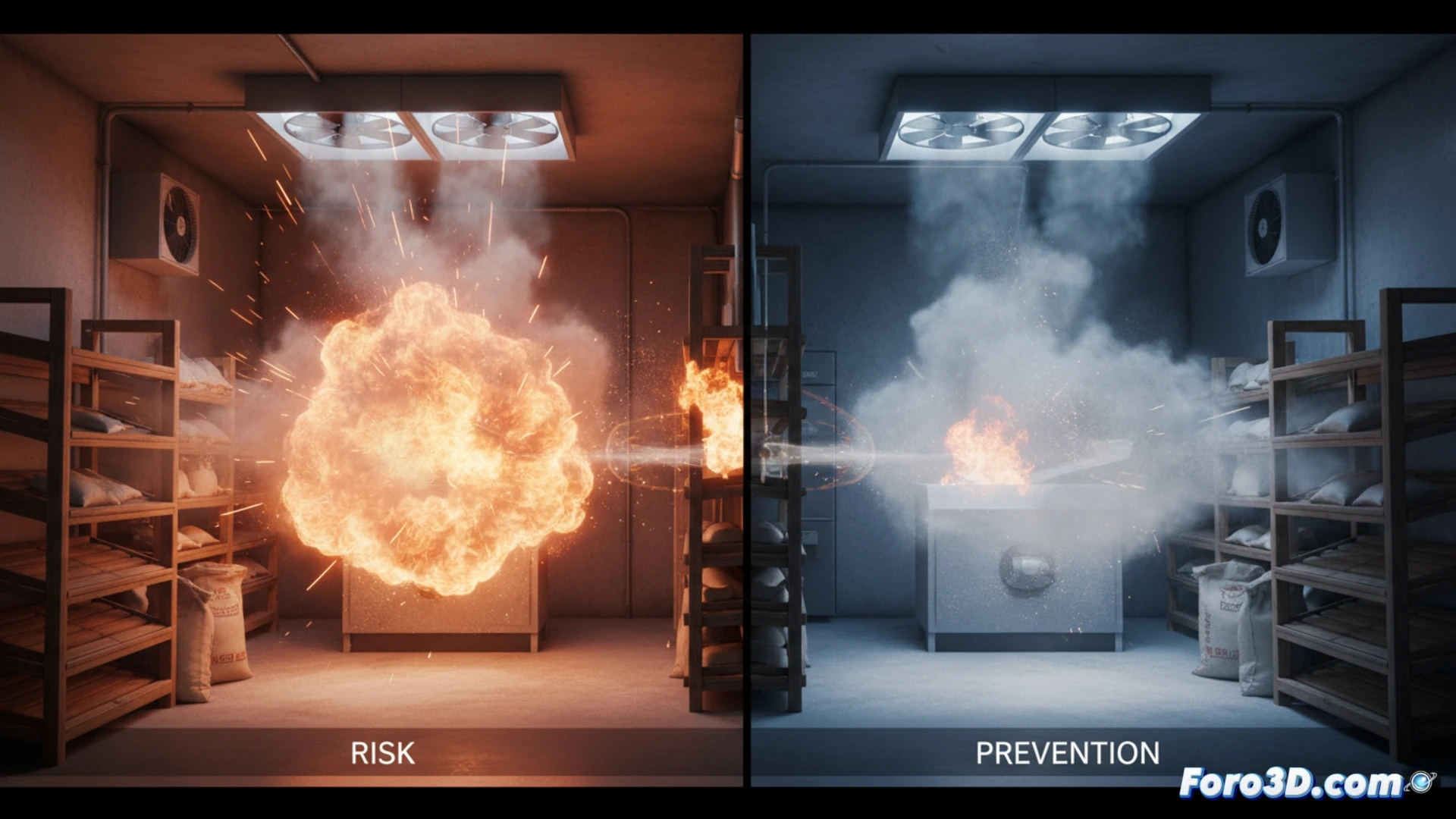
Particle Modeling and Fluid Dynamics in Enclosed Environments 💥
To simulate a flour deflagration in 3D, a particle system is required to emulate the suspended dust cloud, with adjustable parameters for size, density, and concentration. Using physics engines like Blender or Houdini, computational fluid dynamics (CFD) algorithms are applied to calculate the propagation of the pressure wave after ignition. The model must consider the enclosure's ventilation: a high air exchange rate reduces the critical concentration, while sealed spaces amplify the explosion. Visualizations will show spherical flame fronts and pressure peaks that deform virtual structures, comparing scenarios with 10% and 30% dust concentration.
Visual Lessons for Industrial Safety 🔥
These simulations are not just a technical exercise but a tool for raising awareness. By observing how a minimal spark in an enclosed space generates a shockwave capable of knocking down walls, the need for ventilation systems and periodic cleaning becomes clear. 3D visualization allows engineers and firefighters to plan escape routes and assess potential damage, transforming an everyday risk into a preventable scenario. Flour, harmless at first glance, reveals its destructive power when modeled in a virtual environment.
How can a 3D simulation of flour deflagration help identify critical dust accumulation points in an industrial bakery to design more effective prevention systems?
(PS: Simulating catastrophes is fun until the computer crashes and you are the catastrophe.)