Fatigue wear is one of the main causes of failure in mechanical components subjected to cyclic loads. 3D simulation allows predicting the service life of these materials, but traditional tests introduce parasitic contact stresses. Acoustic and magnetic levitation offers a revolutionary way to perform frictionless tests, isolating the pure fatigue phenomenon from abrasive wear.
Modeling progressive wear in FEM environments 🛠️
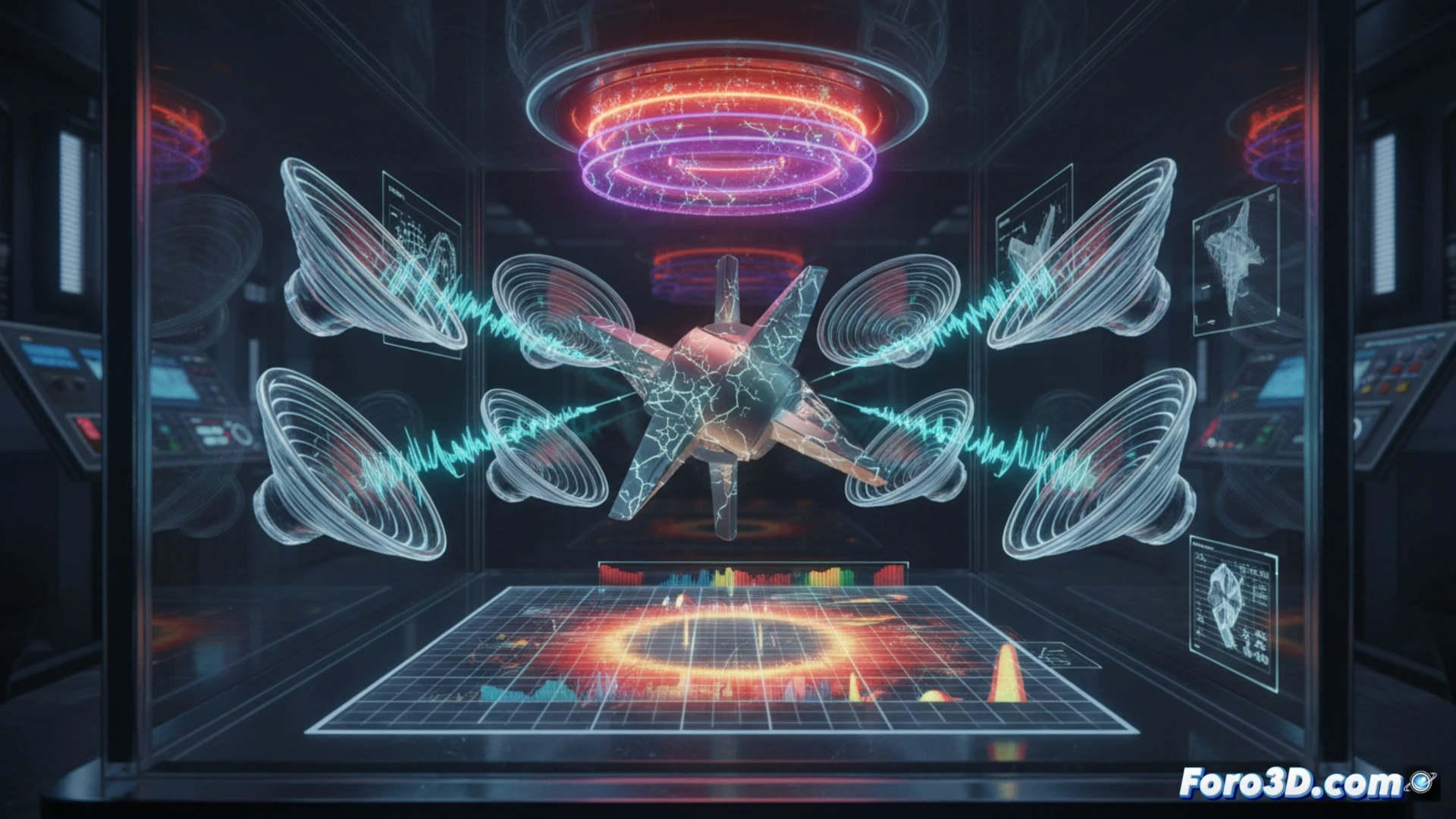
In platforms like ANSYS Mechanical or COMSOL Multiphysics, fatigue wear is modeled by accumulating damage in the 3D mesh. Cyclic load histories are applied to complex geometries, and the solver calculates stress redistribution in each cycle. The result is Von Mises stress maps and plastic deformations that identify critical zones. To simulate levitation, an acoustic pressure field (in COMSOL, the Acoustics module) or a magnetic field (AC/DC module) is added to support the specimen. This allows studying how the material vibrates without physical support, revealing fatigue modes that would be hidden by fixture friction.
Levitation as a predictive tool for collapse 🔬
Imagine a turbine blade floating in a sound field while receiving millions of load pulses. 3D simulation shows that internal microcracks propagate from the center to the surface, a pattern that is almost impossible to detect in contact tests. By eliminating friction wear, levitation allows isolating pure fatigue, providing more accurate data for predictive maintenance. This approach not only extends component life but redefines how we understand failure in advanced materials.
How does acoustic levitation allow real-time observation and measurement of the initiation and propagation of fatigue microcracks in materials without physical contact?
(PS: Material fatigue is like yours after 10 hours of simulation.)