Aerospace testing failure represents one of the most critical scenarios in the design of components for aircraft and satellites. Material fatigue simulation using 3D technologies allows for precise prediction of the exact breaking point, analyzing the propagation of microscopic cracks up to their critical state. This approach revolutionizes the validation of structures subjected to extreme load cycles.
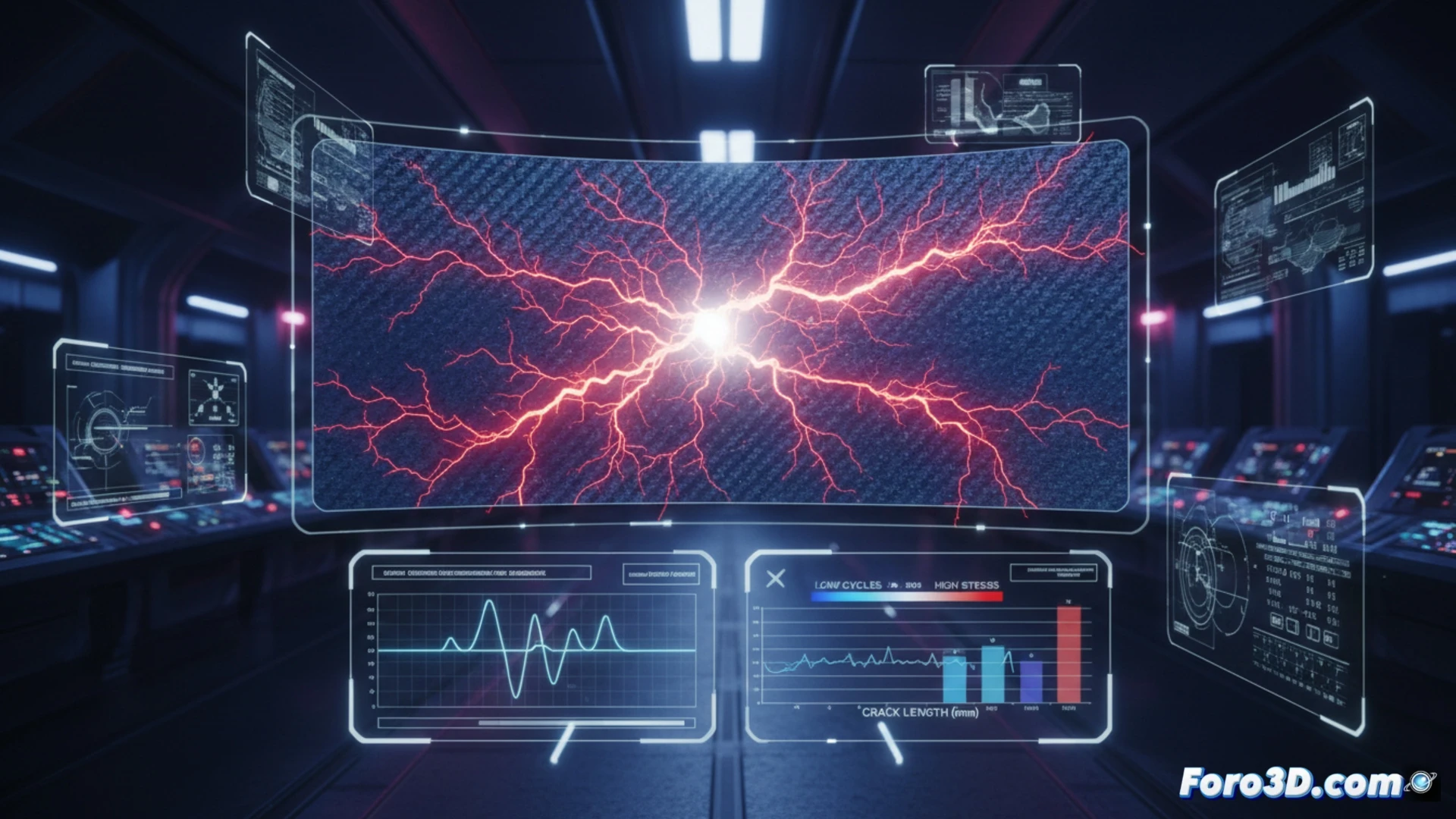
3D modeling of crack propagation and internal stresses 🛠️
3D simulation software uses finite element meshes to represent the material's microstructure. In aerospace fatigue tests, volumetric models are generated that show how internal stresses concentrate in specific areas, such as welded joints or hole edges. 3D visualization allows real-time observation of crack evolution under repetitive load and unload cycles. For example, in critical components such as landing gear or turbine blades, simulation reveals failure nucleation points that would be invisible in traditional physical tests. Engineers can adjust parameters like load frequency or ambient temperature to see their direct effect on structural integrity.
Disaster prevention through advanced visualization 🚀
Real-world cases such as cracks in the Boeing 737 fuselage or failures in helicopter rotors have shown that 3D fatigue simulation is an indispensable tool. By digitally recreating flight conditions and dynamic loads, design teams can identify potential failures before manufacturing. This methodology not only reduces prototyping costs but also saves lives by preventing catastrophic failures during service. Three-dimensional visualization turns abstract data into clear images of material degradation.
How can 3D fatigue simulations accurately predict the service life of aerospace materials when real-flight load conditions differ significantly from standardized tests?
(PS: Material fatigue is like yours after 10 hours of simulation.)