The evolution of modern vehicles towards artificial intelligence and autonomous driving has exponentially increased the complexity of their electronic systems. The concept of Intelligent Vehicle Failure does not refer to a traditional mechanical failure, but to a systemic error in the communication between ADAS sensors, actuators, and the Electronic Control Unit (ECU). Diagnosing these failures requires tools that go beyond manual analysis; this is where 3D modeling technologies offer a crucial advantage for visualizing and isolating problems invisible to the human eye.
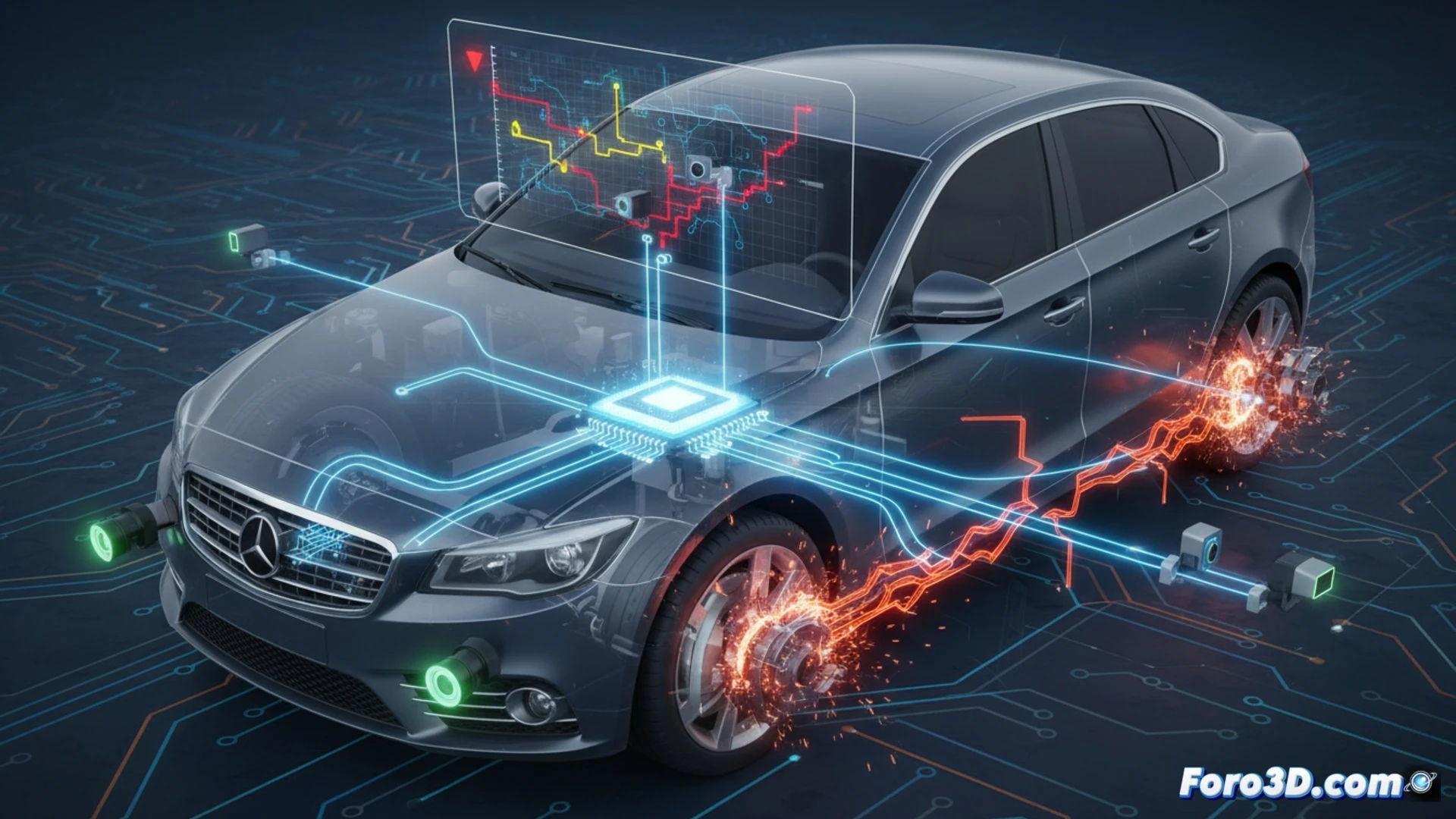
Digital Twin Modeling for ECU and ADAS Sensor Diagnostics 🚗
To analyze an Intelligent Vehicle Failure, a digital twin of the vehicle's control system is built in a 3D environment. This model includes the geometric and logical representation of the ECU, LiDAR radar modules, and stereo cameras. The simulation allows mapping the data flow in real-time, identifying points of thermal stress or electromagnetic interference. For example, a simulated short circuit on the CAN bus generates a 3D visualization of the node disconnection, showing exactly where the data frame is corrupted. Similarly, a software error in the logic of a distance sensor is represented as an anomalous flash in the 3D point cloud, allowing the engineer to locate the faulty instruction without physically disassembling the vehicle.
The Future of Predictive Maintenance without Destructive Testing 🔧
The true revolution of this technology lies in its ability to perform virtual stress tests. Instead of subjecting a physical vehicle to extreme conditions that could damage expensive components, the digital twin allows intelligent failures to be injected in a controlled manner. This accelerates the development and validation cycle of active safety systems. The 3D visualization of a failure in the neural network of an automatic braking system, for example, offers an immediate understanding of the root cause, transforming diagnosis from a dark art into an accessible visual science for the entire engineering team.
How can 3D simulation of failures in intelligent vehicular electronic systems improve the reliability of autonomous driving algorithms before their implementation in real environments?
(PS: ADAS systems are like in-laws: always watching what you do)