Failure in a nuclear fusion plant represents one of the most complex scenarios for catastrophe simulation. This technical article analyzes the 3D modeling of the reactor during a critical event, including thermal propagation by forced convection, the dispersion of radioactive particles within containment, and the structural analysis of the shell collapse. Digital twins are used to predict damage and optimize emergency protocols, offering a key visual tool for engineers and planners.
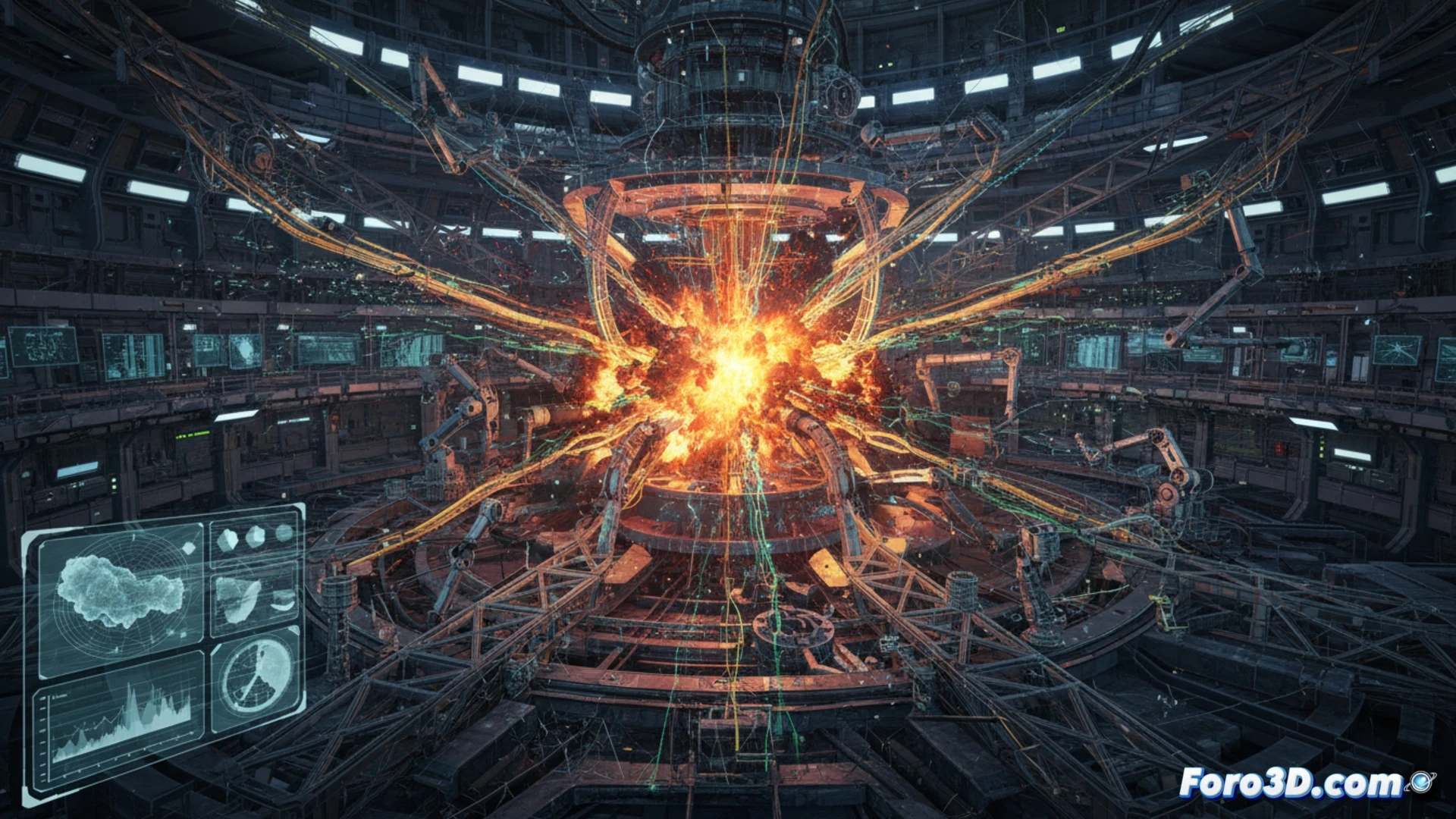
Reactor Modeling and Thermal Propagation in a 3D Environment 🔥
To recreate the failure, a CAD model of the tokamak reactor is used, with precise geometries of the superconducting magnets and the blanket. Thermal simulation is performed using computational fluid dynamics (CFD), where a heat pulse equivalent to the loss of confinement is injected. Temperature is visualized in cross-sections, from the plasma at 150 million degrees to the containment shell. Particle dispersion is modeled with particle systems that follow turbulent trajectories, showing the radioactive cloud in real time. The visual comparison between the normal state (stable containment) and the critical state (deformation and leakage) allows identifying structural failure points in the dome and cooling pipes, using von Mises stress maps.
Reflection: 3D Visualization as a Prevention Tool 💡
3D simulation not only documents the disaster but transforms abstract data into tangible visual lessons. By being able to virtually walk through the burning reactor or examine particle dispersion from any angle, emergency teams anticipate evacuation routes and reinforce weak points. This approach, based on digital twins, turns the catastrophe into a controlled drill, reducing real risks. In a field where human or technical error can be fatal, the graphical representation of chaos becomes the best ally for resilience.
Is it possible to accurately simulate the behavior of molten materials and the containment structure during a progressive collapse in a nuclear fusion plant using real-time 3D models, or do computational limitations force the simplification of critical parameters such as plasma convection and concrete creep?
(PS: Simulating catastrophes is fun until the computer melts down and you are the catastrophe.)