When a helicopter suffers a catastrophic failure, reaction time is measured in seconds. The combination of critical components such as the main rotor, transmission, and engine turns any technical deviation into a high-risk scenario. 3D simulation and digital twins have revolutionized the forensic investigation of these accidents, allowing the sequence of mechanical failures that led to the aircraft's collapse to be recreated with millimeter precision.
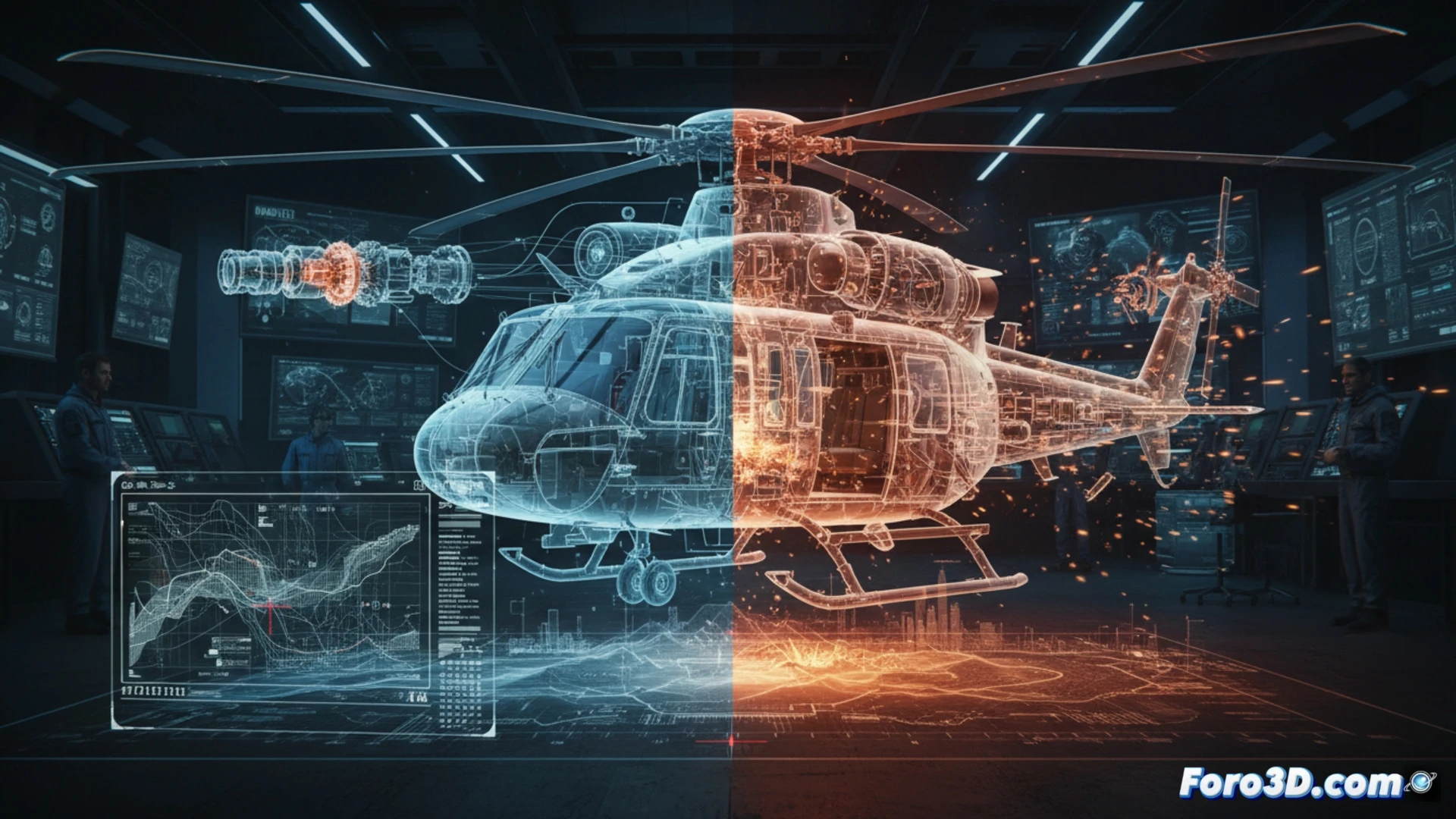
Forensic Reconstruction and Structural Fatigue Analysis 🛠️
Parametric 3D models allow forensic engineers to isolate each variable involved in a helicopter failure. For example, using finite element simulations (FEA), material fatigue on the rotor shaft after 10,000 flight cycles can be reproduced. Digital twins integrate real flight data (black box) with environmental parameters such as wind gusts or dynamic loads. In real accidents, such as the main transmission collapse in rescue helicopters, simulation has identified fracture points undetectable during post-impact visual inspection. This technology allows validating mechanical failure hypotheses without destroying the original parts, speeding up the investigation.
Virtual Reality Training and Emergency Protocols 🎮
The 3D recreation of helicopter failures is not only useful for investigation; it is a vital training tool. Pilots can experience tail rotor failure or power loss scenarios in autorotation regime within a safe virtual environment. These high-fidelity simulators teach corrective maneuvers that, in real life, would be deadly to practice. By integrating this data into the safety protocols of the aviation industry, response times are reduced and lives are saved, transforming catastrophe into a technical lesson.
How does a digital twin model the interaction between structural fatigue of the rotors and transmission system vibration to predict catastrophic failures in helicopters before they occur?
(PS: Simulating catastrophes is fun until the computer crashes and you are the catastrophe.)